What Forensic Psychologists Actually Do: Profiling, Risk Assessment, and the Reality of Correctional Counseling
A clinician's look past the media myth of profiling — how forensic risk assessment and correctional counseling really work, and how to stay effective with high-risk clients.
Key takeaway
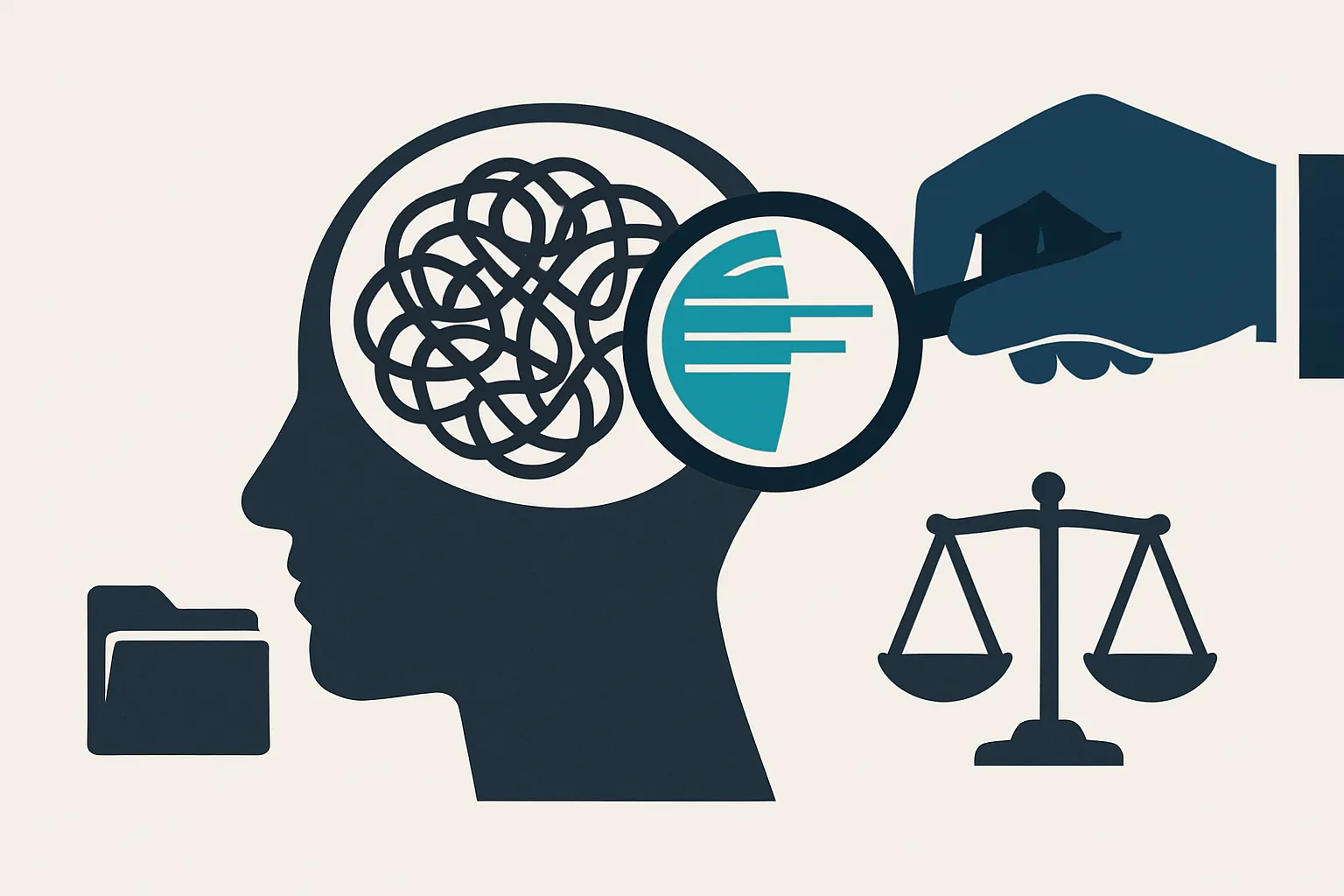
The day-to-day work of forensic psychology looks little like the profiling dramatized on screen. Its core is structured violence and recidivism risk assessment and correctional counseling with largely involuntary clients. Using instruments such as the PCL-R and actuarial/structured tools like the Static-99R, HCR-20, and SVR-20, clinicians weigh risk and protective factors while screening for malingering and manipulation. Effective practice rests on the Risk-Need-Responsivity model, CBT-based and directive interventions, firm boundaries, supervision for countertransference, and meticulous, defensible documentation.
Beyond Profiling: The Real Clinical World of Forensic Psychology
Crime dramas have made "profiler" and "forensic psychologist" two of the most romanticized job titles in popular culture. But clinicians who work in this field know the reality behind the on-screen deductions: a demanding, often dry, intensely disciplined practice that has far more to do with treatment and risk management than with catching a culprit in the final act.
Forensic psychology is not a technique for identifying offenders. It is the scientific analysis of human behavior at its most troubling — and the painstaking work of helping people return to, and remain safely within, their communities. As practitioners, we keep returning to a few uncomfortable questions: Can a working alliance form with a client who presents with marked antisocial traits? When deception and manipulation are the client's baseline, how do we extract clinically meaningful truth from what they tell us?
These are not concerns unique to secure settings. Any clinician will eventually sit across from a client with borderline or antisocial features, and the same ethical and practical dilemmas surface in a community practice. This article strips away the fictional gloss and looks closely, from a clinical vantage point, at the assessment and counseling that forensic psychologists actually perform.
Scientific Diagnosis, Not Just Investigative Support: Profiling and Risk Assessment in Practice
Forensic work divides broadly into two arenas: investigative profiling and the assessment-and-treatment work that unfolds at the adjudication and incarceration stages. Profiling — the part the public knows best — uses behavioral evidence from a scene to infer an unknown offender's personality, behavioral patterns, and demographic characteristics. For the practicing clinician, however, the more consequential domain is risk assessment: a highly specialized task grounded in statistical data and structured clinical interviewing, not intuition.
Structured Professional Judgment (SPJ)
Forensic psychologists evaluate clients using instruments such as the PCL-R (Hare Psychopathy Checklist–Revised) alongside actuarial and structured risk tools. For sexual-offense risk, the Static-99R is widely used; the SVR-20 structures judgment about sexual violence risk; and the HCR-20 is a standard for general violence risk. These tools integrate history, personality features, and current mental state into a defensible picture of risk.
Where an intake in general practice centers on the presenting problem, a forensic evaluation centers on identifying potential risk factors and protective factors in order to forecast future behavior. The orientation is prospective rather than purely restorative.
Statement Analysis and Validity Testing
Clients in forensic settings — whether awaiting trial or serving a sentence — often have strong incentives to exaggerate symptoms (malingering) to avoid responsibility, or to minimize them (defensiveness) to secure release. The clinician must therefore read subtle nonverbal cues and track internal contradictions across an account. This resembles the everyday analysis of a client's defenses, but it carries far heavier weight: the conclusions can inform legal decisions.
Mapping the Psychological Mechanics of the Offense
The work goes past "why did this happen?" to the cognitive distortions and failures of emotion regulation operating at the time of the offense. With a client who has committed a sexual offense, for example, distinguishing whether a deficit in victim empathy is dispositional or situational is central to building a coherent treatment plan.
The Front Line of Therapeutic Justice: How Correctional Counseling Differs from General Therapy
The most labor-intensive — and least understood — part of forensic practice is correctional counseling. Here the work is not simply healing; it is balancing change against control, a genuinely difficult clinical act. The guiding framework is the Risk-Need-Responsivity (RNR) model (Andrews & Bonta): concentrate the most intensive resources on the highest-risk clients, target the criminogenic needs that actually drive offending, and match the style of intervention to the client's learning style and abilities.
The table below contrasts general therapy with correctional counseling.
| Dimension | General Therapy | Forensic / Correctional Counseling |
|---|---|---|
| Primary goal | Relieve psychological distress; support growth and self-actualization | Prevent reoffending; restructure criminal thinking |
| Therapeutic stance | Unconditional positive regard, empathic understanding | Directive, psychoeducational, with firm boundaries |
| Client motivation | Usually voluntary; some readiness to change | Frequently mandated; high resistance and reactance |
| Confidentiality | Strictly protected, with limited exceptions | Duty to report for security and safety overrides confidentiality |
Table 1. Clinical features of general therapy versus forensic/correctional counseling.
The Dilemmas Clinicians Face — and Practical Responses
Clinicians in correctional settings contend with powerful countertransference. The anger, fear, and helplessness stirred by hearing accounts of brutal offenses — or by a client actively trying to manipulate the therapist — degrade the quality of the work if left unexamined. Heavy administrative and documentation burdens compound the problem, pulling attention away from the person in the room. So how do we sustain professional effectiveness?
Structured, CBT-Based Intervention
For restructuring criminal thinking, concrete, present-focused CBT outperforms insight-oriented approaches. Catch the cognitive errors in how the client interprets a situation, and use Socratic questioning to train alternative appraisals. Done well, this lowers defenses and lets the client surface their own logical inconsistencies rather than having them imposed.
Firm Boundaries and Self-Protection
A working alliance matters, but the stance that works in correctional counseling is that of the benevolent authority. Strictly limit personal self-disclosure and make the rules of the work explicit; both blunt attempts at manipulation. Regular peer supervision is the safeguard that metabolizes countertransference and preserves objectivity — treat it as essential infrastructure, not a luxury.
Data-Driven Documentation and the Role of Technology
In forensic settings, records become evidence — for parole review, for legal proceedings, for any later dispute. Accurate, verbatim documentation of what the client said is therefore not optional. Increasingly, tools that automatically transcribe sessions and surface key themes are being adopted, freeing the clinician from the keyboard to attend more fully to a client's nonverbal stance and affect.
A jurisdictional note: mandatory-reporting and duty-to-warn obligations vary substantially across states, provinces, and countries. Confirm the specific reporting thresholds and confidentiality exceptions that govern your own setting before relying on any general statement here.
Conclusion: Clear-Eyed Analysis, Warm Engagement
Forensic psychologists and correctional counselors are at once guardians of public safety and agents of change for people standing at the edge. The field rewards patience and data-grounded analysis far more than dramatic deduction. With clients who present antisocial features especially, the clinician's intuition is not enough — objective instruments and disciplined records carry the weight, because every step of the work may have to stand as clinical and legal evidence.
In that context, AI-assisted session-transcript tools offer a practical way to raise the quality of correctional counseling. Converting lengthy client statements into accurate text — and surfacing shifts in tone and affect as reviewable data — helps catch the small cues a clinician might otherwise miss. Modalia AI is built for exactly this kind of security-first clinical work: it handles transcription, supports case conceptualization, and lightens documentation so your attention can go to the therapeutic task of restructuring distorted cognition. Spend less energy on the record, and more on the intervention, and even clients who seem beyond change may reveal a first ember of one.
References
- 1.
- 2.
- 3.
- 4.
Frequently asked questions
What is the difference between forensic profiling and forensic risk assessment?
Profiling infers an unknown offender's traits from behavioral evidence at a scene and supports investigations. Risk assessment is a structured clinical task that evaluates a known individual's likelihood of future violence or reoffending using validated instruments and structured interviews — and it is the core of most forensic clinical practice.
Which instruments are commonly used in forensic risk assessment?
The PCL-R measures psychopathic traits. For violence risk, the HCR-20 is a standard structured professional judgment tool. For sexual-offense risk, clinicians often use the actuarial Static-99R alongside the SVR-20. Selection depends on the referral question and the population being assessed.
How does correctional counseling differ from general psychotherapy?
Correctional counseling typically involves mandated, resistant clients and aims to reduce reoffending and restructure criminal thinking rather than primarily relieving distress. It uses directive, psychoeducational, CBT-based methods, firmer boundaries, and operates under reporting obligations that can override standard confidentiality.
How do clinicians manage countertransference in forensic settings?
Through firm role boundaries, limited self-disclosure, the stance of a benevolent authority, and — most importantly — regular peer supervision that allows strong reactions like anger, fear, or helplessness to be processed so they don't compromise clinical judgment.
This article was written and reviewed using Modalia AI's clinical guidelines, with professional human review before publication.
Related articles
 Case Conceptualization
Breaking the "Yes, But" Game: A Transactional Analysis Guide for Therapists
Every suggestion you offer gets met with "Yes, but..." Here's the TA structure behind that stall—and four clinical moves to break it.
7 min read Case Conceptualization
Yalom's The Gift of Therapy: Passages Every New Counselor Should Copy by Hand
Irvin Yalom's prescription for therapists who fear silence: meet your client as a "fellow traveler" and let the here-and-now become the heart of the work.
6 min read Case Conceptualization
Working With Silence in Therapy: What Client Silence Means and How to Hold It
Silence in session isn't empty space. Learn to read its clinical meaning, tell productive from defensive silence, and use it as a therapeutic tool.
6 min read