Why Do They Keep Doing That? A Clinician's Guide to Functional Analysis and A-B-C Charting
A practical guide to functional analysis and A-B-C charting—decode the hidden purpose behind a client's puzzling behavior and turn data into intervention.
Key takeaway
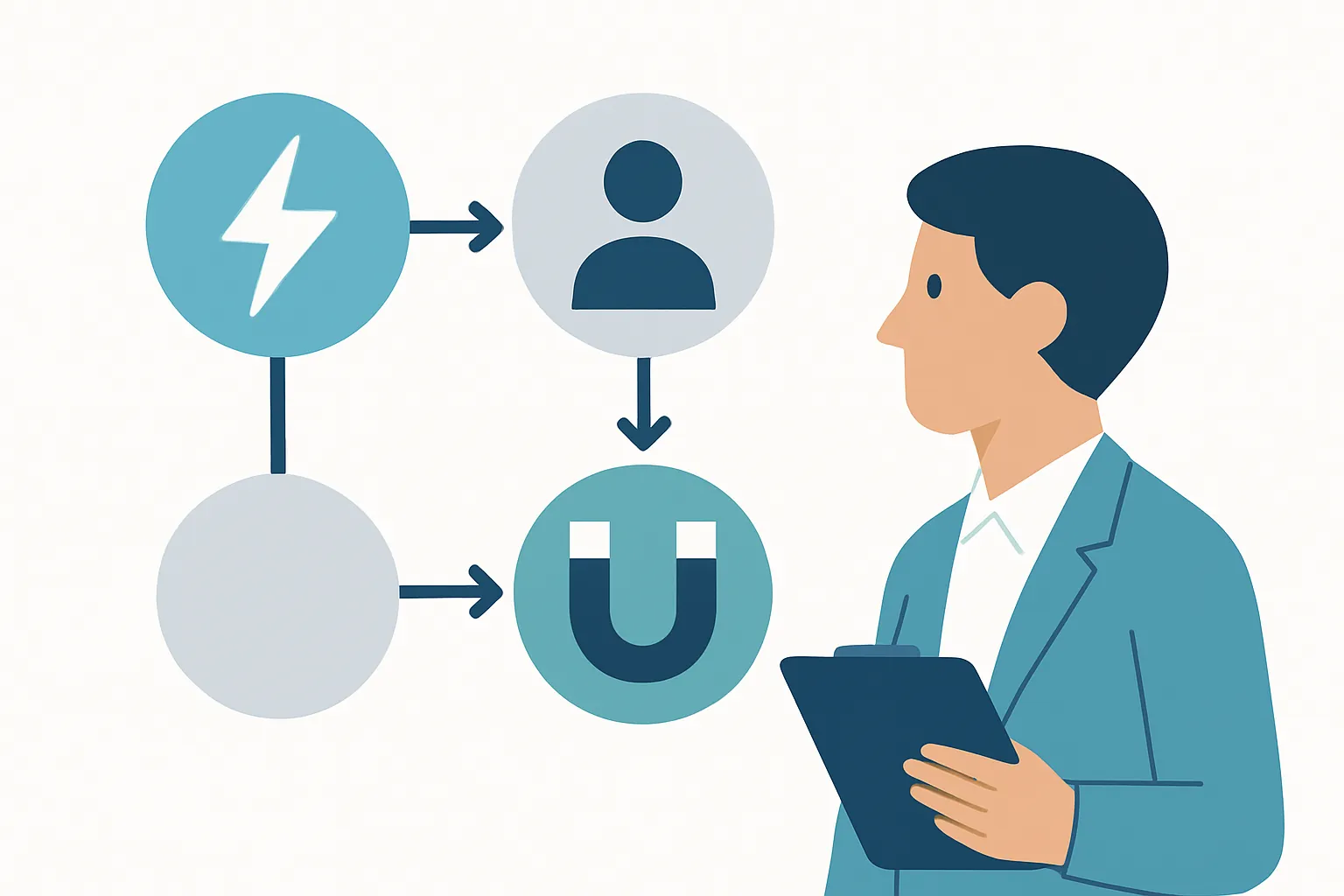
Functional analysis is a behavioral tool for uncovering the environmental reasons behind a client's repetitive, hard-to-explain behavior, and the A-B-C model organizes it into three axes: antecedent, behavior, and consequence. Because behavior is learned and maintained within a specific context rather than occurring at random, effective charting requires operational definitions—observable facts in place of vague interpretation. The data you collect then maps onto three intervention strategies (antecedent intervention, teaching replacement behaviors, and consequence modification), and identifying what reinforcement the behavior delivers to the client is the key to a precise treatment plan.
Why Do They Keep Doing That? Reading the Function Behind a Client's Behavior
Every clinician knows the moment. A client says, "I understand it intellectually, but I just can't stop doing it." Another shuts down or turns combative the instant a particular situation arises. Exploring the unconscious dynamics underneath matters—but sometimes the breakthrough comes from getting precise about the mechanics of the behavior right here, in the present moment.
This is especially true when you're working from a cognitive behavioral (CBT) or behavior-modification frame, where the environmental context surrounding a behavior is essential data. Yet in the press of a full caseload and pages of session notes, it's easy to lose the before-and-after thread. When you rely on a client's vague account—"I don't know, I just got angry"—it's hard to build a strategy with any precision.
This guide walks through functional analysis and the A-B-C chart, one of the most powerful assessment tools in clinical behavioral work, and shows how to use it to find the logic hiding inside a client's most puzzling patterns.
1. Dissecting the Function of a Behavior: The A-B-C Model
In behavioral psychology, every behavior has a reason—a function. The process of finding that reason is functional analysis, and the A-B-C model is its most intuitive structure. Using it, you begin to see that a behavior doesn't simply happen; it is learned and maintained within a specific environment.
Antecedent: Find the Trigger
The antecedent is whatever was present immediately before the behavior. It might be physical (a place, a noise), interpersonal (something said, a criticism), or internal (hunger, an anxious thought). Your job is to probe for the trigger with concrete questions: "What thought crossed your mind just before that?" or "Who were you with at the time?"
Behavior: Strip Out the Vagueness
The most common error in clinical note-taking is defining the behavior abstractly. "Aggressive" means something different to every clinician. Replace it with an operational definition: "struck the desk with a fist twice," "raised voice to roughly double the usual volume." Only then can you measure the behavior's frequency and intensity objectively.
Consequence: What Reinforcement Keeps It Alive?
What happens in the seconds after a behavior decides whether it will be repeated or extinguished. If a client's anger produces an apology, or if avoidance briefly lowers their anxiety (negative reinforcement), the behavior is strengthened. Look closely at the secondary gain—what payoff the consequence is delivering to the client.
2. Charting Like a Professional: Raising the Quality of Your Observations
The A-B-C chart is not a casual incident log. It's a scientific instrument for collecting behavioral data and testing hypotheses. The mistake trainees and early-career clinicians make most often is blending interpretation with fact. Effective functional analysis demands training yourself to set aside subjective judgment and record observable facts.
The table below contrasts inefficient notes with professional-grade A-B-C entries. It's worth asking which column your own notes resemble.
| Element | Inefficient note (subjective/vague) | Professional A-B-C note (objective/specific) |
|---|---|---|
| A (Antecedent) | Mom kept bothering the child. | Mother asked "Did you finish your homework?" three times in a row. |
| B (Behavior) | The child was defiant. | Child slammed the bedroom door and shouted, "Leave me alone!" |
| C (Consequence) | Mom got upset. | Mother stopped the conversation and left for the living room (successful escape from the nagging). |
| Analysis (Function) | Personality problem or teenage rebellion. | Escape/avoidance (C) from the mother's demand (A) reinforces the behavior (B). |
Table 1. Inefficient notes vs. a professional A-B-C chart.
3. From Data to Intervention
Once the chart has accumulated data, it's time to intervene. The goal is to go beyond "that behavior is harmful" and build strategies that break the chain or substitute for it. Three core approaches are ready to apply immediately.
Antecedent Intervention: Redesign the Environment
Make the behavior harder to trigger in the first place. If a client recovering from alcohol dependence feels the urge to drink (B) every time they pass the convenience store on the walk home (A), suggest rerouting the commute through a park instead. Simply identifying triggers together and planning concrete ways to avoid or modify them can dramatically reduce the frequency of the problem behavior.
Teaching Replacement Behaviors: Functional Equivalence
Teach a behavior that serves the same function but is socially acceptable. If a client shouts (B) when a supervisor reprimands them and the function is "discharging stress," train an alternative—stepping into the restroom to breathe deeply, squeezing a stress ball. The key is to change the behavior without taking away the payoff (relief, a sense of control) the client is seeking.
Consequence Modification: Rearranging Reinforcement
Remove the reward for the problem behavior and deliver an immediate reward for the desired one. For a client whose self-harm (B) draws attention (C) from those around them, respond to the self-harm with calm, matter-of-fact medical care and minimal emotional reaction—while concentrating warm support and attention on the moments they express emotion in a healthy way. This same logic is invaluable for managing transference and countertransference within the therapeutic relationship itself.
4. A Technical Note: Working Past the Limits of Memory
The success of a functional analysis hinges on how accurately you captured the data. But observing a client's words and nonverbal cues while simultaneously keeping a flawless A-B-C chart is, realistically, very difficult. Bury your attention in note-taking and you lose eye contact and rapport; stay fully present and you risk forgetting a crucial antecedent.
This is where modern AI tools can ease the clinical load. A security-first AI partner built for counselors—handling session transcription and analysis—can convert the conversation to text in real time and surface a client's key statements and shifts in affect. Used well, it changes the work in three ways:
- Guards against memory distortion: After the session, reviewing the AI-organized transcript lets you trace the A-B-C elements backward and catch the easily-missed cue a client tossed off in passing—"and then the phone suddenly rang..." (an antecedent).
- Automates pattern recognition: Across accumulated session data, the tool can visualize the subtle behavioral patterns and recurring triggers you might not have spotted on your own.
- Extends clinical intuition: Freed from pure documentation, you can pour your energy into the deeper question of why—and into building higher-order treatment strategies.
Change in a client's behavior begins with accurate understanding. With a tool as powerful as the A-B-C chart, supported by an efficient record-keeping system, you can find the clear exit inside the maze of a client's most complicated behavior—and be the skilled clinician who guides them out.
FAQ
See the frequently asked questions below.
Frequently asked questions
What is functional analysis in behavioral therapy?
Functional analysis is a method for identifying the environmental reasons a behavior occurs and persists. Rather than treating a behavior as random, it examines what came before it and what followed, revealing the purpose—or function—the behavior serves for the client.
What does A-B-C stand for in an A-B-C chart?
A-B-C stands for Antecedent (what happened immediately before the behavior), Behavior (the specific, observable action), and Consequence (what followed and reinforces or extinguishes the behavior). Charting all three reveals the behavior's function.
Why are operational definitions important when charting behavior?
Vague labels like "aggressive" or "defiant" mean different things to different clinicians and can't be measured. An operational definition—e.g., "struck the desk twice"—describes an observable, countable action, so frequency and intensity can be tracked objectively across sessions.
How do you turn A-B-C data into a treatment intervention?
Three strategies follow directly from the data: antecedent intervention (redesigning the environment to reduce triggers), teaching replacement behaviors (a socially acceptable action that serves the same function), and consequence modification (removing reinforcement for the problem behavior while rewarding healthier alternatives).
This article was written and reviewed using Modalia AI's clinical guidelines, with professional human review before publication.
Related articles
 Clinical Skills
How to Write Better Supervision Questions: Getting What You Actually Need from Your Supervisor
Stuck on what to ask in supervision? Use these structured question strategies to turn vague check-ins into focused clinical insight.
7 min read Clinical Skills
From "The Client Seems Depressed" to a Clinical Hypothesis: How Word Choice Elevates Your Case Reports
Turn vague observations into precise clinical hypotheses. A practical guide to terminology and sentence formulas that make your case reports read like expert work.
7 min read Clinical Skills
The Wounded Healer Trap: Why "I Want to Heal Myself" Sinks Your Counseling Grad School SOP
Why admissions faculty flinch at "I want to heal my own wounds"—and how to transform personal pain into a research-grade statement of purpose that gets you in.
6 min read