The Functional Analysis of Self-Harm: Understanding NSSI as 'Pain to Stop the Pain'
A clinician's guide to the psychological functions of non-suicidal self-injury, how to distinguish NSSI from a suicide attempt, and DBT-informed interventions.
Key takeaway
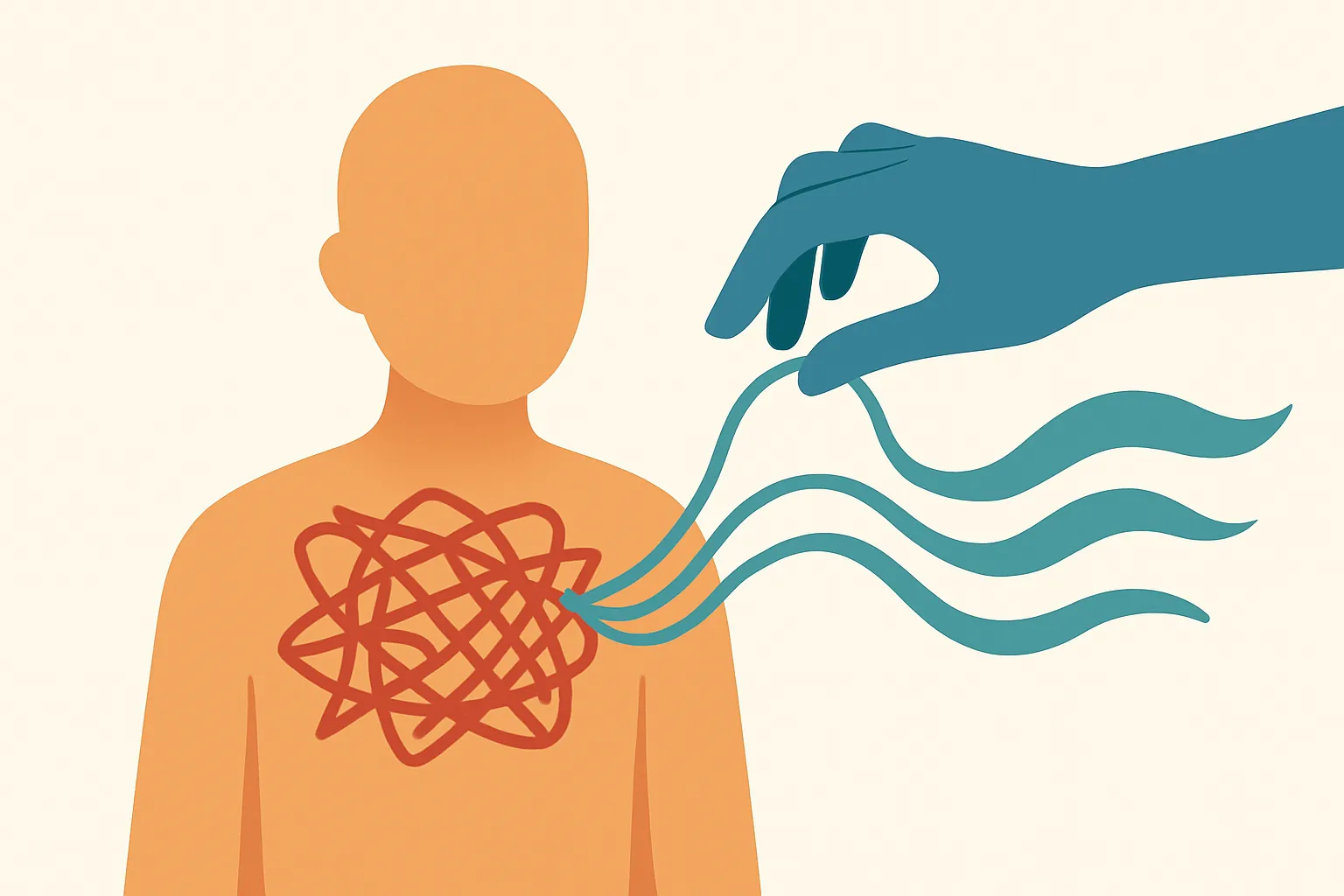
Non-suicidal self-injury (NSSI) is rising sharply among adolescents and young adults, and it is best understood not as attention-seeking but as a desperate strategy to regulate unbearable internal pain. Matthew Nock's four-function model frames self-harm as serving emotion regulation, self-punishment, and interpersonal communication—so targeting the behavior for extinction without addressing its function can weaken the therapeutic alliance or push clients toward more dangerous substitutes. Because NSSI is also one of the strongest long-term predictors of suicide, clinicians should monitor risk along a continuum and intervene with tools such as DBT chain analysis, intense-sensation substitution skills, and a non-judgmental stance that validates the pain behind the behavior.
A Cry for Help, or a Survival Strategy? Reading What Lies Behind 'Pain to Stop the Pain'
When a client first discloses self-harm, most clinicians feel two things at once: deep concern for the client's safety, and a quiet dread about how to manage the crisis that might follow. That tension sharpens when a client says, "I didn't want to die—I just wanted the feeling to stop." It is one of the more disorienting clinical moments we encounter, because it asks us to hold safety and meaning in the same hand.
Non-suicidal self-injury (NSSI) is rising sharply among adolescents and young adults. It cannot be dismissed as "acting out" or "attention-seeking." For most clients, it functions as a desperate coping mechanism for regulating psychological pain. Many counselors instinctively ask, "How do I get this client to stop?" But the more clinically useful question is "What is this behavior doing for the client?"
If we move to extinguish the behavior without first understanding its function, the client may feel we are taking away their only psychological lifeline. That can erode the working alliance—or, worse, drive the client toward a more dangerous substitute. This article offers a precise functional analysis of self-harm and a set of practical interventions that hold the client's pain with compassion while building healthier ways to cope.
Why Choose Pain? The Four Core Functions of Self-Harm
Clinical psychologist Matthew Nock's functional model organizes self-harm along two axes: intrapersonal vs. interpersonal function, each operating through positive or negative reinforcement. Mapping where a given client's behavior falls is the first step in any treatment plan.
1. Emotion Regulation (Automatic Negative Reinforcement)
This is the most common function—the mechanism of "pain to stop the pain." Faced with intolerable anxiety, anger, or grief, the client uses self-injury to discharge the emotion immediately. Physical pain triggers endogenous opioid release, producing a brief calming effect. Over time this reinforces a powerful but distorted belief: "Only self-harm can settle me."
2. Self-Punishment and 'Feeling Something' (Automatic Positive Reinforcement)
This appears in clients carrying intense self-loathing or guilt. Self-injury enacts an inner verdict—"I deserve to suffer." For others, the function is the opposite of numbness: when dissociation sets in, the pain confirms "I am still here, I am alive." The behavior generates an internal state the client cannot otherwise access.
3. Interpersonal Communication and Influence (Social Reinforcement)
This is what the "attention-seeking" label gets wrong. A client who lacks the language to express overwhelming distress may use the body to say "I am drowning." Self-injury can also be an out-of-awareness attempt to stop criticism or to elicit care. Recognizing the communicative function—rather than moralizing about it—lets us teach the client more effective ways to be heard.
Clinical Differentiation: NSSI vs. a Suicide Attempt
One of the most anxiety-provoking judgments in practice is assessing whether self-harm signals suicidal intent. NSSI and suicide attempts overlap, but they differ meaningfully in intent and psychological background. Confusing the two can lead either to over-reactive interventions that damage rapport, or to missing genuine warning signs.
Table 1. Clinical Features: NSSI vs. Suicide Attempt
| Dimension | Non-Suicidal Self-Injury (NSSI) | Suicide Attempt |
|---|---|---|
| Core intent | Regulate painful affect in order to keep living (a survival strategy) | End unbearable pain by stopping life (an escape strategy) |
| Frequency | Often habitual and repetitive | Comparatively infrequent, but high-stakes |
| Method & lethality | Cutting, scratching, hitting—low lethality | Overdose, falls from height—high lethality |
| Affect afterward | Brief relief, followed quickly by guilt or shame | Persistent hopelessness, or frustration at "failing" |
The critical caveat: NSSI is one of the strongest long-term predictors of future suicide. As self-injury repeats, the client builds tolerance to physical pain and fear of death diminishes—what Joiner terms the acquired capability for suicide. So rather than treating NSSI and suicidality as a clean binary, clinicians should monitor risk along a continuum, reassessing it as a moving target across sessions.
Practical Interventions: From Stopping the Behavior to Healing
Once you understand the function, the work shifts to building the client's capacity to tolerate pain without self-injury. A simple "promise not to hurt yourself" contract is largely ineffective—and it often just sets the client up to feel they've failed.
1. Chain Analysis
Borrow this core DBT technique. Working backward from a specific incident, map the sequence with the client—ideally on paper or a whiteboard:
Vulnerability factors → triggering event → thoughts and feelings → urge and behavior → consequences.
- The client comes to see that the self-harm did not happen "out of nowhere," but followed an identifiable pattern.
- You can locate the highest-leverage point for intervention (e.g., reducing vulnerability with sleep and food vs. inserting a skill at the emotional peak).
2. Intense-Sensation Substitution (TIPP Skills)
When a client is emotionally flooded, cognitive strategies ("reframe the thought") rarely land. The nervous system needs a physiological intervention first:
- Holding ice: delivers an intense but tissue-safe stimulus that interrupts the urge and re-orients the nervous system.
- Cold water on the face (the dive response): triggers the mammalian diving reflex, slowing heart rate and activating the parasympathetic system.
- Intense exercise: discharges accumulated physical arousal, releasing emotional pressure.
3. Validation and a Non-Judgmental Stance
Replace "Why would you do that?" with "You were in so much pain that this felt like the only option you had." You do not have to endorse the behavior to validate the legitimacy of the suffering that produced it. When a clinician receives a client's pain without blame, the client can begin to set down the shame and put feelings into words instead of onto skin.
Closing: A Safe Space Built on Careful Observation
Working with self-harm asks the clinician for a particular kind of sustained vigilance. The method, the frequency, and the subtle shifts in affect a client describes are not incidental detail—they are the raw material of accurate risk assessment and a sound treatment plan. Tracking how the nuance of self-harm references changes from one session to the next is often where the most important clinical signal lives.
The deeper work, though, happens when you are fully present—able to attend to the client's eyes and the tremor in their voice rather than your documentation. That is where genuine therapeutic contact occurs, and it is worth protecting. Modalia AI, a security-first AI partner for counselors, can carry part of the recording and pattern-tracking load—surfacing recurring crisis language and emotional patterns as reviewable data—so you can stay in the human role this work demands.
Action Items for Therapists
- ✅ Standardize your risk assessment. During intake, use a validated measure that distinguishes NSSI from suicide risk—for example, the Inventory of Statements About Self-Injury (ISAS), which captures the function of the behavior, alongside a suicide-specific screen such as the Columbia-Suicide Severity Rating Scale (C-SSRS).
- ✅ Co-create a coping kit. Build a personalized "crisis toolbox" the client can reach for in the moment—TIPP skills, grounding objects, and a short list of people and resources to contact.
- ✅ Know and share local crisis resources. Keep current contact information for your national or local crisis line and emergency services, and give clients a written safety plan. In the U.S. and Canada, that includes 988; in the U.K. and Ireland, the Samaritans; in Australia, Lifeline. Always pair this with same-day pathways to emergency care.
- ✅ Bring the case to supervision. Self-harm cases carry real clinical and emotional weight—review them in supervision or peer consultation, and use concrete session detail to ground the discussion and manage your own countertransference.
References
- 1.
- 2.
- 3.
- 4.
Frequently asked questions
Is non-suicidal self-injury just attention-seeking?
No. While self-harm can serve an interpersonal communication function, framing it as attention-seeking misreads it. For most clients it regulates intolerable emotion, enacts self-punishment, or counters dissociation. Treating it as manipulation damages the alliance and misses the underlying distress.
How is NSSI different from a suicide attempt?
Intent is the key difference: NSSI aims to manage pain in order to keep living, while a suicide attempt aims to end life. NSSI is typically more frequent and lower in lethality. However, repeated NSSI is a strong predictor of future suicide because it builds tolerance to pain and reduces fear of death, so risk should be monitored along a continuum.
What should I do instead of a no-harm contract?
Simple no-harm contracts are largely ineffective and can set clients up to feel they've failed. More useful tools include DBT chain analysis to map the behavior's sequence, TIPP skills (ice, cold-water face immersion, intense exercise) for moments of emotional flooding, and validation of the pain behind the behavior.
Which assessment tools help distinguish NSSI from suicide risk?
The Inventory of Statements About Self-Injury (ISAS) captures the functions of NSSI, while a suicide-specific screen such as the Columbia-Suicide Severity Rating Scale (C-SSRS) assesses suicidal ideation and behavior. Using both gives a clearer picture than either alone.
This article was written and reviewed using Modalia AI's clinical guidelines, with professional human review before publication.
Related articles
 Case Conceptualization
Breaking the "Yes, But" Game: A Transactional Analysis Guide for Therapists
Every suggestion you offer gets met with "Yes, but..." Here's the TA structure behind that stall—and four clinical moves to break it.
7 min read Case Conceptualization
Yalom's The Gift of Therapy: Passages Every New Counselor Should Copy by Hand
Irvin Yalom's prescription for therapists who fear silence: meet your client as a "fellow traveler" and let the here-and-now become the heart of the work.
6 min read Case Conceptualization
Working With Silence in Therapy: What Client Silence Means and How to Hold It
Silence in session isn't empty space. Learn to read its clinical meaning, tell productive from defensive silence, and use it as a therapeutic tool.
6 min read