Reading the Genogram: How to Surface the Family Secrets Clients Don't Name
A clinician's guide to reading the silences, gaps, and missing members in a genogram—and turning hidden family secrets into therapeutic insight.
Key takeaway
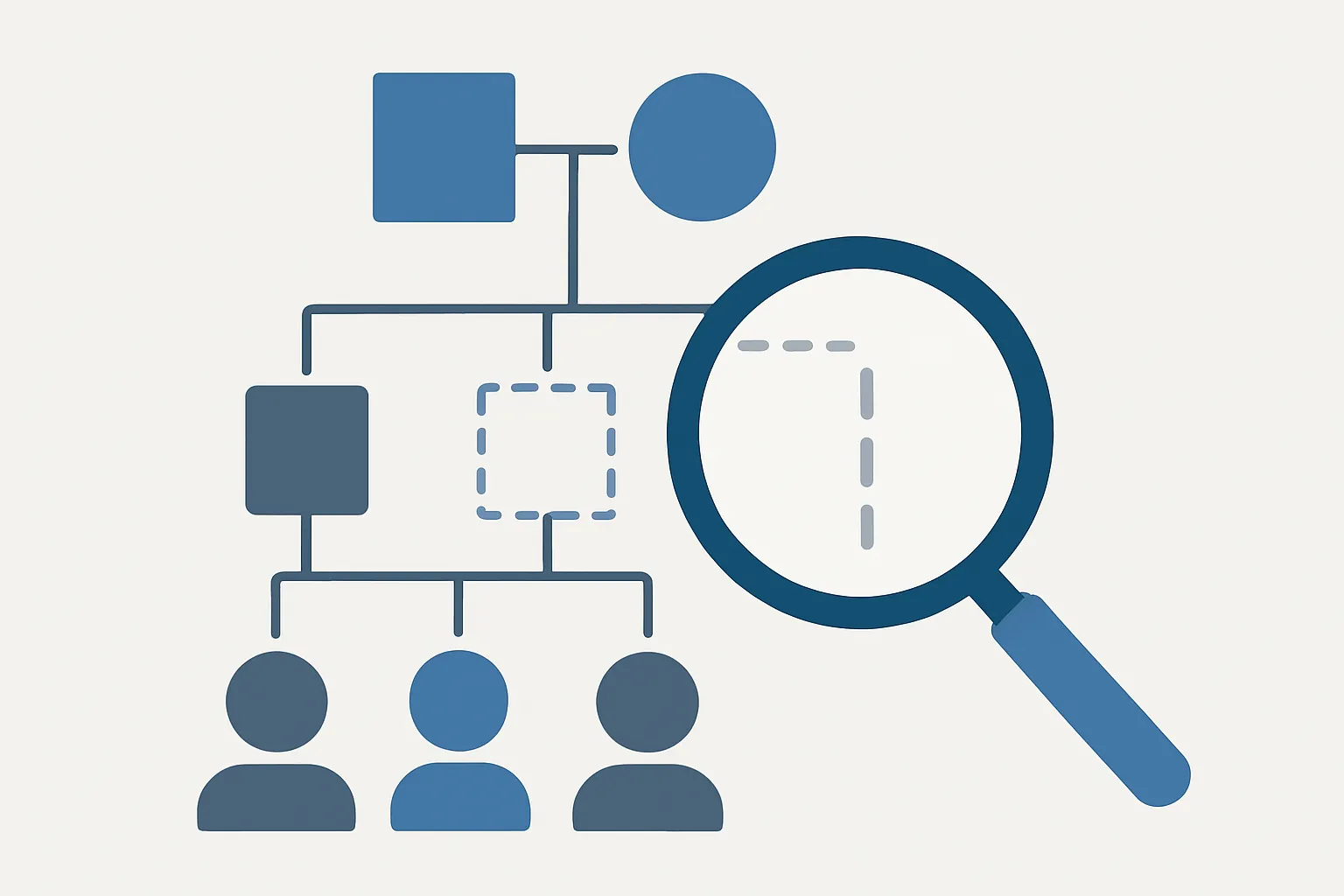
A genogram is not an intake formality; in Bowen's multigenerational framework it is a historical map of the dynamics producing a client's current symptoms. The most clinically useful data often lives in what clients omit: the relative they 'can't remember,' the flat 'he was just normal' delivered after a long pause, the subject changed too quickly. These blanks fall into three types—simple information gaps, emotional cutoff, and protective secrecy—and each calls for a different hypothesis and interview strategy. Reading them well, using process-oriented and circular questions while also mapping family resources, is a core competency for surfacing and safely holding family secrets.
Why Reading a Genogram Matters More Than Drawing One
Most of us learn the genogram as an intake task: map the family, note ages and occupations, draw the lines, move on. It becomes an administrative step on the way to the "real" work. But as Murray Bowen's multigenerational theory argues, the genogram is not a chart of who's who—it's a historical map of the relational forces that produced the symptoms sitting in front of you today.
The richest clinical material is rarely in what the client reports cleanly. It's in what goes unspoken: the relative who is suddenly hard to recall, the family member described in a single flat sentence, the small silence that opens up around one particular name. If you've ever felt stuck in a complex case—circling the same dynamic without a foothold—the next move may not be to gather more facts. It may be to look at the empty space between the symbols on the page.
This piece is about that empty space: how to recognize the family secrets a client is concealing, sometimes deliberately and sometimes without knowing it, and how to work with them therapeutically.
Seeing What Isn't There: The Clinical Meaning of the Blank
When a client resists, deflects, or simply leaves a gap in the family history, it's easy to read it as a dead end. In fact it's often the most informative thing in the session. Family secrets are typically protective—they guard against shame, preserve loyalty, or contain trauma. When a client says "I don't really know much about him" or steers away from a particular person, there's a strong chance you're standing at the edge of an unresolved emotional cutoff or a triangulation that still organizes the family today.
Mind the Mismatch: Verbal vs. Nonverbal Data
A client may say, "My father was an ordinary guy," while breaking eye contact and dropping their voice. That incongruence between the words and the body is the signal. It can point to concealed material—problem drinking, family violence, an affair—long before anyone is ready to name it. This is why it helps to occasionally lift your pen, stop drawing, and watch the client's face. The genogram can wait; the micro-expression won't repeat.
Three Types of Blank—and Three Different Hypotheses
A true absence of information is not the same as an intentional gap. The table below distinguishes the kinds of "blank" that surface in a genogram interview and what each one asks of you.
| Type of response | What the client says | Clinical hypothesis | Where to take it |
|---|---|---|---|
| Simple information gap | "My grandfather died before I was born, so I never really knew him." | Information lost in transmission. Low emotional charge. | Explore the stories told about him by other family members (parents, aunts/uncles). |
| Emotional cutoff | "I don't want to talk about that person. They're not important." | Unresolved conflict or anger, often tied closely to the presenting problem. | Ask how the avoidance itself shapes current relationship patterns. |
| Protective secrecy | (long pause) "...It was fine. Nothing unusual happened." (visibly anxious) | A family taboo, shame, or concealed trauma. | Prioritize safety over confrontation. Reflect gently: "It seems like there's something here that's hard to talk about." |
Table 1. Types of "blanks" in the genogram interview and corresponding strategies.
Lowering Defenses and Going Deeper: Genogram Interview Skills
So how do you move past a well-built defense toward what's actually there—without turning the session into an interrogation? The goal is to become a companion exploring the family's history alongside the client, not a detective extracting a confession. These techniques protect the ethics of the work while maximizing therapeutic insight.
1. Use Process-Oriented Questions
Instead of content questions—"How old is your father?"—shift toward the client's present experience: "Your expression changed a little when you mentioned your father. What came to mind just then?" This single move elevates the genogram from data collection to a therapeutic intervention happening in real time.
2. Track the Missing—Indirectly
When a direct question feels too exposing, an oblique route works better. "Is there anyone in the family who left suddenly, or whose name almost never comes up at family gatherings?" lets you explore the family's shadow without naming a specific person. Circular questions do similar work: "If your late grandmother were sitting here now, what do you think she'd say about how your mother raised you?" invites the client to view the family system from the outside, with more distance and less defensiveness.
3. Map Resources and Strengths, Not Only Wounds
If you mine only for secrets and injuries, the client can leave depleted. Always mark the resources and strengths in the system, too. "Who in the family helped you get through that hard stretch?" brings positive energy onto the page and supports the client in accepting—rather than disowning—their roots.
Conclusion: Insight Beyond the Record
A genogram is not a one-and-done assignment. It's a living map, revised and expanded across the whole arc of therapy. Reading the blanks a client leaves, and holding the secrets inside them safely, is a defining clinical skill. Healing tends to begin precisely when you catch the truth behind the silence, the slight tremor, and the "I don't really know."
This kind of attentive interviewing creates a familiar dilemma: you want to give the client's nonverbal signals your full attention, yet you also have to capture a tangle of relationships and details without losing them. It's worth being honest about that tension rather than pretending one can do both perfectly at once.
It's also where some clinicians have begun to lean on AI-assisted documentation tools as a support—not a replacement for clinical judgment. Used thoughtfully (and with appropriate attention to consent and data security), such tools can:
- Capture the texture of silence. Beyond plain transcription, some tools log pause length and changes in speech rate—objective markers that can prompt a useful question on review: "Why the five-second silence right here?"
- Surface recurring language and relational patterns. Repeated words ("always," "in the end") and the emotional vocabulary attached to specific family members can be aggregated, helping you see dynamics you might have missed in the moment.
- Free your attention for the room. Offloading some of the recording burden lets you hold the client's gaze and stay with the here-and-now interaction.
This is the lane Modalia AI is built for—a security-first AI partner for counselors covering transcription, case conceptualization support, and documentation—though any tool should serve the relationship, not the other way around.
This week, consider setting the pen down for a moment and lingering a little longer in your client's eyes and in the white space of their family history. What fills that empty space, in the end, isn't recorded text—it's the trust and understanding built between the two of you.
FAQ
References
- 1.
Frequently asked questions
What does a 'blank' or silence in a genogram actually tell me clinically?
It depends on the type. A low-charge information gap (a relative who died before the client was born) usually just means lost family knowledge. But an emotionally loaded avoidance often signals unresolved cutoff or conflict, and a long, anxious pause around one person can indicate protective secrecy guarding shame or trauma. Each calls for a different hypothesis and pace.
How is a genogram different from a standard family-history intake?
An intake catalogs facts—names, ages, occupations. A genogram, in Bowen's multigenerational framework, is a working map of the relational patterns producing the client's current symptoms. It's revised throughout therapy and treated as a living clinical tool, not a one-time form.
What's the difference between process-oriented and circular questions?
Process-oriented questions ask about the client's present experience as they speak ('Your expression shifted just then—what came up?'), turning the genogram into an intervention. Circular questions ask the client to imagine another family member's perspective, which creates distance and lets them observe family dynamics with less defensiveness.
How do I approach a suspected family secret without pushing too hard?
Prioritize safety over confrontation. Reflect what you observe gently ('It seems like there's something here that's hard to talk about'), use indirect questions that don't single anyone out, and balance the exploration by also mapping the family's resources and strengths so the client isn't left depleted.
This article was written and reviewed using Modalia AI's clinical guidelines, with professional human review before publication.
Related articles
 Case Conceptualization
Breaking the "Yes, But" Game: A Transactional Analysis Guide for Therapists
Every suggestion you offer gets met with "Yes, but..." Here's the TA structure behind that stall—and four clinical moves to break it.
7 min read Case Conceptualization
Yalom's The Gift of Therapy: Passages Every New Counselor Should Copy by Hand
Irvin Yalom's prescription for therapists who fear silence: meet your client as a "fellow traveler" and let the here-and-now become the heart of the work.
6 min read Case Conceptualization
Working With Silence in Therapy: What Client Silence Means and How to Hold It
Silence in session isn't empty space. Learn to read its clinical meaning, tell productive from defensive silence, and use it as a therapeutic tool.
6 min read