The Genogram as a Therapeutic Tool: Drawing Insight With Your Clients
Move the genogram beyond intake paperwork into a living clinical tool. Learn how drawing a family map with clients surfaces multigenerational patterns and real insight.
Key takeaway
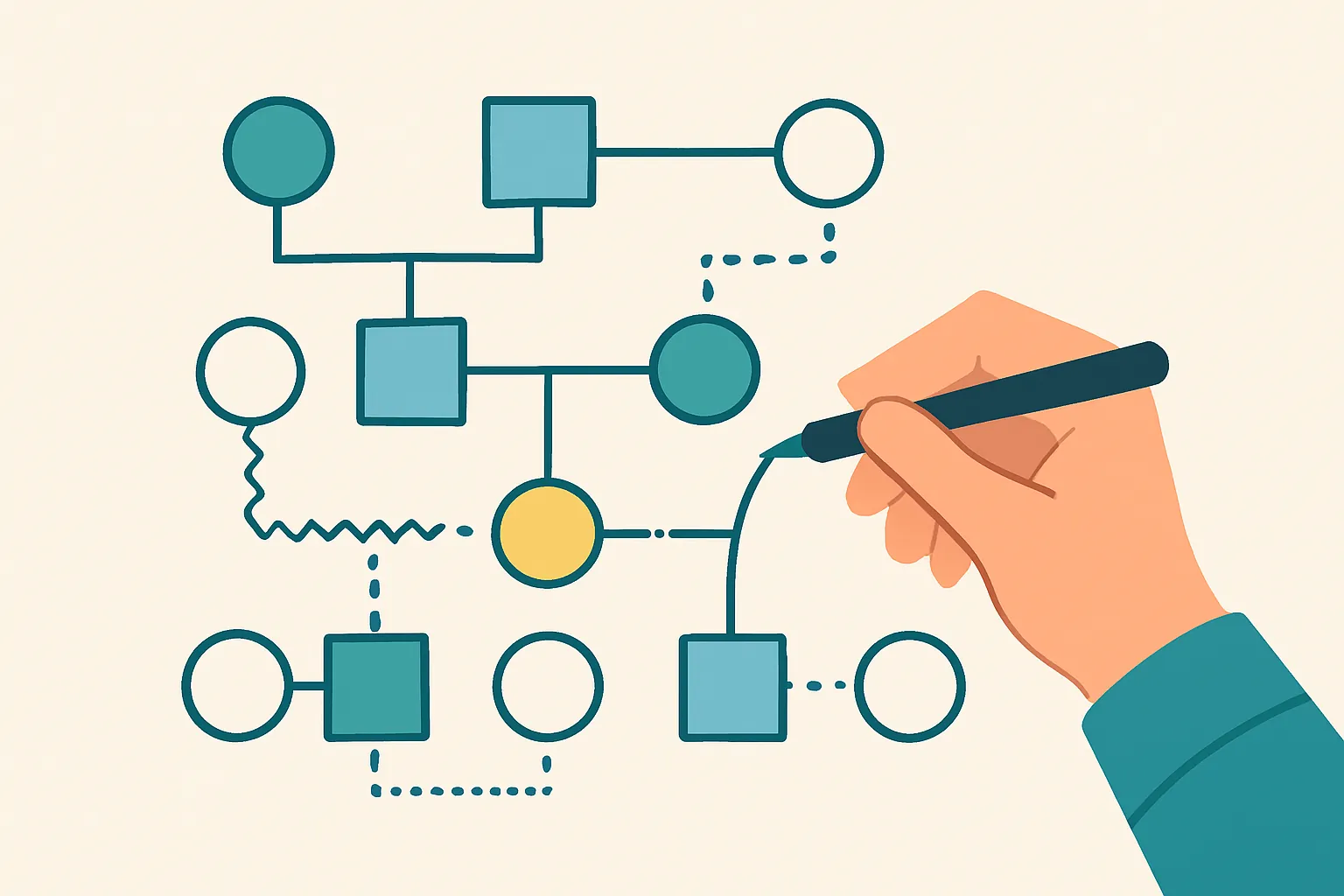
A genogram is a visual map of a client's family relationships, and in Murray Bowen's multigenerational family systems theory, the act of drawing it is itself a therapeutic intervention. Sketching figures and relationship lines alongside the client externalizes inherited anxiety, triangulation, and unresolved cutoffs, creating moments of insight that talking alone rarely produces. When the clinician shifts from interrogator to collaborative explorer, the genogram becomes a living narrative map that is revised throughout the course of therapy.
Mapping a Client's Life on a Single Page: The Genogram as More Than a Record
How do you map a client's family relationships during intake? Do you stop at the ages and occupations of family members, or do you probe the dynamics underneath? In session, we routinely meet clients who insist, "I'll never live the way my mother did," while reproducing the exact same relational pattern they swore to escape. The single most powerful tool for making that unconscious repetition — and the invisible threads running through a family — visible is the genogram.
Many clinicians treat the genogram as little more than an administrative step for gathering information. Drawing a thicket of symbols against the clock, it's easy to worry that you'll miss the client's emotion while you're busy with notation. But as Murray Bowen's multigenerational family systems theory suggests, the process of drawing a genogram can be a potent intervention in its own right. Putting pen to paper with a client — sketching circles and squares, connecting lines — integrates scattered fragments of family history into a single coherent narrative, and that integration is where insight happens. This article looks at how to use the genogram not as a static record but as a core therapeutic tool for drawing out client insight.
1. Why Drawing Beats Talking: The Clinical Power of the Genogram
When a client narrates family history out loud, they tend to collapse into a single event or feeling and lose the larger context. A visual tool lets them step back and view their family from an objective distance — an effect we can think of as a form of externalization.
Visualizing patterns and confirming inherited anxiety
Saying "divorce runs in my family" is one thing. Watching a chain of cutoffs trace visibly from grandmother to mother to aunt and down to oneself on the page is an experience of an entirely different order. Through the visualized pattern, the client comes to recognize that their struggle is not a personal defect but anxiety transmitted across generations within a family system. That reframe relieves guilt and becomes a powerful source of motivation for change.
Discovering triangulation
As the genogram takes shape, the role the client has played between their parents comes into focus. When the dynamic of a couple pulling a child into their conflict surfaces on the page, the client often arrives at the insight: "I was the emotional container for my parents' marriage." That recognition is a first step toward differentiation of self.
Revisiting unresolved issues and emotional cutoffs
The points where a client has no information about a particular relative — or steers around mentioning them — are important clinical clues. A single question like, "Why does no one in the family talk about this uncle?" can bring a buried family secret or trauma to the surface.
2. From Information-Gathering to Collaborative Exploration
To use the genogram effectively, the stance has to shift. Rather than the clinician asking and the client passively answering, the work calls for the posture of a collaborative explorer drawing the map together. The table below contrasts traditional history-taking with a therapeutic approach to the genogram.
| Dimension | Traditional History-Taking | Therapeutic Genogram |
|---|---|---|
| Primary goal | Verify facts, accumulate data | Explore relational patterns, catalyze insight |
| Clinician role | Questioner, recorder (directive) | Guide, co-explorer (collaborative) |
| Client experience | Passive responding, feels interrogated | Active participation, self-discovery |
| When it's used | Mostly a one-time intake task | Revised and expanded across the whole course |
| Focus | "Who" and "when" (fact) | "How" and "why" (process and emotion) |
Table 1. Traditional history-taking versus a therapeutic approach to the genogram.
As the table shows, a therapeutic genogram concentrates on the quality of relationships rather than fact-checking. Instead of asking, "How was your relationship with your father?" try: "What shape should the line between you and your father take? A straight line? A broken, dotted one? Or a jagged line of conflict?" The very act of the client weighing and choosing the shape of that line becomes a therapeutic exploration of their inner dynamics.
3. Concrete Strategies for the Therapy Room
So how do you use the genogram more effectively within an actual session? You need a strategic approach that keeps the drawing from becoming a burden or a time sink.
Make it shared work on a whiteboard or large paper
A genogram scribbled by the clinician alone in the corner of a notepad is never shared with the client. Keep a whiteboard in the room, or roll out a large sheet and draw standing alongside the client. Handing them the pen to place family members themselves dramatically raises engagement. You can also give spatial arrangement meaning — "There's an empty space next to your aunt here; whose place might that be?"
Lead with curiosity, not interrogation
Direct questions can trigger defenses. Lean instead on naïve curiosity. Read back what the drawing reveals and invite the client's interpretation: "Looking at this, the women on your mother's side are all very closely connected, while your father's side seems more distant. How does that difference feel to you?"
Track anniversary reactions and the family life cycle
Note significant dates on the genogram — deaths, divorces, accidents. When a client's depression or anxiety recurs at a particular time of year, there's a strong chance it's linked to a date on the map. Discovering, for example, that a client's panic attacks began at the same age their father first collapsed is a clinically significant insight.
4. Balancing Detailed Documentation With Clinical Presence
The central dilemma of genogram work is the tension between recording and connecting. While you're mapping complex relationships, writing in dates, and marking relational lines, you risk missing the subtle shifts in the client's expression and affect. And capturing every piece of family detail a client pours out in real time — who fought with whom, when each event happened — is all but impossible.
This is where modern tools can help. Keep the genogram itself as a diagram, and preserve the rich conversation and nuance around it some other way. The efficient division of labor is to focus your attention on the drawing and on meeting the client's eyes, while letting technology hold the textual detail.
Conclusion: The Genogram Is a Living Narrative Map
The genogram is not a static document you draw once and file away. It is a living narrative map — new facts get added, relational lines shift, and the client's interpretation evolves as therapy unfolds. Time spent drawing a genogram with a client is time spent honoring the family history they carry and finding new meaning inside it.
So open the genogram again in your next session. Hand the client the pen and ask: "Shall we draw these relationships together?"
An Action Plan for Clinicians
- Prepare your materials. Keep large paper (A3 or bigger) or a whiteboard in the room, along with markers in several colors for expressing emotional lines.
- Rethink how you document. To stay focused on the client's nonverbal responses while you draw, look for ways to lighten the burden of capturing the conversation. An AI session-note tool lets you immerse yourself fully in drawing and empathic attunement while the technology organizes the dense family narrative into text — so you don't miss key client statements and can keep your clinical attention where it belongs.
- Update it continually. Every five or ten sessions, take the genogram back out and revise it with the client to reflect changed relationships and new realizations.
References
- 1.
- 2.
Frequently asked questions
What is a genogram and how is it different from a family tree?
A genogram is a visual map of a family across generations that goes beyond a basic family tree. Alongside names and dates, it encodes relational quality and dynamics — closeness, conflict, emotional cutoff, and triangulation — making patterns that repeat across generations visible at a glance.
Why is drawing a genogram considered a therapeutic intervention rather than just record-keeping?
In Bowen's multigenerational family systems theory, the act of constructing the map externalizes the family system so the client can view it at an objective distance. Seeing inherited patterns laid out visually reframes a personal 'defect' as transmitted family anxiety, relieves guilt, and motivates change in ways that talking alone rarely achieves.
How do I draw a genogram without missing the client's emotional cues?
Separate the diagram from the detail. Keep your attention on the drawing and on meeting the client's eyes, and let a tool capture the surrounding narrative. Many clinicians use an AI session-note tool to organize the dense family history into text so they can stay fully present during the work.
When should a genogram be used in the course of therapy?
Treat it as a living document rather than a one-time intake task. Introduce it early, then revisit and revise it every several sessions as new facts emerge, relationships shift, and the client's interpretation evolves.
This article was written and reviewed using Modalia AI's clinical guidelines, with professional human review before publication.
Related articles
 Case Conceptualization
Breaking the "Yes, But" Game: A Transactional Analysis Guide for Therapists
Every suggestion you offer gets met with "Yes, but..." Here's the TA structure behind that stall—and four clinical moves to break it.
7 min read Case Conceptualization
Yalom's The Gift of Therapy: Passages Every New Counselor Should Copy by Hand
Irvin Yalom's prescription for therapists who fear silence: meet your client as a "fellow traveler" and let the here-and-now become the heart of the work.
6 min read Case Conceptualization
Working With Silence in Therapy: What Client Silence Means and How to Hold It
Silence in session isn't empty space. Learn to read its clinical meaning, tell productive from defensive silence, and use it as a therapeutic tool.
6 min read