Grounding and Breathing Techniques for Anxious Clients: A Clinician's Stabilization Guide
Practical grounding and breathing protocols to stabilize acute anxiety and dissociation in session—plus a crisis-intervention workflow for clinicians.
Key takeaway
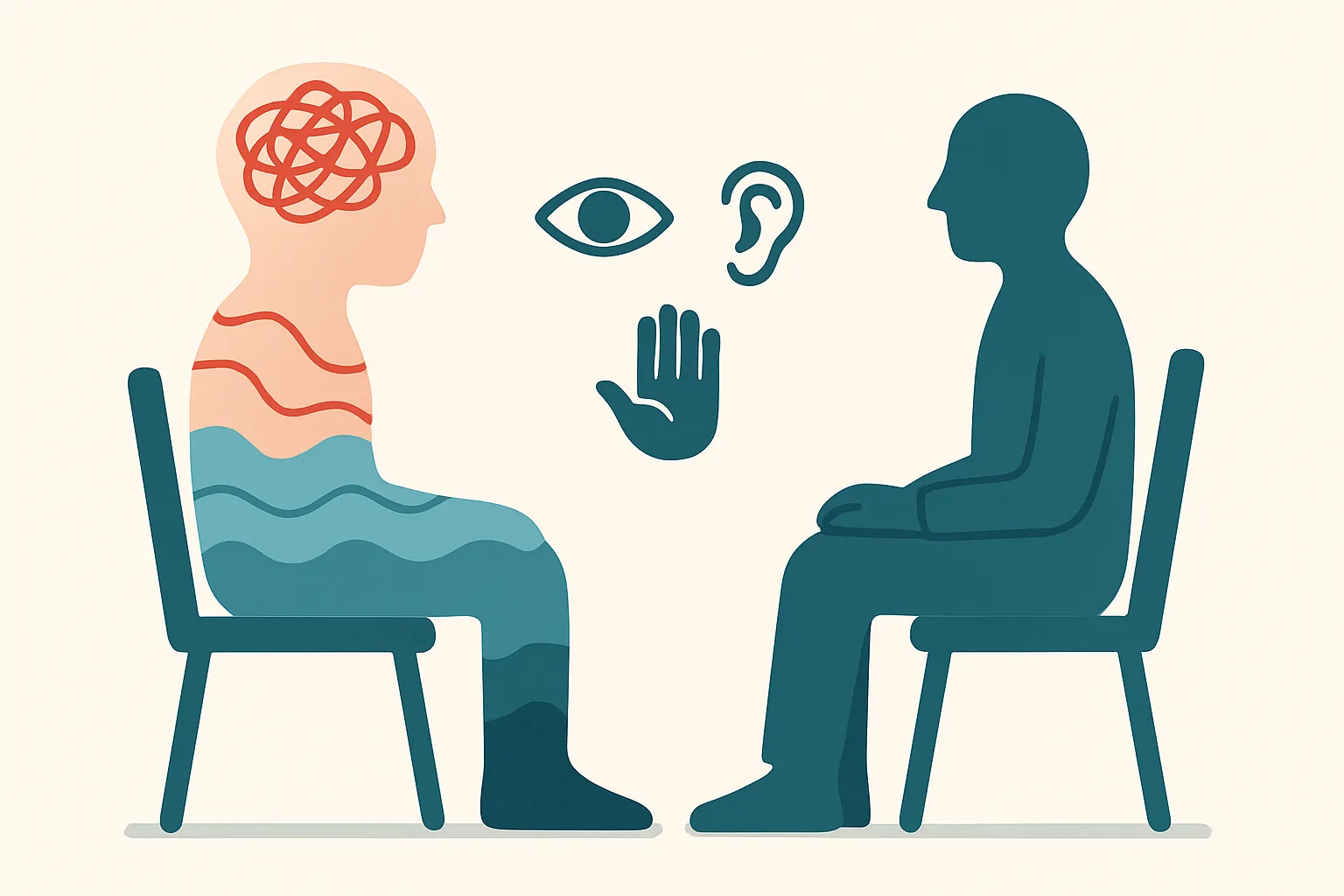
When a client moves into acute anxiety, a panic attack, or dissociation mid-session, the clinician's first goal is not insight or interpretation—it is restoring a felt sense of safety. Two evidence-aligned protocols do most of the work: the 5-4-3-2-1 sensory grounding technique, which redirects attention outward for clients who are dissociating, and box breathing, which activates the parasympathetic nervous system and vagal tone for clients who are hyperventilating or physically tense. During the intervention, set documentation aside and attend fully to the client's breath, eyes, and muscle tension; reviewing an AI-generated session transcript afterward can help you pinpoint the anxiety triggers you couldn't track in the moment.
When Your Client's Breathing Quickens: An Emergency Intervention Guide for the Clinical Room
A client sits down and is already breathing fast and shallow. Or, midway through a session, a traumatic memory is triggered and they begin to dissociate—eyes glazing, voice flattening. "I can't breathe." "I don't know where I am." In moments like these, most of us feel a flash of tension too.
This is the point where it helps to remember what the first clinical goal actually is. It is not insight. It is not interpretation. It is safety stabilization—bringing a client who is in acute anxiety, panic, or a hyperaroused state safely back to the here and now. That capacity is one of the quiet core competencies that keeps the working alliance intact under pressure.
Most clinicians know grounding and relaxation techniques in theory. Applying them with calm, fluent confidence while a client is in genuine distress is a different skill entirely. When the amygdala has effectively hijacked the system, verbal interpretation has sharp limits—the prefrontal cortex isn't available to receive it. This guide lays out concrete, immediately usable protocols for grounding and breath regulation, and then looks at how to document and analyze these moments without sacrificing your presence in the room.
The Physiology of Anxiety and Why Grounding Works
Returning to the Window of Tolerance
Clinically, grounding is more than "calming someone down." Using Dan Siegel's concept of the window of tolerance, a client in acute anxiety or panic is typically in a hyperaroused state—sympathetic nervous system in overdrive—or, conversely, in a hypoaroused state where their sense of reality goes numb and distant.
Grounding is a cognitive-behavioral intervention that engages the five senses to pull the brain's attention away from internal re-experiencing or catastrophic future-thinking and toward concrete external reality. By re-engaging the prefrontal cortex, it helps the client recover a sense of control over their own emotional state.
Breath: The Remote Control for the Autonomic Nervous System
Breathing is one of the few autonomic functions we can consciously override. Shallow, rapid chest breathing keeps sending the brain a "this is an emergency" signal, which amplifies anxiety in a self-reinforcing loop. Deliberate breathing with a lengthened exhale does the opposite: it activates the parasympathetic nervous system and stimulates the vagus nerve, producing an immediate physical relaxation response. The goal is for the client to experience, firsthand, the self-efficacy of regulating their own body—proof that they can influence what is happening inside them.
Clinical Protocols: Matching the Technique to the Presentation
In practice, the technique you reach for depends on the client's state and the intensity of the anxiety. Below are two of the most reliably effective protocols and how to deliver them.
1. The 5-4-3-2-1 Sensory Grounding Technique
This works well for clients who are dissociating or overwhelmed by intense affect. Deliver it in a calm but directive tone, walking through each step:
- Sight (5): "Can you name five things you can see right now, out loud? Describe the color or shape too." (e.g., a blue trash bin, a square clock)
- Touch (4): "Now find four things you can physically feel." (e.g., the firmness of the chair, the texture of your sleeve, your feet on the floor)
- Sound (3): "Tell me three sounds you can hear." (e.g., the air conditioner, a clock ticking, traffic outside)
- Smell (2): "Notice two things you can smell—or call to mind a scent you like."
- Taste (1): "Notice one taste in your mouth, or imagine a taste you'd want right now."
2. Box Breathing for Physiological Regulation
Box breathing is widely used for stress regulation under pressure—it's a staple in high-stakes training environments, including among U.S. Navy SEALs—and it's especially useful at the first signs of a panic attack. Breathe alongside your client and set the pace for them.
- Inhale slowly through the nose for 4 seconds.
- Hold the breath for 4 seconds.
- Exhale slowly through the mouth for 4 seconds.
- Hold empty for 4 seconds.
- Repeat 3–5 cycles, checking in on shifts in physical sensation as you go.
Choosing Between Them: A Quick Comparison
Deciding which technique to lead with depends on how the client is presenting. The table below contrasts the two.
| Grounding (5-4-3-2-1) | Breath Regulation (Box Breathing) | |
|---|---|---|
| Primary target | Dissociation, flashbacks, derealization | Hyperventilation, physical tension, early panic |
| Mechanism | Shifts attention from internal to external | Parasympathetic activation, physiological calming |
| Clinician's role | Eliciting concrete answers through questions (directive) | Breathing alongside, setting the pace (modeling) |
| When to use | "I don't know where I am," a blank or distant gaze | "My chest is tight," "I can't breathe" |
Table 1. Clinical comparison of grounding and breath-regulation techniques.
Staying Fully Present: Where Technology Helps
In a crisis, part of the clinician's job is to serve as the client's auxiliary ego—an external regulating presence. At the most acute moment, when a client is gasping and losing their grip on reality, reaching for a pen to take notes or mentally drafting your next question means breaking eye contact—and that can deepen the client's isolation right when they most need contact. While grounding is underway, your attention belongs entirely on the client's breathing, eye movements, and muscle tension—breathing with them, not writing about them.
This is exactly where AI-assisted session documentation and transcription have become genuinely useful tools. In a crisis intervention, it's far more effective to set the documentation burden down in the moment and review an accurate transcript—including paralinguistic vocal data—afterward. AI analysis can surface things you may have missed: the change in speech rate just before the breathing quickened, the length of a silence, the moment a trigger landed. Reviewing that data after the fact gives you real insight into the triggers of a client's anxiety that are nearly impossible to track live.
An Action Plan for Practitioners
- Practice it yourself. Build box breathing and grounding into your own routine until they're embodied. A clinician's steady tone of voice is itself a powerful grounding tool for the client.
- Prepare your space. Keep tactile or visual props for the 5-4-3-2-1 technique within reach—an hourglass, a textured cushion, anything that engages the senses.
- Document smartly. The more intense the session, the more reason to lean on an AI transcript: stay focused on contact during the session, and analyze the client's patterns precisely from the data afterward.
What an anxious client needs most is not eloquence. It is the unshaken presence of a clinician who stays. With fluency in a few well-chosen techniques—and the right tools to handle the record-keeping—you can offer your clients a safer, steadier here and now.
How Modalia AI Fits In
Modalia AI is a security-first AI partner built for counselors and therapists. It handles session transcription, case conceptualization support, and progress-note documentation so you can keep your full attention on the person in front of you. In crisis moments especially, it lets you set the clipboard down—then return afterward to an accurate, reviewable record of what happened and what may have triggered it.
References
- 1.
Frequently asked questions
When should I use 5-4-3-2-1 grounding versus box breathing?
Lead with 5-4-3-2-1 sensory grounding when a client is dissociating—blank gaze, derealization, "I don't know where I am"—because it redirects attention outward. Choose box breathing when the distress is primarily physiological: hyperventilation, chest tightness, or the early signs of a panic attack. The two can also be sequenced, breathing first to settle the body, then grounding to re-anchor attention.
What is the clinician's first goal when a client panics in session?
Safety stabilization—restoring a felt sense of safety and returning the client to the here and now—not insight or interpretation. When a client is hyperaroused, the prefrontal cortex isn't fully available to process verbal interpretation, so co-regulation and concrete grounding come first. Interpretive work can resume once the client is back inside their window of tolerance.
Should I take notes during a crisis intervention?
No. In acute moments, set documentation aside and stay in contact—attending to the client's breath, eyes, and muscle tension, and breathing with them. Capture the record afterward. AI-assisted transcription lets you reconstruct the session accurately later, including shifts in speech rate and silences that often mark the anxiety trigger.
What should I do if these techniques don't reduce the client's distress?
If a client remains in acute crisis, is at risk of harm, or cannot be brought back to baseline, escalate to your local or national crisis line or emergency services and follow your practice's safety protocol. Grounding and breathing are stabilization tools, not a substitute for emergency care when safety is in question.
This article was written and reviewed using Modalia AI's clinical guidelines, with professional human review before publication.
Related articles
 Case Conceptualization
Breaking the "Yes, But" Game: A Transactional Analysis Guide for Therapists
Every suggestion you offer gets met with "Yes, but..." Here's the TA structure behind that stall—and four clinical moves to break it.
7 min read Case Conceptualization
Yalom's The Gift of Therapy: Passages Every New Counselor Should Copy by Hand
Irvin Yalom's prescription for therapists who fear silence: meet your client as a "fellow traveler" and let the here-and-now become the heart of the work.
6 min read Case Conceptualization
Working With Silence in Therapy: What Client Silence Means and How to Hold It
Silence in session isn't empty space. Learn to read its clinical meaning, tell productive from defensive silence, and use it as a therapeutic tool.
6 min read