How to Write a Group Counseling Program Proposal: Session Goals and Activity Design That Actually Work
A clinician's framework for designing group counseling programs—stage-based goals, the warm-up/main/closing structure, outcome measures, and smarter documentation.
Key takeaway
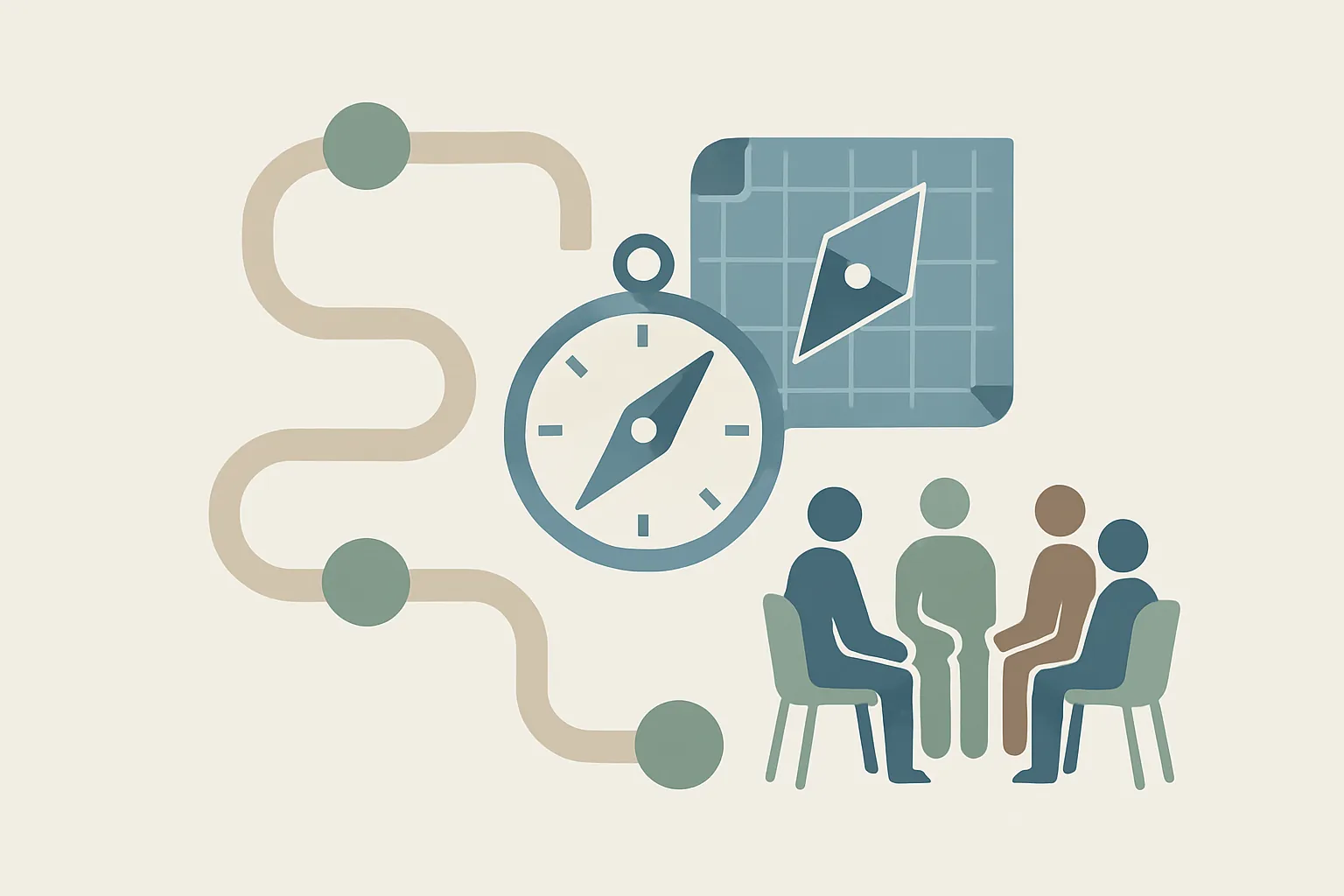
A well-written group counseling proposal is not paperwork for administrative sign-off; it is a clinical tool that serves as a compass for the facilitator and a safe container for participants. The core of strong planning is mapping clinical goals onto the group's developmental arc—early stage (building safety), transition and working stages (addressing resistance and core concerns), and termination (integrating change)—drawing on Yalom's and Tuckman's models. Each session should follow a warm-up/main activity/closing structure, with the proposal making clear that the processing and group dynamics after an activity, not the activity itself, are where therapeutic change happens. Specifying pre/post outcome measures and a documentation strategy from the planning stage raises both the rigor and the demonstrated effectiveness of the program.
When the Blank Proposal Template Feels Impossible
If you've ever been asked to "submit a proposal for next quarter's group program" and then sat staring at an empty document, you're in good company. Individual therapy lets us follow the client's lead and improvise in the moment. Group work is different. Dynamics can only unfold safely inside a clear, predictable structure—and building eight, ten, or twelve sessions into a logical arc, with a meaningful activity anchoring each one, is genuinely hard, even for seasoned clinicians.
The doubts pile up. Will this actually help these clients? Is this exercise too gimmicky? Can we realistically do it within the budget and time we have?
Here's the reframe that changes everything: a strong proposal is not a form you fill out to get administrative approval. It's a clinical instrument—a compass for you as the facilitator, and a container that keeps participants safe enough to do real work. What follows is a clinically grounded approach to designing group programs that move clients toward change, turning a vague idea into a structured therapeutic space.
1. Build the Skeleton First: Goals That Follow the Group's Developmental Arc
The first move in any group proposal is to design the arc, not the activities. Yalom's work on group psychotherapy and Tuckman's stage model of small-group development both point to the same truth: groups change over time, and your clinical goals have to change with them.
The most common planning mistake is asking for deep self-disclosure too early, or filling the working stage with light, low-risk exercises that never reach the core material. A successful program assigns each developmental stage a goal that fits where the group actually is.
Early stage (sessions 1–2): engagement and psychological safety. The work here is rapport and structure. Participants arrive anxious and guarded—that's expected and appropriate. Your goals should center on establishing a psychological safe zone and co-creating group norms. Introductions, choosing a name or handle for oneself in the group, and setting ground rules together are essentials, not warm-up filler.
Transition and working stages (session 3 to mid-program): working with resistance and approaching core concerns. As members grow familiar with one another, conflict surfaces and defenses come into the room. This is precisely when therapeutic intervention should be most active. The proposal should build in space for specific, concrete feedback between members and for cognitive and emotional challenge aimed at the work itself.
Termination stage (later sessions): integrating change and rehearsing goodbye. This is the generalization phase—carrying what was learned in the group back into real life. Hold the bittersweetness and the sense of accomplishment together, and design activities that help members make concrete plans for what comes next.
The table below contrasts vague goals with clinically informed ones, and shows how activity design follows from the goal. Use it to sharpen the detail in your own proposals.
| Stage | Vague planning (avoid) | Clinically informed planning (aim for) | Suggested activities |
|---|---|---|---|
| Early (exploration) | "Time to get to know each other" | Reduce group anxiety and evoke a sense of universality | Map your anxiety on a graph; "find what we share" bingo |
| Middle (working) | "Talk things through together" | Build insight into interpersonal patterns; facilitate emotional catharsis | Role-play; empty-chair technique; structured feedback exchange |
| Termination (integration) | "Share closing thoughts and wrap up" | Internalize a changed self-image; address unfinished business | Member-written certificates of completion; letter to your future self |
Table 1. Stage-based goals and corresponding activity design for group counseling.
2. Inside Each Session: The Warm-Up / Main / Closing Ratio
Once the skeleton is in place, the question becomes how to fill each session. A 90- to 120-minute group needs a timetable as deliberate as a lesson plan. Writing "art activity" tells the reader nothing; specifying the therapeutic intent and the time allotted signals real expertise.
Warm-up (10–15 minutes). Open with a check-in on life since the last session and spark interest in today's theme. A light movement exercise or brief grounding practice helps members release tension and bring their attention to the here and now.
Main activity (60–80 minutes). Run the core exercise you planned—but remember that the activity is never the point. It is only a vehicle. The therapeutic substance lives in the sharing and the group dynamics that follow. Strong proposals include the facilitator's own list of processing questions: What will I ask after this exercise to draw out members' insight? That list is often the most clinically revealing part of the whole document.
Closing (10–15 minutes). Invite members to distill the session into a single word or sentence, and preview the next meeting. Never send participants home emotionally activated—build in a cool-down that supports affect regulation before they leave the room.
3. Raising the Bar: Evaluation and Documentation
A strong proposal considers not only feasibility but demonstrated effectiveness. Program directors and funders will eventually ask the only question that matters to them: How well did this program work? Answer it from the planning stage by naming your pre/post outcome measures up front. For a depression-focused group, a well-validated instrument like the Beck Depression Inventory (BDI) fits; for an interpersonal-process group, a measure such as the Inventory of Interpersonal Problems (IIP-32) or the Structural Analysis of Social Behavior (SASB) lets you capture relational change. Specifying these in the proposal makes your clinical rigor visible.
Then there's the perennial headache of group work: documentation. Unlike individual sessions, group counseling has several people speaking at once and dynamics that move fast. No facilitator can hold and record all of it. When it's time for supervision or a case study, reconstructing who said what, and when, drains enormous energy.
Build a documentation strategy into the proposal itself:
- Use a co-leader. While the primary facilitator drives the dynamics, the co-leader focuses on observation and note-taking.
- Adopt a structured session report. A checklist covering each member's responses, key issues raised, and adjustments for the next session keeps records consistent and fast to complete.
- Bring in current tools. Name the technology you'll use to ease the burden of recording and transcription, so the plan is concrete rather than aspirational.
Closing: Facilitate the Group—Let Technology Carry the Record
Designing a group program isn't scheduling. It's an act of creation—building a small world in which people can grow. With goals matched to the developmental arc, a solid warm-up/main/closing structure, and outcome measures that can evidence change, your proposal won't just clear approval; it will hold up in the room.
One last suggestion, on the accuracy of the record. Capturing a complete verbatim transcript of five to eight people talking over and around one another is, realistically, beyond any single facilitator working alone. And the cost of trying is steep: every minute spent scribbling is a minute you're not reading a member's micro-expression or tracking the here-and-now interaction that just shifted the whole group.
This is where AI-assisted documentation earns its place. Modern transcription tools with speaker diarization can record who said what with far more fidelity than manual notes, and surface key themes automatically—freeing you to stay fully present to the group's dynamics and intervene where it counts. Modalia AI is built for exactly this: a security-first partner for counselors that handles transcription, case conceptualization support, and documentation so the clinical attention stays with the people in the room. Consider listing "AI-assisted documentation for precise supervision material and record-keeping" as one line in your next operational plan. May your planning plant warm seeds of change for the clients you serve.
References
- 1.
- 2.
- 3.
- 4.
Frequently asked questions
What should a group counseling program proposal actually include?
At minimum: clinical goals mapped to each developmental stage of the group, a session-by-session timetable using a warm-up/main activity/closing structure, the therapeutic intent and processing questions behind each activity, named pre/post outcome measures, and a documentation strategy. A strong proposal reads as a clinical instrument, not an administrative form.
How do I set goals for each session?
Follow the group's developmental arc rather than the calendar. Early sessions focus on engagement, psychological safety, and norms; transition and working sessions address resistance and core concerns through feedback and cognitive-emotional challenge; termination sessions integrate change, address unfinished business, and rehearse goodbye. Match each goal to where the group actually is, not where you wish it were.
Which outcome measures should I specify in the proposal?
Choose validated instruments that fit the group's focus and name them at the planning stage. For a depression-focused group, the Beck Depression Inventory (BDI) is a common choice; for an interpersonal-process group, the Inventory of Interpersonal Problems (IIP-32) or the Structural Analysis of Social Behavior (SASB) can capture relational change. Pre/post administration lets you demonstrate effectiveness to stakeholders.
How can I keep accurate records during fast-moving group sessions?
Manual verbatim notes for five to eight people talking at once are nearly impossible and pull your attention away from the group. Use a co-leader dedicated to observation, a structured session-report checklist, and AI-assisted transcription with speaker diarization so the record stays accurate while you stay present to the dynamics.
This article was written and reviewed using Modalia AI's clinical guidelines, with professional human review before publication.
Related articles
 Clinical Skills
How to Write Better Supervision Questions: Getting What You Actually Need from Your Supervisor
Stuck on what to ask in supervision? Use these structured question strategies to turn vague check-ins into focused clinical insight.
7 min read Clinical Skills
From "The Client Seems Depressed" to a Clinical Hypothesis: How Word Choice Elevates Your Case Reports
Turn vague observations into precise clinical hypotheses. A practical guide to terminology and sentence formulas that make your case reports read like expert work.
7 min read Clinical Skills
The Wounded Healer Trap: Why "I Want to Heal Myself" Sinks Your Counseling Grad School SOP
Why admissions faculty flinch at "I want to heal my own wounds"—and how to transform personal pain into a research-grade statement of purpose that gets you in.
6 min read