Reading Ego Strength in the HTP Tree Drawing: A Clinical Guide
How to interpret the trunk, roots, and crown of an HTP tree drawing to infer a client's ego strength—and how to do it safely.
Key takeaway
In the HTP (House-Tree-Person) projective test, the tree drawing offers a window into a client's ego strength—their capacity to tolerate stress, regulate impulses, and recover emotionally. Clinicians read the trunk as vitality and ego force, the roots as reality grounding and contact with unconscious drives, and the crown as engagement with the outside world; line quality and pressure add a layer about energy and tension. Reliable interpretation never rests on single-symbol decoding: it integrates the drawing's structure with the post-drawing inquiry, cross-validates against objective measures like the MMPI-2 and TCI, and stays alert to the clinician's own countertransference.
Why Ego Strength Is the First Thing We Want to Know 🌳
One of the first things most clinicians try to gauge with a new client is ego strength—the inner capacity to withstand current stress and psychological pressure. That single judgment shapes almost everything downstream: how fast we can pace interventions, whether confrontation is safe yet, and how much we need to shore up before we challenge.
"Is this client solid enough for me to confront the avoidance directly?" "Is this depression at a level where pushing could risk decompensation rather than insight?" These aren't abstract questions—they're the weight we carry into every early session.
This is where projective testing earns its place, and within the HTP (House-Tree-Person), the tree drawing is an unusually rich instrument. Where the house tends to project the family environment and the felt safety of one's relational base, and the person tends to surface the conscious self-image and defenses operating in reality, the tree reaches deeper. It tends to project the client's vitality, the core structure of personality, and ego strength at a more unconscious level.
There's a reason the tree carries this much weight. A tree is a living thing that puts down roots and keeps growing through changing conditions—a natural analog for human psychological development. So the lines, size, proportions, and overall form a client produces, often without quite knowing why, become a meaningful starting point for setting treatment goals in complex cases.
The Tree's Structure and What It Maps Onto 🔍
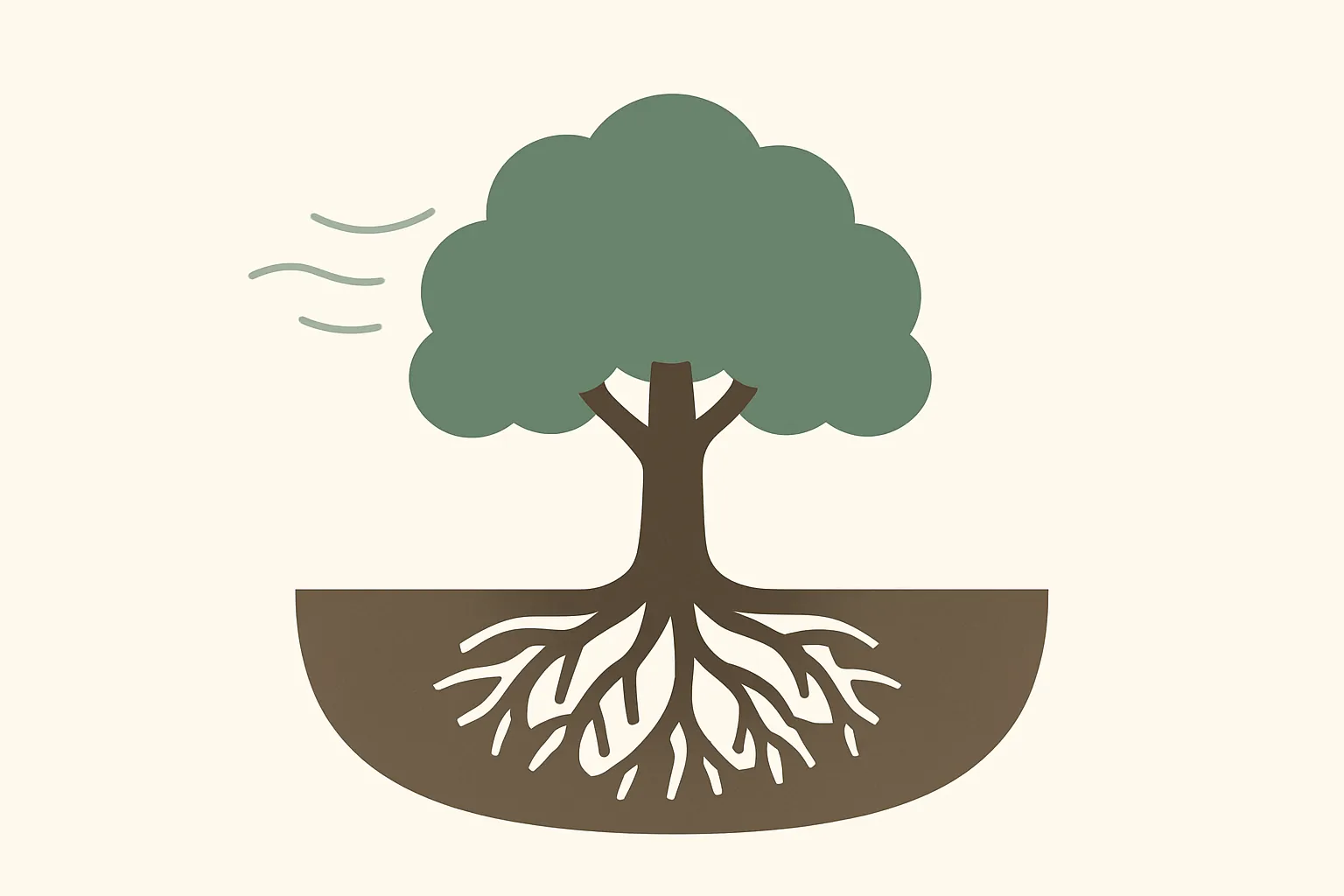
From a psychodynamic angle, ego strength bundles together three things: reality testing, impulse control, and emotional resilience. In the HTP, these tend to show up symbolically across the tree's three main structures—the roots, the trunk, and the crown (branches and foliage).
Broadly: the trunk represents the strength and life force of the ego; the roots represent grounding in reality and contact with unconscious drives; the branches and foliage represent engagement with the environment and the capacity to seek satisfaction from the outside world. Breaking a drawing down structurally lets you locate where a client's current psychological deficit sits, rather than forming a vague global impression.
The table below organizes the most clinically useful features and the directions they tend to point.
| Feature | Healthier ego strength (stable presentation) | More vulnerable ego strength (constricted, anxious) |
|---|---|---|
| Trunk | Adequate width, upright form, sits stably on the ground line, smooth contour | Very thin or broken outline, prominent wounds or knotholes, sharply bent as if wind-blown |
| Roots | Extend appropriately below the ground line, giving a sense of support | No ground line or roots floating in air (weak reality contact); razor-sharp roots (aggression) |
| Crown / branches | Balanced in scale with the trunk, reaching upward, rounded or full | Bare twigs with no foliage (depression, depleted energy); a crown that dwarfs the trunk (retreat into fantasy) |
| Pressure & line quality | Even, fluid pressure; few erasures; natural strokes | Faint or broken lines (low energy, apathy); pressure so heavy it nearly tears the page (anger, acute tension) |
The form a client draws really is a mirror of their inner world. But as clinicians we have to resist the pull of single-symbol decoding. "The branches are pointed, therefore the client is aggressive" is exactly the kind of mechanical one-to-one reading that hollows out what makes projective work valuable—and, ethically, it risks premature labeling. The skill lies in integrating the structural features of the drawing with the client's nonverbal manner and their own verbal narrative.
Putting It to Work in Session 💡
So how do you fold this projected data about ego strength into the actual work of therapy—not just a report, but the relationship and the client's own insight? A few strategies you can use immediately:
1. Use the post-drawing inquiry to open up narrative and meaning
The real value of the HTP lives in the inquiry phase that follows the drawing. Try questions like: "Where does this tree live?" "What does this tree need most right now?" "If a strong wind came, what would happen to it?"
Through the safe distance of the image, clients tend to put words to vulnerable, projected feelings without the resistance a direct question would trigger. The story they assign to the tree is itself excellent clinical data about how flexible—or how brittle—their ego strength currently is.
2. Systematically cross-validate against objective measures (MMPI-2, TCI)
Never let a projective drawing alone settle a question of pathology or ego strength. Take the instability you see in the tree—floating roots, a thin or broken trunk—and cross-check it against the MMPI-2 Ego Strength scale (Es) and Negative Treatment Indicators (TRT), or the Self-Directedness (SD) dimension of the TCI.
Think of it as two complementary lenses: the projective test surfaces the qualitative, unconscious appeal, while objective testing confirms the quantitative, present-state symptom picture. Combining them is what makes your formulation defensible.
3. Intervene metaphorically to strengthen the alliance
Early on—when defenses run high or rapport is fragile—the tree is a gift of a metaphor. Rather than naming a client's vulnerability directly, you can support it through the image: "The branches you drew look bare, like they're getting through a hard winter. But those roots hidden in the ground seem to be holding the whole tree very firmly in place."
Language like this affirms the client's ego strength (the roots) while staying empathic, and it helps them experience you not as a threat but as someone who can safely hold what they bring.
4. Check your own transference and use peer supervision
Projective interpretation is fertile ground for countertransference—your own projections leaking into the read. If a particular client's tree leaves you with an unusually heavy sense of despair, pause and sort out whether that feeling is genuinely theirs or whether something in your own unconscious has been activated. Build regular peer supervision into your routine to recalibrate your perspective and pressure-test the validity of your interpretations.
Protecting the Data Without Losing the Client 🚀
Inferring ego strength from a tree drawing is, finally, both art and science: morphological analysis, the client's verbal narrative, and your own clinical intuition converging on a hypothesis. The feelings that pour out around the image, and the fine verbal nuances during the inquiry phase, are clinical data you can't afford to miss.
And here's the everyday dilemma. While you're watching the drawing, tracking nonverbal cues, and trying to write down everything the client says, you end up sacrificing the deep eye contact that the moment actually calls for. This is where a secure, AI-assisted transcription and note tool—Modalia AI, a security-first AI partner built for counselors (transcription, case conceptualization, documentation)—can resolve the trade-off between your ethical duty to keep accurate records and the practical need to stay present. As the system captures the conversation and the client's key data into text, you stay fully with the tree, the expressions behind it, the shifts in tone, and the meaning of the silences. The result is more accurate records, lower administrative fatigue, and more room for clinical insight.
Our ultimate goal is to help each client's unique tree bend without breaking through whatever weather comes. Two action items you can start with this week: first, pull an old HTP record from a case that once stalled and re-read it through the lens of ego strength. Second, seriously evaluate adopting secure voice-capture technology so the inquiry phase no longer leaks information you'll wish you'd kept. Small changes in workflow can widen how you see your clients—and raise the quality of the work itself.
References
- 1.
- 2.
- 3.
Frequently asked questions
What does the tree drawing in the HTP reveal that the house and person don't?
While the house tends to project the family environment and relational safety, and the person reflects the conscious self-image and defenses, the tree reaches a deeper layer—projecting vitality, the core structure of personality, and ego strength at a more unconscious level. That makes it especially useful for gauging a client's capacity to withstand stress.
Which features of the tree point to stronger ego strength?
Look for an adequately thick, upright trunk that sits stably on a ground line; roots that extend below ground and convey support; a crown balanced in scale with the trunk and reaching upward; and even, fluid line pressure with few erasures. Floating roots, a thin or broken trunk, bare branches, or page-tearing pressure point toward more vulnerable ego strength.
Can I diagnose or determine ego strength from the tree drawing alone?
No. Single-symbol decoding is unreliable and risks premature labeling. Treat the drawing as one source of hypotheses, then integrate it with the post-drawing inquiry, the client's nonverbal manner, and objective measures such as the MMPI-2 Ego Strength (Es) scale or the TCI Self-Directedness dimension before drawing conclusions.
How does the post-drawing inquiry add clinical value?
The inquiry phase—asking where the tree lives, what it needs, or how it would weather a storm—lets clients put words to vulnerable, projected feelings through the safe distance of the image. The narrative they construct is itself data about how flexible or brittle their current ego strength is.
This article was written and reviewed using Modalia AI's clinical guidelines, with professional human review before publication.
Related articles
 Case Conceptualization
Breaking the "Yes, But" Game: A Transactional Analysis Guide for Therapists
Every suggestion you offer gets met with "Yes, but..." Here's the TA structure behind that stall—and four clinical moves to break it.
7 min read Case Conceptualization
Yalom's The Gift of Therapy: Passages Every New Counselor Should Copy by Hand
Irvin Yalom's prescription for therapists who fear silence: meet your client as a "fellow traveler" and let the here-and-now become the heart of the work.
6 min read Case Conceptualization
Working With Silence in Therapy: What Client Silence Means and How to Hold It
Silence in session isn't empty space. Learn to read its clinical meaning, tell productive from defensive silence, and use it as a therapeutic tool.
6 min read