Do You Really Need a Separate Art or Play Therapy Credential? Integrating Expressive Tools Into Your Core Practice
When talk therapy hits a wall, you don't always need a new credential. Here's how to integrate art and play methods into your core practice—ethically and effectively.
Key takeaway
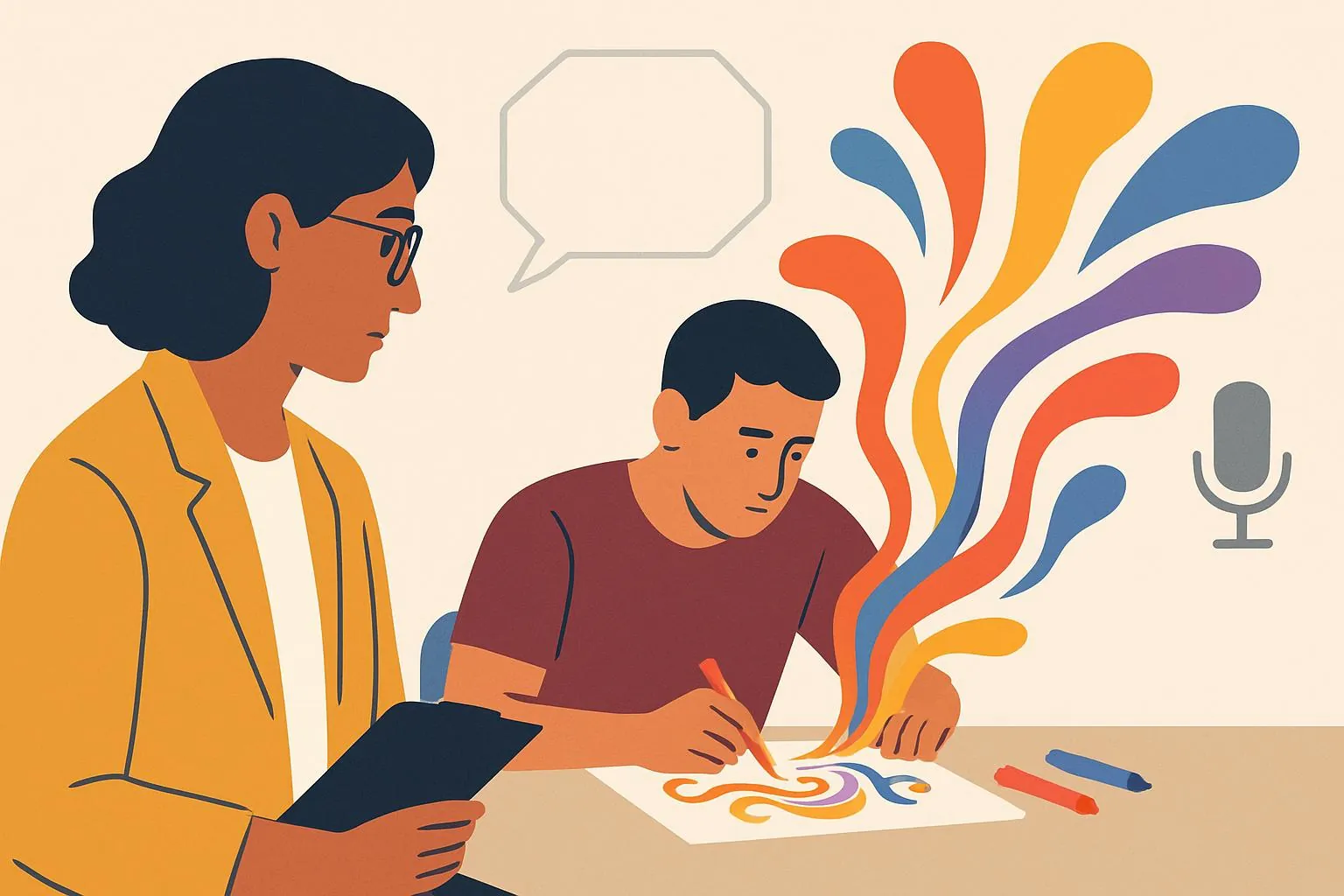
Verbal psychotherapy can reach its limits with children or clients who struggle to put feelings into words, and art and play offer a complementary channel that bypasses the mind's censorship. Whether you need a separate credential depends on your primary caseload: clinicians who mainly serve adolescents and adults through talk therapy often gain more from short workshops and targeted supervision than from a full certification track. What matters most is not collecting credentials but the clinical judgment to know whether a given tool is the right fit for this client, right now.
When Words Aren't Enough
Every clinician knows the moment. A client sits across from you, clearly carrying something heavy, and the words simply won't come. Maybe they struggle to name what they feel. Maybe trauma has built defenses so sturdy that language itself has become a way to avoid rather than approach. In those silences, even seasoned therapists can feel a quiet helplessness.
It's often here that the question surfaces: "Should I go get certified in art therapy or play therapy? Is my current approach simply not enough?"
That question rarely comes from a desire to pad a résumé. It comes from an ethical pull—the wish to offer clients a richer path to healing—and from a genuine drive to grow as a professional. But time and money are real constraints, and "get another credential" isn't automatically the right answer. This article looks at how expressive tools (art, play) can be integrated into a verbal-therapy practice, what the clinical evidence actually supports, and how to make a strategic decision that fits your caseload.
The Limits of Talk Therapy—and Why Expressive Media Matter
Traditional psychotherapy works primarily through language, using conversation to cultivate cognitive insight and emotional processing. But for children, adolescents, and adults with alexithymia—difficulty identifying and describing emotions—language can become a barrier rather than a bridge. For these clients, art and play function as a powerful "third language," one that sidesteps the mind's habitual censorship and lets material surface that words can't easily reach.
The clinical literature on integrative approaches consistently points in the same direction: when expressive methods are woven into treatment, rapport tends to build faster and client resistance tends to soften. Crucially, though, that benefit does not require a second master's degree or a specialist title. The two things that actually drive results are tool proficiency and a solid grasp of therapeutic context—knowing what the tool does, and when its use serves the work.
The table below maps where verbal and expressive approaches complement each other.
| Verbal Therapy | Art / Play-Based Work | Integrative Synergy | |
|---|---|---|---|
| Primary channel | Cognitive processing, narrative, dialogue | Sensory experience, symbolic expression, projection | Integration of cognition and the senses (a whole-brain approach) |
| Strengths | Insight, problem-solving, reshaping thought patterns | Bypassing defenses, emotional release, catharsis | Making insight visible and change experiential |
| Limitations | Depends on verbal ability; invites intellectualization | Interpretive ambiguity; harder to consolidate in words | Therapeutic focus can scatter when tools are used clumsily |
Comparing the clinical characteristics of verbal therapy and expressive media—and where they reinforce one another.
Credential vs. Integration: A Realistic Decision Framework
So do you have to pursue a separate credential? The honest answer is: it depends on your caseload and your goals.
If your primary clients are preschool-age children, or people with developmental disabilities, then formal play therapy or art therapy training—with its supervised practicum hours—is essential, not optional. But if your core clients are adolescents and adults, and your main modality is talk therapy with expressive media in a supporting role, the strategy looks different.
1. Know Your Scope of Competence
The single most important rule when you use expressive media without a specialist credential: don't present yourself as an art or play therapist. Frame it accurately—"psychotherapy that incorporates art-based methods." Stay away from formal projective assessment or interpretation of drawings, and keep the focus on using the medium to help clients visualize an emotion and open a conversation around it. That distinction is what keeps you on solid ethical ground.
2. Match the Tool to Your Theory
Choose media that fit the model you already work in:
- CBT + art: Instead of a written thought record, try "drawing the feeling," or diagramming a cognitive distortion visually to support restructuring.
- Gestalt / humanistic + play or art: To activate the here-and-now and bring the contact boundary to life, introduce working with clay or role-play.
3. Get the Most From Workshops and Supervision
Instead of a certification track that can cost thousands of dollars and span years, build the specific skills you need through short, intensive workshops offered by recognized professional bodies—in the US, organizations affiliated with the ACA; in the UK, BACP-aligned providers; across Europe and beyond, bodies such as EACAT and similar associations. Then bring cases where you've used those methods to a clinician experienced in expressive therapies for targeted supervision. For most practitioners, that combination sharpens clinical skill far more efficiently than a full credential.
Practical Hurdles—and How to Clear Them
Once you decide to bring expressive media into the room, a few real-world obstacles tend to appear: the hassle of preparing materials, managing the clock, and above all, the complexity of documentation.
1. Capturing Non-Verbal Interaction
With talk therapy, you can largely record what was said. Expressive work is different—the client's facial expression as they draw, the pressure of each brushstroke, the sound of a toy being thrown all carry clinical meaning. These non-verbal cues are often the heart of the session. Observing them while simultaneously taking notes or building a transcript is close to impossible, and the result is either diminished session quality or missed clinical moments.
2. Structuring the Session
It's easy to get absorbed in the creative work and blow past the 50-minute mark. You need timekeeping skill: a clear structure separating the making phase (roughly 20–30 minutes) from the sharing phase (15–20 minutes). A simple timer helps, and agreeing on how time will be divided before the work begins is essential.
3. Managing Materials and Space
You don't need a fully stocked studio. Build a minimal kit: a few sheets of paper, a box of crayons, some clay, and a handful of figurines are enough for meaningful projective work. What matters isn't the range of supplies—it's how comfortably and confidently you handle the ones you have.
Conclusion: Be Led by Clinical Judgment, Not by the Tool
In the end, the question isn't whether you hold an art or play therapy credential. It's whether you have the clinical insight to ask, "Is this tool the most appropriate thing for this client's problem, right now?" Rather than collecting certifications like badges, the wiser strategy is to integrate expressive media flexibly into the core approach you already practice—adding depth without diluting focus.
Expressive work in particular demands that your eyes and ears stay fully on the client's behavior and their creation. The instant you have to ask "sorry, what was that?" or drop your gaze to write, the thread of rapport frays.
This is exactly why a growing number of clinicians are turning to AI-assisted session documentation and transcription. When an AI tool accurately captures the dialogue and context of a session as text, you're freed to give your full attention to the clinical data that actually matters in expressive work—the slight tremor in a client's hand as they draw, a subtle sigh during play, the look in their eyes as they describe what they made. Modalia AI is built for precisely this: a security-first partner that handles transcription, case conceptualization support, and progress notes, so your attention can stay where it belongs—on the client.
Action items you can try this week:
- 🔍 Audit your caseload. Estimate the share of your current clients for whom talk alone keeps hitting a wall.
- 🎨 Start small. Before enrolling in any major certification, take a single short workshop on drawing-based methods or expressive-media facilitation.
- 🎙️ Document smarter. So you can stay focused on observation during expressive activities, trial an AI recording-and-documentation tool that organizes the session for you. It may be the most reliable investment you make in the quality of this work.
Frequently asked questions
Do I need a formal art or play therapy credential to use these methods?
It depends on your caseload. If you primarily serve preschool-age children or clients with developmental disabilities, formal training with supervised practicum hours is essential. If you mainly work with adolescents and adults through talk therapy and want expressive media in a supporting role, short workshops plus targeted supervision are usually more efficient than a full certification track.
How do I use expressive media ethically without a specialist credential?
Don't present yourself as an art or play therapist. Frame your work as psychotherapy that incorporates art-based methods, avoid formal projective assessment or interpretation of drawings, and focus on using the medium to help clients visualize emotion and open conversation. Staying within your scope of competence is what keeps the practice ethically sound.
Which expressive methods fit my theoretical orientation?
Match the medium to your model. In CBT, try drawing a feeling or visually diagramming a cognitive distortion instead of a written thought record. In Gestalt or humanistic work, introduce clay or role-play to activate the here-and-now and bring the contact boundary to life.
Why is documentation harder in expressive sessions?
Expressive work depends on non-verbal cues—facial expression, brushstroke pressure, sounds during play—that you can't capture by taking notes without breaking eye contact and rapport. AI-assisted transcription handles the verbal record so you can keep your full attention on observing the client and their creation.
This article was written and reviewed using Modalia AI's clinical guidelines, with professional human review before publication.
Related articles
 Case Conceptualization
Breaking the "Yes, But" Game: A Transactional Analysis Guide for Therapists
Every suggestion you offer gets met with "Yes, but..." Here's the TA structure behind that stall—and four clinical moves to break it.
7 min read Case Conceptualization
Yalom's The Gift of Therapy: Passages Every New Counselor Should Copy by Hand
Irvin Yalom's prescription for therapists who fear silence: meet your client as a "fellow traveler" and let the here-and-now become the heart of the work.
6 min read Case Conceptualization
Working With Silence in Therapy: What Client Silence Means and How to Hold It
Silence in session isn't empty space. Learn to read its clinical meaning, tell productive from defensive silence, and use it as a therapeutic tool.
6 min read