Interoceptive Exposure for Panic Disorder: Two In-Session Drills to Befriend Feared Body Sensations
How interoceptive exposure breaks the fear of physical panic symptoms—plus two tool-free techniques (straw breathing and running in place) you can run in session today.
Key takeaway
Clients with panic disorder often understand intellectually that a panic attack won't kill them, yet plunge back into terror the moment physical symptoms appear. Interoceptive exposure bridges that gap by deliberately reproducing feared sensations in a safe setting so the client learns, in the body, that no catastrophe follows. Two techniques require no equipment and can be run in any office: straw breathing (targeting suffocation fear) and running in place (targeting cardiac fear). Both work best when paired with SUDS tracking, clinician modeling, and structured debriefing, which together build the client's tolerance for uncomfortable bodily sensations.
"I thought my heart was going to explode—I nearly died." How long do we let panic clients keep avoiding their own bodies?
If you work with panic disorder, you know the wall. You've done careful cognitive work in CBT. The client can recite it back to you: a panic attack is not a heart attack, it isn't dangerous, it passes. And then the next wave of symptoms arrives, and they're right back in raw terror. We feel the compassion and the clinical puzzle at the same time: why won't the cognitive shift travel down into the body?
The research on panic treatment is clear that the active ingredient isn't relaxation and it isn't avoidance—it's deliberate interoceptive exposure: intentionally bringing on the very sensations the client dreads (a pounding heart, breathlessness, dizziness) inside the safety of your office, and letting them discover, viscerally, that the feared catastrophe (a heart attack, suffocation, "going crazy") never arrives. Saying to a client "let's make it hard to breathe right now" takes both clinical nerve and a clear ethical frame. This piece walks through two of the most practical, equipment-free ways to do it well: straw breathing and running in place.
Why interoceptive exposure means leaning into discomfort on purpose
The core mechanism in panic disorder is catastrophic misinterpretation. A racing heart that a non-anxious person reads as "I just climbed the stairs" gets read here as "this is how the heart attack starts." So the goal of treatment isn't to eliminate the sensations—it's to teach the nervous system that the sensation can be present and still not be dangerous. Three things have to happen for that learning to stick.
1. Dropping safety behaviors
When panic hits, clients reach for small safety behaviors: sipping water, lying down, checking for a particular medication, gripping a chair. These lower anxiety in the moment but quietly reinforce the belief "I survived because I did that." That belief is exactly what blocks recovery. Interoceptive exposure builds the capacity to ride out the sensations without the safety behavior.
2. Expectancy violation
The client holds a prediction—"if my heart races hard for a full minute, I'll pass out." Exposure is the experiment that disconfirms it. Each time they drive the heart rate up and don't faint, the amygdala has less reason to keep sounding the alarm. Designing the exposure as a falsifiable test ("what exactly do you predict will happen?") is what makes the violation land. This inhibitory-learning framing—maximizing the gap between what's feared and what occurs—is the modern engine of exposure work.
3. Building tolerance
Nobody is asked to enjoy these sensations. The aim is to make them tolerable—something the client can have and outlast. That tolerance is one of the strongest protective factors against relapse after you terminate.
Clinical guide: straw breathing and running in place
Of the many interoceptive provocations available, these two need no special equipment, fit in a small office, and target the two most common symptom clusters. Match the technique to the client's primary complaint.
| Straw Breathing | Running in Place | |
|---|---|---|
| Primary target symptom | Suffocation feelings, breathlessness, chest tightness | Pounding heart (tachycardia), heat/flushing, chest pain |
| Sensations evoked | "Can't get enough air," lightheadedness | Spiking heart rate, sweating, muscle tension, breathlessness |
| Catastrophic thoughts addressed | "I'll suffocate and die." / "I'll faint from lack of oxygen." | "I'm having a heart attack." / "A blood vessel is going to burst." |
| How to run it | Pinch the nose closed and breathe only through a thin coffee-stirrer straw (or a narrow cocktail straw) for 1–2 minutes | High knees / jogging in place at full effort for ~1 minute |
| Cautions | Clients who hyperventilate easily can spike fast—agree on a stop signal in advance | Screen for hypertension, cardiac, or other conditions; get physician clearance where indicated |
Table 1. Two core interoceptive exposure techniques for panic disorder.
1. Straw breathing: facing the fear of "I can't breathe"
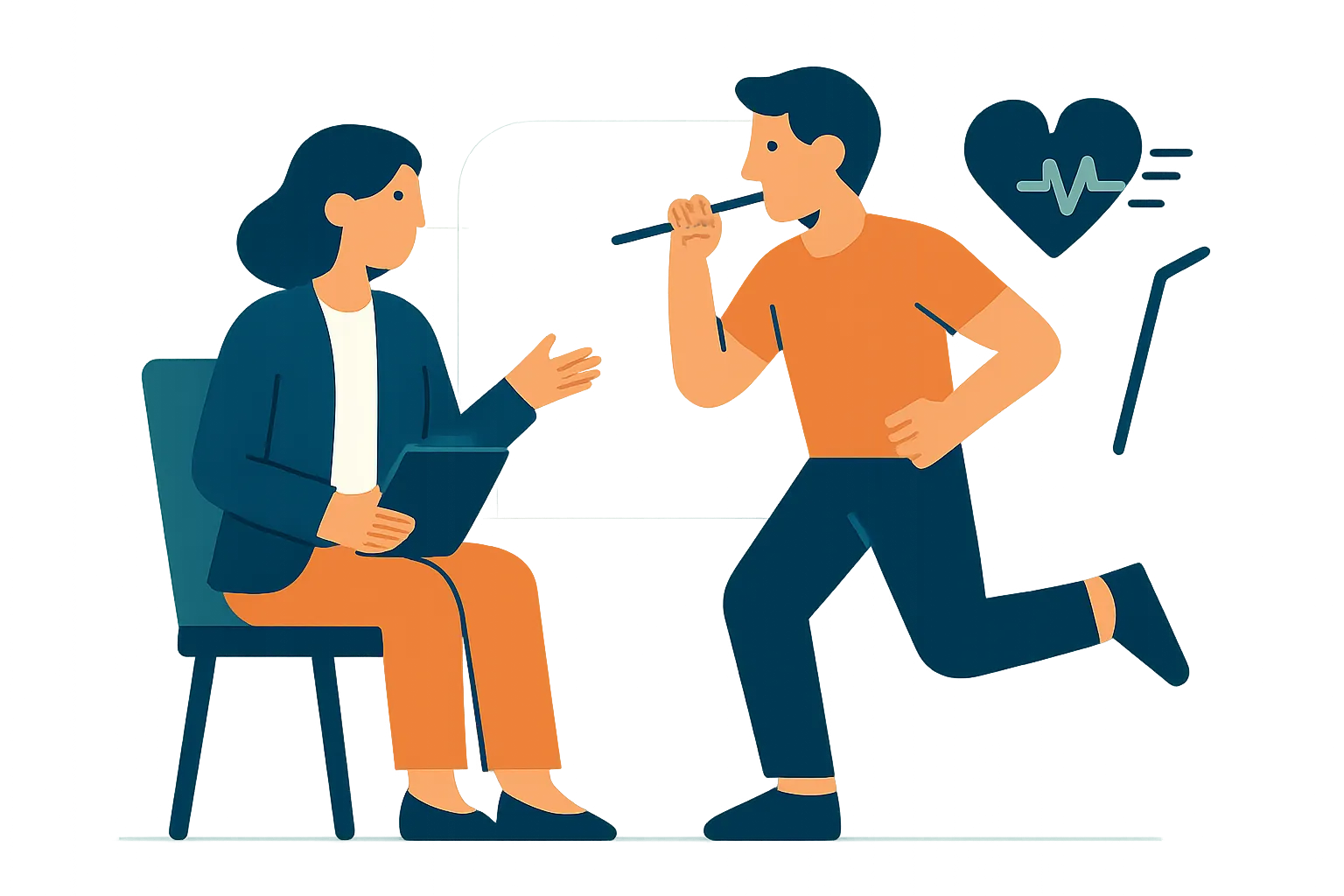
Straw breathing manufactures the breathlessness so many panic clients dread most. Where diaphragmatic breathing aims at calm, this drill aims at discomfort on purpose. Use a thin straw—a coffee stirrer or a narrow cocktail straw works well—pinch the nostrils shut, and have the client breathe only through the straw. The "I'm not getting enough air" fear shows up quickly. Your job is to encourage them not to spit out the straw or release their nose, and to ride out the agreed interval (usually one to two minutes). The moment it ends, debrief the prediction: "Did you actually suffocate? What was the worst thing that actually happened?"
2. Running in place: making friends with a racing heart
This one fits the client who reads a fast heartbeat as the opening move of a heart attack. It works in the tightest office. Add high knees to push the heart rate to its peak in a short burst. The key detail: don't let them sit down and recover immediately. Have them stay standing and fully feel the pounding heart. That's what reteaches the body that "exertion makes the heart speed up, and that is a healthy, normal response."
Your role: pacer and safe observer, not just instructor
Running these drills well, you're less a director than a pacesetter and a safe witness. Done carelessly, an exposure can be retraumatizing, so the setup matters as much as the drill.
- Track SUDS continuously. Take a Subjective Units of Distress reading (0–100) before, during, and after. The therapeutic moment is the client watching their own anxiety peak and then come down on its own with the passage of time—seeing that curve is the point.
- Model it. When a client hesitates, picking up the straw yourself or jogging in place alongside them gives real courage. "I'm doing it with you—this is okay" is a surprisingly powerful alliance move.
- Debrief every time. The physical provocation isn't the end of the treatment. Afterward, ask "Did the disaster you predicted happen?" and explicitly compare their prediction to the actual outcome. That comparison is where the new learning consolidates.
Staying present when the room gets intense
Interoceptive exposure is one of the most charged moments in the room. The client is gasping and voicing their fear; you're tracking SUDS and watching for the micro safety behaviors (a clenched fist, eyes squeezed shut). If you're heads-down scribbling notes through all of that, the client can feel abandoned at the exact moment they need you—and you can miss clinically vital signals.
This is where lightening the documentation load pays off clinically. A security-first AI partner for counselors—Modalia AI handles transcription, case conceptualization support, and progress notes—lets you set the pen down and keep your eyes on the client and your breathing matched to theirs. The pivotal, half-spoken moment of self-insight a client lets slip mid-drill—"I'm going to die… wait, no, I didn't"—gets captured accurately so you don't have to choose between presence and the record. And that data becomes a therapeutic tool later: in a future session you can show the change objectively—"in session three your SUDS hit 90; today you told me it was 40."
If you have a client coming in next week who's struggling with panic symptoms, consider doing more than talking it through from your chairs. Stand up and do it together. Sometimes a single thin straw is the key that cracks open a very large fear.
Frequently asked questions
References
- 1.
- 2.
Frequently asked questions
Is it safe to deliberately trigger panic symptoms in session?
For most clients, yes—interoceptive exposure is a well-established panic treatment. Screen first for cardiac, respiratory, or other relevant conditions and obtain physician clearance where indicated, agree on a stop signal in advance, keep the intensity within an evidence-based protocol, and always debrief afterward.
What's the difference between interoceptive exposure and relaxation breathing?
Relaxation or diaphragmatic breathing aims to reduce arousal. Interoceptive exposure does the opposite on purpose: it provokes the feared sensation so the client learns it isn't dangerous. Using breathing only to calm down can become a safety behavior that maintains the fear.
Why track SUDS during the exposure?
Recording Subjective Units of Distress (0–100) before, during, and after lets the client watch their anxiety peak and then fall on its own. Witnessing that natural decline—without any safety behavior—is central to the learning, and the numbers give you an objective marker of progress across sessions.
What if a client refuses to attempt the exercise?
Start with modeling—do it yourself or alongside them—and break the task into smaller steps (a shorter interval, a slightly wider straw). Revisit the rationale, confirm the prediction you're testing together, and let the client set the pace. Forcing it risks a retraumatizing experience.
This article was written and reviewed using Modalia AI's clinical guidelines, with professional human review before publication.
Related articles
 Case Conceptualization
Breaking the "Yes, But" Game: A Transactional Analysis Guide for Therapists
Every suggestion you offer gets met with "Yes, but..." Here's the TA structure behind that stall—and four clinical moves to break it.
7 min read Case Conceptualization
Yalom's The Gift of Therapy: Passages Every New Counselor Should Copy by Hand
Irvin Yalom's prescription for therapists who fear silence: meet your client as a "fellow traveler" and let the here-and-now become the heart of the work.
6 min read Case Conceptualization
Working With Silence in Therapy: What Client Silence Means and How to Hold It
Silence in session isn't empty space. Learn to read its clinical meaning, tell productive from defensive silence, and use it as a therapeutic tool.
6 min read