Introverted vs. Extraverted Counselors: Therapeutic Style and Energy Management
Is an introverted or extraverted counselor more effective? Neither—each brings distinct clinical strengths and burnout patterns. Here's how to work with your temperament.
Key takeaway
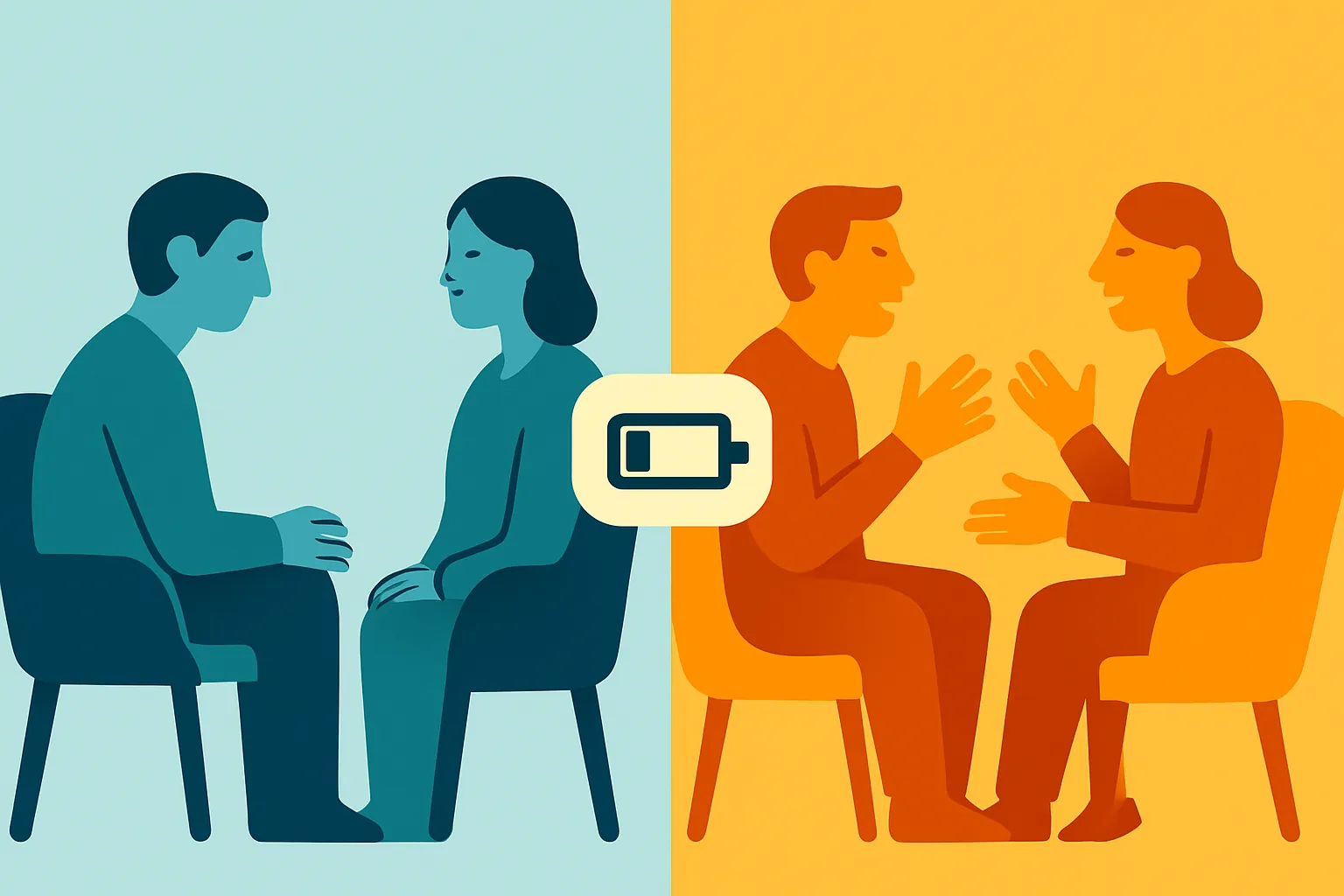
There is no clinical evidence that introverted or extraverted clinicians make better counselors—Jung framed introversion and extraversion as differences in the direction of energy, not in therapeutic competence. What does differ is how each builds the therapeutic alliance and how each burns out. Introverted counselors tend to excel at containing through silence and deep listening, while extraverted counselors excel as facilitators who build rapid rapport and drive behavioral activation. Sustainable practice comes from playing to your strengths and shoring up your vulnerabilities with scheduling strategy and tools like AI-assisted documentation—not from forcing a temperament change.
"I'm pretty introverted—am I even cut out to be a counselor?"
It's one of the most common worries trainees and early-career clinicians bring to supervision: a quiet doubt about whether their temperament is suited to the work. Introverted clinicians often say, "My energy feels low—I don't think I draw clients out enough." Extraverted clinicians worry from the opposite direction: "I can't sit with silence, and I talk so much I'm afraid I'm taking the floor away from the client."
From a clinical-psychology standpoint, there is no evidence that one temperament makes a better therapist than the other. Carl Jung framed introversion and extraversion along a single dimension—a difference in the direction of psychic energy, not a difference in therapeutic capacity. What does differ, and visibly so, is how each type forms the therapeutic alliance in session and how each experiences burnout afterward. This article looks at how the introversion–extraversion personality dimension actually shows up in the consulting room, and what a sustainable practice looks like for each end of it.
A note on terminology: rather than lean on a popular personality-type brand whose validity is contested in the clinical literature, we use the well-established introversion–extraversion dimension. The point isn't a four-letter label—it's where your energy naturally flows.
How Therapeutic Style Differs—and Where Each Excels
Introverted and extraverted clinicians offer clients a "secure base" in different ways. The introverted counselor is gifted at descending with the client into their inner world; the extraverted counselor is gifted at generating the momentum that reconnects a client to the outside world. Compared clinically:
| Introverted counselor | Extraverted counselor | |
|---|---|---|
| Core strength | Deep listening, reading nonverbal cues, using silence | Speed of rapport, therapeutic confrontation, energizing the room |
| Therapeutic climate | Calm, steady, containing | Animated, open, motivating |
| Natural modality fit | Psychodynamic, person-centered, analytical psychology | Cognitive behavioral therapy (CBT), Gestalt, reality therapy |
| Clinical watch-point | Passivity—missing the moment to intervene | Getting ahead of the client's own insight with interpretation or advice |
The introverted clinician's tools: silence and resonance
Introverted counselors are often exceptional at containing. They can sit with a client's painful affect without rushing to fill it, holding space until the client arrives at their own insight. That capacity is decisive with high-arousal presentations—trauma, or the affective volatility seen in borderline personality organization—where therapeutic steadiness is itself the intervention. Because introverted attention turns inward, these clinicians also tend toward high sensitivity to micro-shifts in expression and the unspoken nuance underneath a client's words.
The extraverted clinician's tools: expression and facilitation
Extraverted counselors are natural facilitators. They build early rapport quickly and can serve as a living model of vitality for clients presenting with depression or anhedonia. Through active questioning and feedback they rapidly surface and challenge cognitive distortions and drive behavioral activation. They keep the air in the room from going heavy, and their energy helps clients locate their own motivation to change.
The Mechanics of Depletion: When Does Compassion Fatigue Hit?
Burnout and vicarious trauma have different triggers depending on temperament. Knowing exactly when and why your battery drains isn't self-indulgence—it's a precondition for practicing ethically over a career.
Introverted depletion: "I need to get away from people."
Introverted clinicians lose energy less to any single session than to continuous social contact. Run five or six cases back-to-back and, by the final hour, cognitive resources are depleted and concentration drops off sharply. They also tend to internalize a client's intense affect and ruminate on it, so emotional detachment after hours comes hard—and fatigue follows them home.
Extraverted depletion: "I'm talking to a wall."
Extraverted clinicians, paradoxically, are stressed by the absence of interaction. Chronic client silence, entrenched resistance to intervention, or a stretch of isolated administrative work with no colleague to debrief a case with can produce a sudden sense of helplessness. When they feel their energy isn't reaching the client, efficacy drops and burnout sets in.
Tailored Strategies You Can Use This Week
The goal isn't to force a temperament change—it's to play to your strengths and let systems cover your vulnerabilities.
1. Schedule strategically
Introverted clinicians should protect a genuine 10–15 minute full disconnect between sessions. Spend it with eyes closed and senses dialed down—not reviewing a transcript or returning calls. Extraverted clinicians should front-load high-functioning clients and active sessions into the higher-energy morning or early afternoon, and recharge through lunch or a coffee break with colleagues. Where possible, lead a case conference or study group to keep that sense of connection alive.
2. Make documentation efficient
Documentation burdens every clinician, but for different reasons. Introverted clinicians tend to over-invest in notes out of perfectionism, bleeding energy into them; extraverted clinicians find static paperwork tedious, put it off, and then feel the stress of the backlog.
This is where an AI-assisted documentation tool helps both types. Technology that automatically transcribes a session and surfaces a clinical summary gives the introverted clinician permission to step out of the "perfect note" compulsion and stay fully present with the client, and it sharply cuts the tedious admin hours the extraverted clinician dreads. Modalia AI is built for exactly this—a security-first partner for counselors that handles transcription, case conceptualization support, and documentation so the clinician's attention stays on the work. Used well, that's less a convenience than a second therapeutic tool.
3. Turn temperament into technique
Use your own traits therapeutically. Introverted clinicians can lean on their calm to strengthen grounding work that settles an anxious client. Extraverted clinicians can use their energy as an instrument for projecting hope to a depressed client. In supervision, trade the question "Is my temperament getting in the way of the work?" for the more useful one: "How do I use my temperament as an intervention?"—a reframe that runs straight through your own countertransference.
Conclusion: The Best Counselor Is the One Who Sounds Like You
Freud analyzed clients all day and unwound over evening card games; Rogers was reportedly introverted yet healed countless people through warm, unconditional acceptance. Your temperament isn't a grade. It's a compass that tells you which tools are already in your hand.
If you're introverted, trust the power of deep resonance. If you're extraverted, trust the power of the momentum you create. And wherever energy leaks out along the way, plug it with smart scheduling and modern tools like AI-assisted transcription. When clinicians accept and respect their own temperament as it is, they model exactly what they hope clients will learn—how to love themselves as they are.
References
- 1.
- 2.
Frequently asked questions
Is an introverted or extraverted person better suited to be a counselor?
There's no clinical evidence favoring either. Jung described introversion and extraversion as a difference in the direction of energy, not in therapeutic competence. Introverted clinicians often excel at containing and deep listening; extraverted clinicians excel at rapid rapport and behavioral activation. Effectiveness depends on self-awareness, not temperament.
Why do introverted and extraverted counselors burn out differently?
Introverted clinicians are depleted mainly by continuous back-to-back social contact and by ruminating on clients' intense affect after hours. Extraverted clinicians are stressed by the absence of interaction—chronic client silence, resistance, or isolated administrative work with no one to debrief with.
What's the best way to protect against counselor burnout based on temperament?
Don't force a temperament change—use systems instead. Introverted clinicians benefit from a true 10–15 minute disconnect between sessions; extraverted clinicians benefit from front-loading active sessions and staying connected to colleagues. Both benefit from offloading documentation to AI-assisted tools so attention stays on clinical work.
This article was written and reviewed using Modalia AI's clinical guidelines, with professional human review before publication.
Related articles
 Case Conceptualization
Breaking the "Yes, But" Game: A Transactional Analysis Guide for Therapists
Every suggestion you offer gets met with "Yes, but..." Here's the TA structure behind that stall—and four clinical moves to break it.
7 min read Case Conceptualization
Yalom's The Gift of Therapy: Passages Every New Counselor Should Copy by Hand
Irvin Yalom's prescription for therapists who fear silence: meet your client as a "fellow traveler" and let the here-and-now become the heart of the work.
6 min read Case Conceptualization
Working With Silence in Therapy: What Client Silence Means and How to Hold It
Silence in session isn't empty space. Learn to read its clinical meaning, tell productive from defensive silence, and use it as a therapeutic tool.
6 min read