When a Client Says "I Had the Strangest Dream": Using Dreams as Case Conceptualization Clues
A Jungian framework for turning client dreams into clinical evidence—plus a practical way to capture fragmented dream narratives without losing the session.
Key takeaway
From a Jungian perspective, a client's dream is an autonomous, compensatory message from the unconscious and a powerful clue for case conceptualization and treatment direction. While brief-therapy norms have pushed dream work to the margins, three strategies—comparing the dream-ego with the waking ego, exploring symbols through amplification, and tracking dream series over time—turn dreams into a systematic clinical tool. AI-assisted transcription captures fragmented dream reports accurately, freeing clinicians to stay fully present to the client's nonverbal signals.
When a Client Says "I Had the Strangest Dream": Why We Keep Missing the Clue
Most clinicians know the moment. A client settles in and says, almost offhand, "I had the most bizarre, vivid dream last night." What do you feel in that instant? Curiosity, maybe—but often something more practical: I had a clear agenda for today's session. How do I fold this hazy dream material into the work without losing the thread? And there's a quieter administrative worry underneath it: dream reports tumble out in fragments, and capturing them accurately in your notes is genuinely hard.
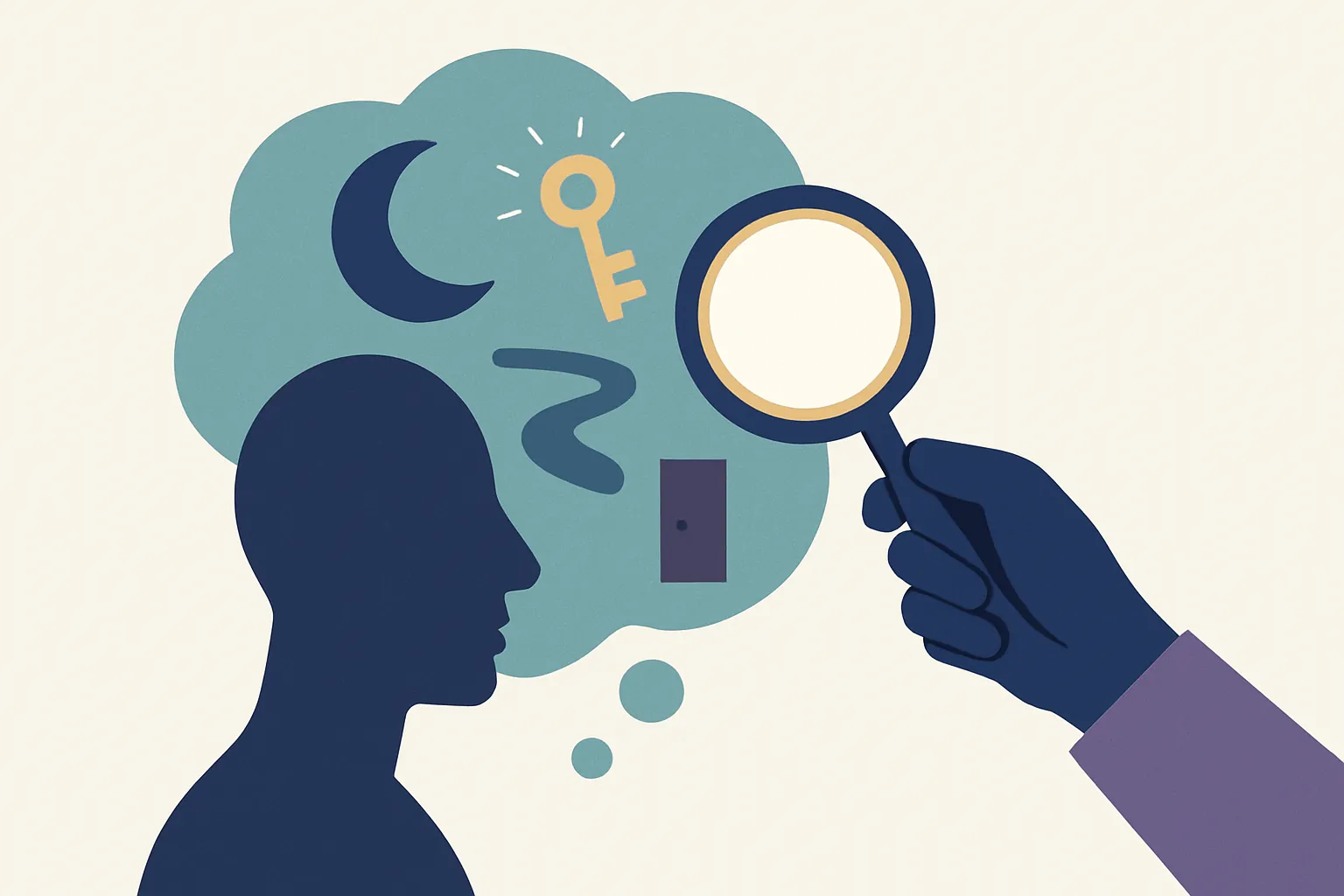
Dreams were once called the royal road to the unconscious. Yet in today's high-volume, brief-therapy-oriented practice, dream work has steadily drifted to the margins. We labor to set effective treatment goals for complex cases while leaving one of the most direct messages the unconscious offers—the dream—on the periphery of our formulation. To deepen clinical insight, dreams deserve to be treated not as one-off episodes but as central clues in case conceptualization. This article lays out how a Jungian lens makes that possible, and how to ease the documentation burden so you can actually apply what the dream is telling you.
A Jungian Lens: The Dream as the Unconscious's Most Honest Diagnostic
Working effectively with dreams starts with adjusting the clinical lens through which we view them. Where classical psychoanalysis framed the dream as the disguised fulfillment of a repressed wish, C. G. Jung's analytical psychology elevates it to a different order entirely. For Jung, the dream is a compensatory message—an autonomous communication from the unconscious aimed at restoring the wholeness of a psyche that the conscious ego has lost sight of or turned away from.
Applied to case conceptualization, this reframes the client's presenting symptoms—depression, anxiety, relational conflict—not as mere pathology but as meaningful growing pains within the process of individuation. The dream points, symbolically, toward where the client needs to go next. The contrast between the two traditions makes the shift concrete:
| Dimension | Freudian Psychoanalysis | Jungian Analytical Psychology |
|---|---|---|
| Nature of the dream | Expression of repressed sexual/aggressive wishes from the past | The unconscious compensating for a current psychic imbalance |
| Temporal orientation | Past-oriented (causal) | Future-oriented (teleological/purposive) |
| Focus of analysis | Decoding the disguised latent content that slipped past censorship | Exploring the manifest symbol's own message and direction |
| Primary technique | Free association | Amplification and active imagination |
| Use in formulation | Mapping defenses and the origins of unconscious conflict | Surfacing psychological resources and setting a therapeutic aim (individuation) |
Three Strategies for Bringing Dreams Into Your Formulation
With the theory in place, here are three concrete, repeatable ways to weave a client's dreams into case conceptualization—treating dreams as a structured analytic tool rather than an exercise in mystical interpretation.
1. Compare the dream-ego with the waking ego
- Core principle: Examine how the client behaves and feels inside the dream (the dream-ego), then compare it with how they present in waking life.
- In practice: Picture a client who, in daily life, reflexively accommodates others and avoids conflict—yet in a dream furiously fights back against a monster. That gap belongs in your formulation immediately. A working hypothesis emerges: the client's unconscious is compensating for a healthy aggression (anger) that is suppressed in waking life, and integrating it into consciousness is a central therapeutic task.
- Payoff: Genuine, defended-against affect surfaces quickly and safely, rather than staying hidden behind the client's habitual defenses.
2. Use amplification to surface and connect core imagery
- Core principle: Move beyond the client's purely personal associations to explore the archetypal, more universal resonance of a dream image (a snake, deep water, a collapsing house).
- In practice: If a client dreams of being trapped in a room as the water rises to their neck, resist locking onto a fixed equation like "water = mother." Instead, amplify: ask what the water evokes from several angles—vitality, suffocation, cleansing, being overwhelmed. This becomes a rich clue for assessing the client's current sense of emotional overwhelm or burnout, and for reading transference and countertransference dynamics.
- Payoff: The client learns to view their symptom as an objective symbol, which increases their sense of mastery over it and deepens self-understanding.
3. Track a dream series to mark treatment milestones
- Core principle: Dreams aren't isolated fragments; they evolve as a series across the arc of treatment. Tracking that progression lets you verify therapeutic change.
- In practice: Suppose a client who, early on, repeatedly dreamed of being chased and fleeing later begins to dream of stopping, turning, and looking at the pursuer. That shift is objective data for your formulation: the client's ego strength is increasing, and avoidance is giving way to confrontation.
- Payoff: It renders the otherwise abstract progress of psychotherapy as clear, shared evidence that both client and clinician can feel.
Capturing the Fragments: AI-Assisted Documentation and Sharper Insight
As the strategies above show, a client's dreams are treasure for case conceptualization and treatment direction. But one of the most stubborn ethical and administrative dilemmas in practice is this: how do you accurately record and analyze a dream narrative that is, by nature, nonlinear and fragmented?
Dream reports are often disjointed, full of logical leaps, and dense with metaphor and symbol. When a clinician bends over notes to capture all of it, the cost is steep: you miss the micro-expressions, the catch in the voice, the shift in breathing—the nonverbal data that often matter most when a client narrates a dream. That divided attention can erode the very thing dream work depends on: the quality of the therapeutic alliance.
This is where AI-assisted documentation has emerged as a strong alternative. A security-first session transcript tool converts fast, disordered dream narratives into accurate text without dropping the fragments—so you can step out from under the pressure of note-taking, hold the client's gaze, and stay present to the emotional resonance the dream carries. Going further, these tools can surface recurring symbolic keywords and core affective language across sessions, which is exactly the kind of support that makes tracking a dream series practical rather than aspirational.
The quality of therapy ultimately rests on how carefully we handle the small clues the unconscious offers, and how systematically we analyze them. Three action items you can apply right away: First, ask your clients, lightly, whether any recent dream has stayed with them. Second, for complex cases, bring dream data into peer supervision and attempt an integrative formulation around it. Third, seriously consider adopting AI-based transcription and automated note-taking so your clinical energy goes entirely toward connection and analysis. The time and breathing room that technology gives back tends to return as exactly what clients need most: insight that is both sharp and warm.
References
- 1.
Frequently asked questions
How is the Jungian view of dreams different from the Freudian view?
Freud saw dreams as the disguised fulfillment of repressed past wishes, so analysis aimed to decode hidden latent content. Jung saw dreams as the unconscious compensating for a current psychic imbalance, with a future-oriented, purposive direction. In practice, that means a Jungian formulation reads the dream's manifest symbols for resources and treatment aims rather than only for defenses and conflict origins.
What is amplification, and how does it differ from free association?
Amplification explores the broader, often archetypal meanings of a dream image—what it evokes across vitality, threat, cleansing, and so on—rather than following the client's personal chain of associations as in free association. It widens the symbol's resonance so the client can view a symptom more objectively, which strengthens self-understanding and a sense of mastery.
Why track dreams as a series across treatment?
Individual dreams can read as random, but across an arc of therapy they tend to evolve. A recurring 'being chased' dream that later becomes 'turning to face the pursuer' is objective evidence of growing ego strength and a shift from avoidance to confrontation—useful, shareable proof of progress for both client and clinician.
How does AI transcription help with dream-focused sessions?
Dream narratives are fast, fragmented, and metaphor-heavy, so manual note-taking pulls attention away from nonverbal cues like tone and breathing. A secure transcription tool captures the report accurately and can surface recurring symbols and affect words across sessions, freeing the clinician to stay present and making dream-series tracking practical.
This article was written and reviewed using Modalia AI's clinical guidelines, with professional human review before publication.
Related articles
 Case Conceptualization
Breaking the "Yes, But" Game: A Transactional Analysis Guide for Therapists
Every suggestion you offer gets met with "Yes, but..." Here's the TA structure behind that stall—and four clinical moves to break it.
7 min read Case Conceptualization
Yalom's The Gift of Therapy: Passages Every New Counselor Should Copy by Hand
Irvin Yalom's prescription for therapists who fear silence: meet your client as a "fellow traveler" and let the here-and-now become the heart of the work.
6 min read Case Conceptualization
Working With Silence in Therapy: What Client Silence Means and How to Hold It
Silence in session isn't empty space. Learn to read its clinical meaning, tell productive from defensive silence, and use it as a therapeutic tool.
6 min read