When a Client's Feelings Feel Like Your Own: Managing and Using Countertransference Wisely
Countertransference can drain you after sessions—or sharpen your insight. Here are three practical strategies to stay grounded and use it therapeutically.

Key takeaway
Countertransference is not an obstacle to eliminate but a dual-natured phenomenon: a therapeutic compass for understanding the client's inner world, and a potential trigger for clinician burnout. Contemporary relational psychoanalysis treats it as central to clinical understanding, but using it well begins with distinguishing concordant from subjective countertransference. In practice, three approaches help you regulate it: using somatic cues as a traffic-light signal, labeling felt emotions as clinical data, and securing a 'third perspective' through transcripts or detailed session notes.
When the Session Ends but the Feeling Doesn't
You close the office door, head home, and the grief or anger a client poured out an hour ago is still sitting heavy in your chest. Maybe a quiet self-reproach follows: Did I get too pulled into their pain? Did I fail to keep a professional distance? If that sounds familiar, you're not doing the work wrong—you're doing the work.
In clinical practice, countertransference is double-edged: it is both a powerful therapeutic instrument and a genuine occupational hazard. Classical psychoanalysis framed it as the therapist's unresolved material—something to be removed. Contemporary relational and interpersonal approaches read it very differently: as a primary compass for understanding the client's inner world.
But theory is one thing. When a client's affect starts to feel like your own and follows you into your evening, your sleep, your relationships, that can be a clear signal of burnout. Caught inside a client's projective identification, how do you hold onto professional objectivity and stay richly empathic at the same time? This piece breaks down how countertransference shows up in the room and offers concrete ways to separate from it and put it to clinical use.
The Two Faces of Countertransference: Empathic Attunement or Boundary Collapse?
When a client's emotion feels like yours, the first question is whether you're experiencing concordant countertransference or subjective countertransference—the latter being your own unresolved material getting activated. In Racker's framework, concordant countertransference is the therapist mirroring the client's emotional state. But when that mirroring becomes flooding—when the therapist's ego is overrun by the client's affect—therapeutic neutrality collapses.
This is especially common when working with clients who have borderline personality organization, or with trauma survivors. You may find yourself swamped by an unexplained helplessness, an intense anger, or a deep shame that doesn't seem to originate with you. The move that matters here is not "What's wrong with me?" but "Where did this feeling come from?"—treating the affect as data. Without first clarifying who the emotion belongs to and re-establishing the boundary, treatment effectiveness drops and the clinician's depletion climbs. The table below contrasts healthy empathy with the countertransference reactions worth watching for.
Table 1 — Healthy Empathy vs. Countertransference Reactions That Need Attention
| Dimension | Healthy Empathy | Countertransference to Watch (Identification) |
|---|---|---|
| Location of the feeling | "I can sense how much they're hurting." (as if) | "I am hurting and overwhelmed right now." (is) |
| Cognitive state | Observing ego stays intact | Judgment clouds; fusion sets in |
| Behavioral response | Therapeutic intervention and reflection | Over-reassuring, advice-giving, or avoidance/defensiveness |
| Residue after the session | Processed and metabolized | Lingers after hours; shows up in dreams |
| Clinical use | A tool for understanding the client | Drives burnout and ethical risk |
Three Strategies for Holding Your Center in a Flood of Affect
So how do you protect the professional you inside a wave of emotion—and turn that wave into something therapeutic? These are concrete practices clinical supervisors commonly recommend.
-
Use Somatic Markers as a Traffic-Light Signal
Countertransference often reaches the body before the mind. A sudden tightness in your chest mid-session, an unexplained wave of drowsiness, a clench in your shoulders—these can be signals of emotional transfer. Simply noticing—"My body is reacting right now"—is often enough to interrupt immediate fusion. A brief breath, or grounding through the feeling of your feet on the floor, lets you step back from the client's emotional vortex and recover the observer's position.
-
Label the Emotion as Data and Analyze It
Don't take ownership of the feeling—objectify it as clinical data. If you suddenly feel anger toward a client, reframe the internal sentence from "I'm angry" to "This client relates to others in a way that pulls anger out of them—is this projective identification?" That shift lets you function not as an emotional dumping ground but as a container: holding the affect, metabolizing it, and handing it back in a usable form.
-
Secure a 'Third Perspective' Through Records (Transcripts and Notes)
The more intense the countertransference, the more your memory of the session distorts—you get overwhelmed by one strand of affect and lose the larger context. The most effective counter is to review the session through a transcript or detailed summary note. Text lowers the emotional temperature and makes rational analysis possible. Seeing on the page exactly where you went quiet, or where you over-intervened, is at the heart of separation and regulation.
Toward Sustainable Practice: Building Clinical Insight Into Your Workflow
Countertransference is a natural consequence of being human in this work. Left unattended, though, it can erode both your own mental health and your client's outcomes. As above, the essentials are self-monitoring, translating felt experience into objective data, and validating your read through peer supervision. That process is what lets us stand on solid therapeutic ground rather than sinking into an emotional swamp.
One practical note: in the emotional turbulence right after a session, the way you capture and review what happened matters. When you reconstruct a session from memory alone, the recall itself can be biased by the countertransference you're trying to examine. A structured workflow—accurate session records or transcripts produced close to the event—gives you a calmer, third-person vantage point on your own reactions, and frees the energy otherwise spent on typing for analyzing the dynamics between you and the client.
This is where a security-first AI partner like Modalia AI can support the work, handling transcription, documentation, and case conceptualization so the objective record exists before memory has a chance to reshape it. The point isn't the tool—it's the breathing room it creates, which translates directly into clinical steadiness and sharper insight.
Try this: Pick the single most emotionally demanding session from your week. Turn that session into text—via accurate notes or a transcription workflow—then read it through and mark, in red, the exact points where your own feelings entered the room. That small exercise can be the start of a meaningful step up in your clinical skill.
References
- 1.
Frequently asked questions
Is countertransference a sign that I'm a bad therapist?
No. Countertransference is a natural, universal part of clinical work and, in contemporary relational thinking, a key source of information about the client. The concern isn't whether you experience it, but whether you notice it, name it, and process it rather than acting it out.
How do I tell empathy apart from harmful countertransference?
Healthy empathy keeps your observing ego intact—you sense the client's pain 'as if' it were yours while staying anchored. Problematic identification collapses that boundary: judgment clouds, the feeling becomes 'mine,' and it lingers after hours or shows up in your dreams.
What can I do in the moment when a client's emotion floods me?
Use your body as an early-warning system. Notice somatic cues like chest tightness or shoulder tension, take a breath, and ground through the contact of your feet on the floor. Then mentally relabel the emotion as clinical data—'Where did this come from?'—to recover the observer's stance.
Why do session records help with countertransference?
Intense countertransference distorts memory, so reconstructing a session from recall alone bakes in the bias you're trying to examine. A transcript or detailed note lowers the emotional temperature and gives you a third-person view of where you went quiet or over-intervened.
This article was written and reviewed using Modalia AI's clinical guidelines, with professional human review before publication.
Related articles
 Case Conceptualization
Breaking the "Yes, But" Game: A Transactional Analysis Guide for Therapists
Every suggestion you offer gets met with "Yes, but..." Here's the TA structure behind that stall—and four clinical moves to break it.
7 min read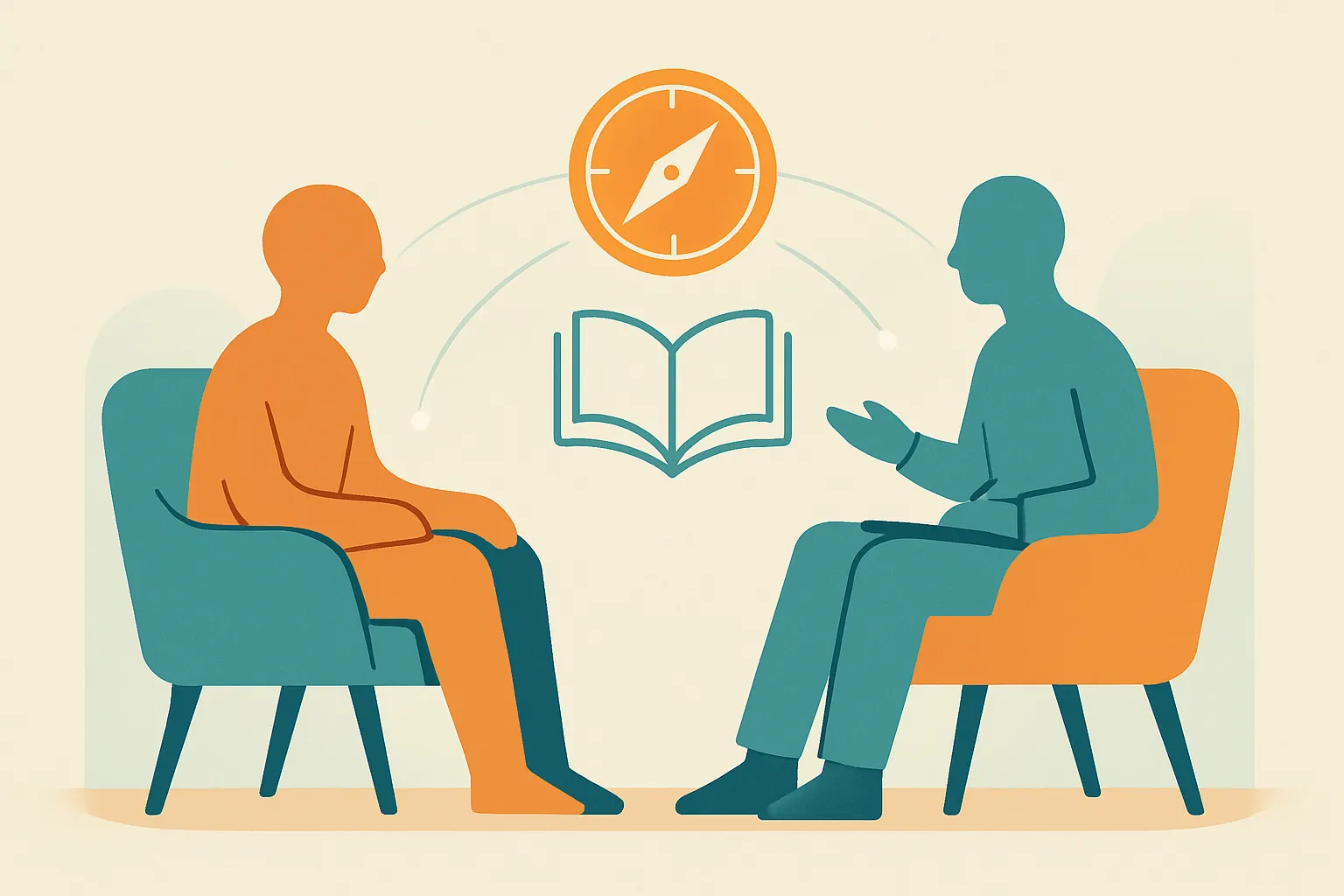 Case Conceptualization
Yalom's The Gift of Therapy: Passages Every New Counselor Should Copy by Hand
Irvin Yalom's prescription for therapists who fear silence: meet your client as a "fellow traveler" and let the here-and-now become the heart of the work.
6 min read Case Conceptualization
Working With Silence in Therapy: What Client Silence Means and How to Hold It
Silence in session isn't empty space. Learn to read its clinical meaning, tell productive from defensive silence, and use it as a therapeutic tool.
6 min read