Counseling Soldiers: Navigating Military Culture, Confidentiality Limits, and the Ethics of Dual Loyalty
How clinicians can hold a service member's trust and unit safety at once—practical strategies for confidentiality limits, reframing, and command consultation.
Key takeaway
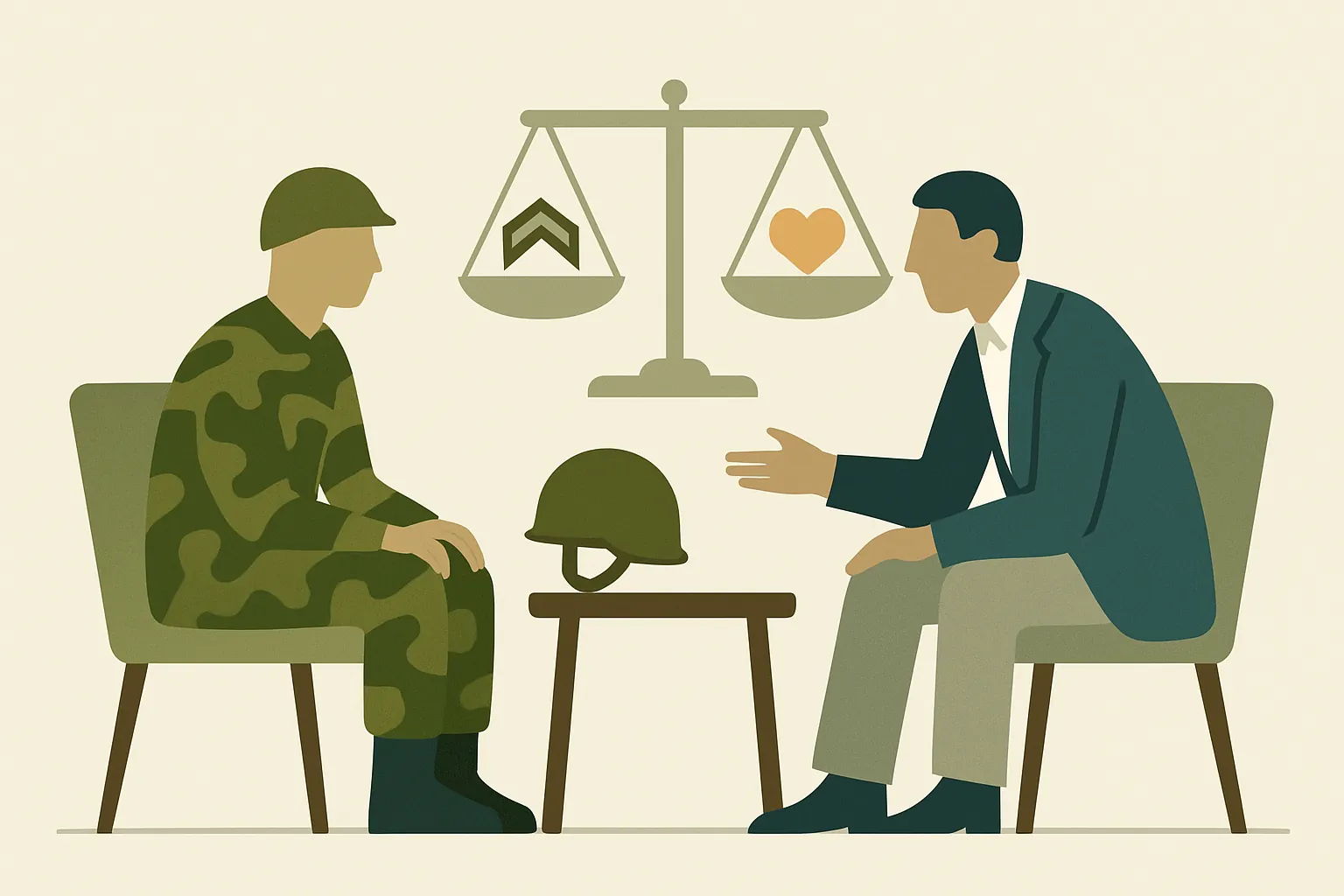
Military counseling happens inside a hierarchical, collectivist culture that prizes toughness, so service members often hide distress for fear of being labeled. Clinicians work in a permanent ethical tension between client confidentiality and the command's safety mandate, inside a closed environment the client cannot escape. The most effective responses: state the limits of confidentiality transparently at the outset, reframe symptoms as 'operational stress' to lower shame, and report to command in terms of functioning level and action plans rather than session content.
"Can I speak without the rank on my collar?" 🪖 The dilemmas of counseling inside the military—and how to work through them
"If I tell you this, does it get back to my commander? Doesn't that mean I'm going to be flagged as a problem?"
If you provide counseling to service members, you have almost certainly heard some version of this question. Few institutions are as hierarchical, as collectivist, or as committed to toughness-as-virtue as the military. In that environment, naming psychological distress can be read as weakness or as being unfit for duty—so for many soldiers, simply walking through the counseling-room door takes real courage.
As younger generations enter the ranks and expectations around communication shift, the culture is changing. But the clinician's core bind has not: you are walking a tightrope between the foundational principle of client confidentiality and the institution's demand for force protection and incident prevention. How far does the duty to report to command actually extend? And how do you protect a client from real threats that live outside the counseling room? This article looks closely at what makes military counseling distinct, and at strategies you can apply in the room tomorrow.
1. A place that demands strength: understanding military culture and its psychological barriers
What most separates military counseling from civilian practice is context. The military exists, at its core, to prepare for combat, and control and discipline are its lifeblood. That culture reinforces a client's defenses and makes rapport harder to build. Three forces do most of the work.
Acute fear of stigma
Many service members believe that the mere record of having sought counseling will cost them—passed-over promotions, removal from a posting, ostracism by peers. The predictable result is symptom minimization ("faking good") and the concealment of the very trauma that brought them in.
Dual roles and the limits of confidentiality
The military clinician is simultaneously a healer and an agent of institutional safety. "Report suicidal ideation the moment you detect it," command says; "please keep this between us," the client pleads. That ethical dilemma is one of the largest drivers of occupational stress for clinicians in this setting.
Stressors the client cannot control
In civilian work, a client can often change or avoid a toxic environment. The military is a closed system with no exit: the client faces the same disliked superior every day and endures training they did not choose. Conditions like these are fertile ground for learned helplessness.
2. Civilian vs. military counseling: naming the structural differences
Effective intervention starts with seeing clearly how your setting differs from a civilian one. This is not a difference in technique but in structure and goals—and once a clinician understands that, they can set off unnecessary guilt and adopt realistic aims.
| Dimension | Civilian counseling | Military counseling |
|---|---|---|
| Goal | Personal growth, self-actualization, symptom relief | Adaptation to service, incident prevention, preserving force readiness |
| Confidentiality | Near-absolute (legal exceptions aside) | Limited (unit safety and command authority take priority) |
| Client motivation | Mostly self-referred | Often involuntary (command-referred) or quasi-mandatory |
| Multiple relationships | Strictly prohibited | Sometimes unavoidable (the counselor may also be a superior) |
| Duration | Long-term work is possible | Short-term, crisis-focused (discharge, transfer, and other variables) |
Table 1. Structural differences between civilian and military counseling.
3. Practical solutions for working within the limits: between trust and reporting
So how do you raise the effectiveness of counseling inside these constraints? You need concrete strategies that honor your ethical obligations while earning the client's trust.
Set transparent limits during the structuring phase (informed consent)
Don't blur the limits of confidentiality at the start. Spell them out, plainly and honestly: "In principle, what you tell me stays here. The only exception is if I judge there's a genuine threat to your safety or to the safety of the people around you—and even then I'd share the minimum necessary. If I ever have to report something, I'll tell you first and we'll talk it through." Counterintuitively, this kind of candor is what builds trust.
Reframe "a problem soldier" as "operational stress"
Work to keep the client from interpreting their distress as weakness. The concept of operational stress—a term adopted across many militaries—is a useful cognitive-reframing tool: it lets you explain that their symptoms are not abnormal but a normal response to an extreme environment. This lowers shame and improves engagement with treatment.
Build a collaborative alliance with command (consultation)
Treat the commanding officer not as someone oppressing your client but as a partner who can shape a therapeutic environment. Rather than reporting the content of what the client said, report on functioning level and a concrete action plan. Reporting practices vary across structures—US, NATO, and other national forces each have their own norms—but the principle holds everywhere: instead of "severe depression," say something like, "Concentration is currently impaired, which makes nighttime guard duty risky; I recommend reassignment to daytime administrative tasks for two weeks." That approach demonstrates clinical expertise and protects the client at the same time.
4. Toward higher-quality, more efficient military counseling
Military counseling is one crisis intervention after another, and the administrative load is far from trivial. Staying focused on the actual clinical work depends on the right systems and tools.
Make supervision and self-care non-negotiable
Military clinicians are highly exposed to vicarious trauma. Don't try to carry every crisis alone inside a closed unit. Use regular supervision with an outside expert to keep your clinical judgment objective, and build peer-support groups with fellow counselors to guard against burnout.
Smarter documentation for objective data
In this setting, your records are both a legal safeguard and the evidence that persuades command. For clients at risk of suicide or going absent, capturing the nuance and key language of a session accurately matters enormously. Yet heavy note-taking during a session breaks eye contact and erodes the connection you're working to build.
This is where an AI-based transcription and analysis partner earns its place. A security-first tool like Modalia AI can automatically convert sessions to text and visualize patterns—shifts in a client's affect over time, the words they reach for most when describing their distress—as data. That lifts the documentation burden so you can stay fully present with the person in front of you. And over time, the accumulated data becomes powerful evidence when you advise command on the direction of unit-wide personnel care.
Inside an institution as vast as the military, one clinician's work can feel small. But never forget that a single empathic sentence can be the only lifeline for a service member standing at the edge. May the strategies and smarter tools described here lighten the weight on your shoulders, even a little.
Frequently asked questions
How is confidentiality different when counseling military service members?
Confidentiality is limited rather than near-absolute. Unit safety, incident prevention, and command authority can require disclosure of information related to a service member's safety or readiness. The most ethical approach is to state these limits transparently during informed consent—explaining that only the minimum necessary will be shared, and that you'll tell the client before reporting whenever possible.
What is 'operational stress' and why use it as a reframe?
Operational stress is a term used across many militaries to describe the psychological strain of demanding service environments. Framing a client's symptoms as operational stress positions them as a normal response to an extreme situation rather than as personal weakness or unfitness. This lowers shame, reduces stigma, and improves engagement with treatment.
How should a clinician report to a commanding officer without breaking trust?
Report on functioning level and a concrete action plan rather than the content of what the client disclosed. For example, instead of naming a diagnosis, describe the practical impact ('concentration is impaired, making nighttime guard duty risky') and recommend a specific accommodation. This protects the client, demonstrates clinical expertise, and frames command as a partner in care.
How can military clinicians protect themselves from burnout and vicarious trauma?
Don't carry crises alone inside a closed unit. Use regular supervision with an outside expert to keep clinical judgment objective, build peer-support groups with fellow counselors, and prioritize self-care. Reducing administrative load—including documentation—also frees attention for the clinical work and lowers the risk of burnout.
This article was written and reviewed using Modalia AI's clinical guidelines, with professional human review before publication.
Related articles
 Case Conceptualization
Breaking the "Yes, But" Game: A Transactional Analysis Guide for Therapists
Every suggestion you offer gets met with "Yes, but..." Here's the TA structure behind that stall—and four clinical moves to break it.
7 min read Case Conceptualization
Yalom's The Gift of Therapy: Passages Every New Counselor Should Copy by Hand
Irvin Yalom's prescription for therapists who fear silence: meet your client as a "fellow traveler" and let the here-and-now become the heart of the work.
6 min read Case Conceptualization
Working With Silence in Therapy: What Client Silence Means and How to Hold It
Silence in session isn't empty space. Learn to read its clinical meaning, tell productive from defensive silence, and use it as a therapeutic tool.
6 min read