Minuchin's Boundary Making: How to Create Space in Enmeshed Parent-Child Relationships
A clinician's guide to Minuchin's three boundary-making techniques for restructuring enmeshed parent-child relationships—without losing the therapeutic alliance.
Key takeaway
In Salvador Minuchin's structural family therapy, an enmeshed boundary describes a state of psychological fusion that undermines a child's autonomy and blocks individuation—seen when a parent answers for the child or the child checks the parent's reaction before any small decision. Therapists can restructure these relationships using three techniques: spatial manipulation (changing seating), blocking transactions, and highlighting differences. Because boundary making disturbs the family's homeostasis, resistance is expected, so joining is essential to protect rapport; reviewing sessions objectively—including AI-based speaker-diarization analysis of who talks how much—helps you check whether your interventions land well. The goal is not separation but healthy reconnection.
Love, or Control? Helping Enmeshed Families Breathe Again
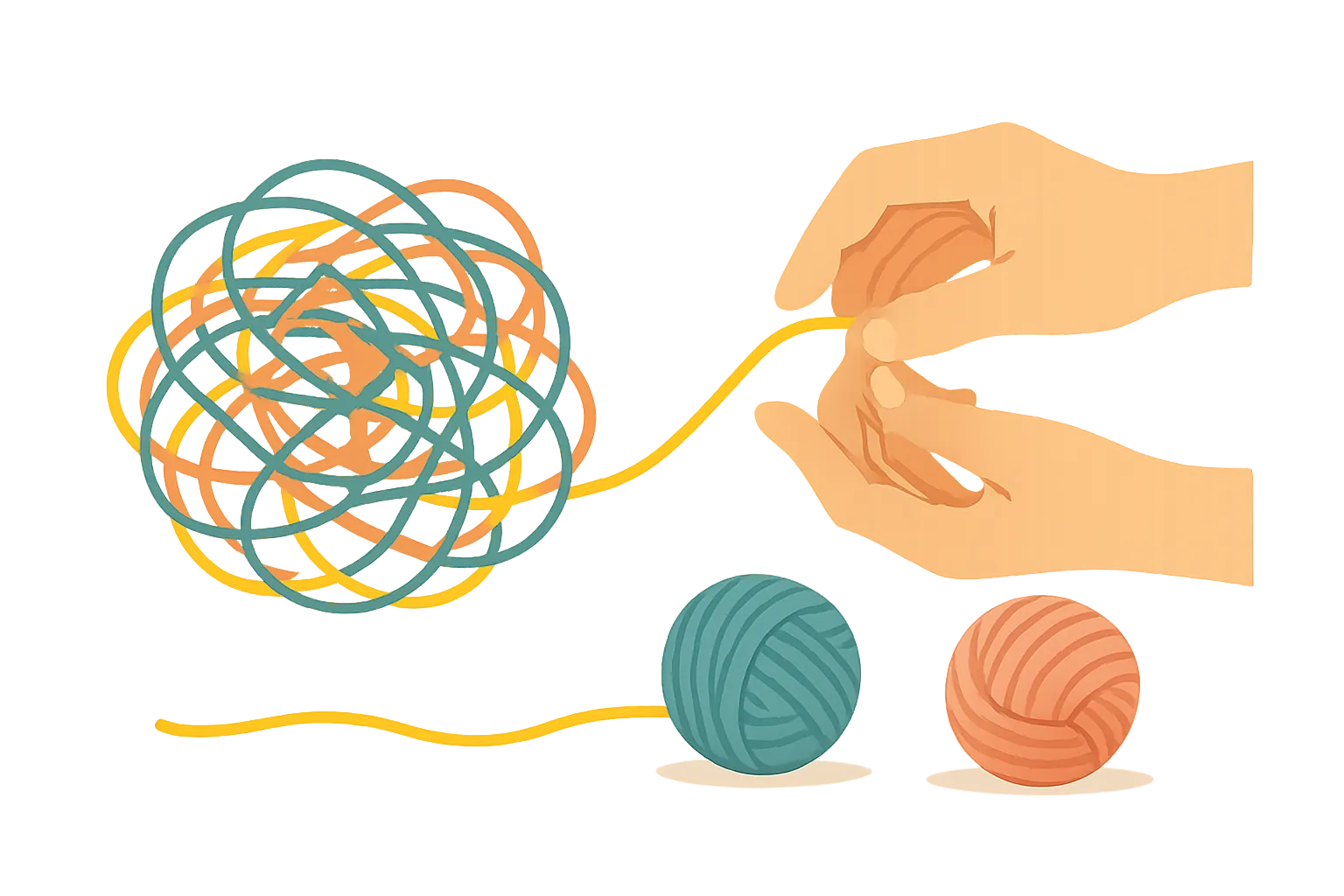
In family and child/adolescent work, we regularly meet a parent and child who seem to move as a single organism. You ask the child a question and the parent answers. The child glances at the parent before venturing even a small opinion. Salvador Minuchin named this configuration the enmeshed boundary. On the surface it reads as devoted love and care, but underneath sits a kind of psychological cohabitation that quietly erodes the child's autonomy and stalls individuation.
This puts us in a bind. How do we attempt healthy boundary making without shaming a parent's obvious devotion? Creating physical and psychological space while keeping client resistance low is genuinely high-level clinical work. Drawing on structural family therapy, this article lays out practical interventions for restructuring an enmeshed relationship into something healthier.
Understanding the Enmeshed Structure: The Prison Called "We"
In Minuchin's model, a boundary is the invisible line that governs how much contact—and what kind—family members have with one another. In an enmeshed family, that line is far too faint. The parent's anxiety transmits instantly to the child; the child's success or failure is experienced as the parent's own identity. This goes well beyond ordinary closeness—it is interdependence amplified to a pathological degree.
Clinically, these families show excessive resonance under stress. When the child hits a minor conflict at school, the parent reacts as if it were happening to them—indignant or anxious, moving immediately to intervene. The therapist's task is to recognize clearly that this pattern is not "love" but the absence of boundaries, and to be ready to make that visible to the family. Effective intervention begins with an accurate read of the family's boundary type.
| Enmeshed | Clear | Disengaged | |
|---|---|---|---|
| Communication | Speaking for others, blurred thoughts/feelings, frequent interrupting | Direct exchange, listening and respect, room to speak for oneself | Little contact, indifference, low responsiveness |
| Emotional response | Excessive resonance, very fast emotional contagion | Empathic understanding; can tell one's own feelings from another's | Flat response, little emotional support |
| Autonomy | Low (individuation fails), interdependent | High (independence and connection in balance) | Excessively high (isolated independence) |
| Treatment goal | Strengthen boundaries and support individuation | Maintain and reinforce | Increase interaction and build connection |
Three In-Session Techniques for Boundary Making
Once the theory is clear, you need moves you can use in the room right now. Boundary making isn't an abstraction—it's an active intervention in which the therapist alters structure by controlling the physical environment and the flow of conversation.
1. Spatial Manipulation
The most intuitive and immediately effective move is to change the seating. An enmeshed pair typically sits side by side, or facing each other so they can trade glances continuously.
- In practice: Ask gently but firmly to rearrange the room. "Would you mind moving over here for a moment? Today, so I can really hear what your son has to say, I'd like you to sit in the observer's chair over there."
- Why it works: Physical distance is the first step toward psychological distance. Out from under the parent's gaze—a form of nonverbal control—the child gets to experience interacting with you one to one.
2. Blocking the Transaction
When the parent answers or explains on the child's behalf, block it—courteously. This sends the child the message "you are someone who can speak for yourself," and the parent the message "your child is a separate person."
- In practice: Raise a palm in a soft gesture and say, "One moment—I can see how well you know your daughter. But right now I want to hear her put it in her own words, even if it comes out a little clumsy."
- Key point: Stress that this serves a therapeutic purpose, not a criticism, so the rapport doesn't fracture.
3. Highlighting Differences
Enmeshed relationships run on the fantasy that "we are the same." Deliberately surface differences in thought, feeling, and preference to distinguish I from you.
- In practice: "You said this situation makes you anxious—but your son says it actually makes him angry. The two of you feel completely different things about the same event. That's fascinating."
- Why it works: Confirming that they're allowed to feel differently cracks the emotional fusion and gives each person their own territory.
Refining the Work: Ethics and a Technical Assist
Because boundary making disturbs the family's homeostasis, resistance is inevitable. The parent may feel rejected; the child may fear standing alone. So the therapist has to be something of a chameleon—using joining to respect the family's culture while still steering change.
Throughout, you should keep checking whether your interventions are well calibrated. The dynamics of an enmeshed relationship surface in the subtlest nonverbal signals—a glance, a sigh—and in the turn-taking of conversation, and capturing all of that in the moment is hard. This is where current tools create real leverage.
Supervision Grounded in Objective Data
To confirm whether you constricted the parent too much, or gave the child enough room to speak, you need an objective replay of the session. AI-based session documentation uses speaker diarization to measure, accurately, how much airtime the counselor, the child, and the caregiver each took. A data point like "the parent spoke for 70% of the session" is feedback you can feel immediately. Modalia AI is built for exactly this kind of secure, clinician-facing review—transcription, case conceptualization support, and documentation that keeps client data protected.
Surfacing Hidden Patterns
A good AI transcript goes beyond plain text: it can track the frequency of telling phrases ("my child always…", "as their parent, I…") and the flow of affect across the hour. With that, you can catch micro-management patterns you'd otherwise miss and set the next session's goals with precision. It also shortens documentation time—doubling as a tool for clinical insight, not just record-keeping.
The Real Goal: Reconnection, Not Separation
Minuchin's boundary making was never about prying a family apart. It's a process of reconnecting in a healthier way—giving the parent the room to trust and watch from a small distance, and giving the child space to breathe on their own. What boundaries are being drawn in your room this week? Warm but firm intervention is how you help a family grow.
References
- 1.
Frequently asked questions
What is an enmeshed boundary in structural family therapy?
An enmeshed boundary is Minuchin's term for a state of psychological fusion in which the line between family members is too faint—anxiety transmits instantly, and one person's success or failure is experienced as the other's identity. It looks like devotion but undermines autonomy and blocks individuation.
What are Minuchin's main boundary-making techniques?
Three core techniques: spatial manipulation (changing seating to create physical and psychological distance), blocking the transaction (courteously interrupting a parent who speaks for the child), and highlighting differences (surfacing distinct thoughts and feelings to separate 'I' from 'you').
How do I keep boundary making from damaging the therapeutic alliance?
Frame every intervention as serving a therapeutic purpose rather than as criticism, and lean on joining to respect the family's culture while steering change. Because boundary making disturbs the family's homeostasis, expect resistance and protect rapport deliberately.
Is the goal of boundary making to separate the parent and child?
No. The aim is healthy reconnection, not separation—giving the parent room to trust and observe from a small distance, and giving the child space to breathe and speak for themselves.
This article was written and reviewed using Modalia AI's clinical guidelines, with professional human review before publication.
Related articles
 Case Conceptualization
Breaking the "Yes, But" Game: A Transactional Analysis Guide for Therapists
Every suggestion you offer gets met with "Yes, but..." Here's the TA structure behind that stall—and four clinical moves to break it.
7 min read Case Conceptualization
Yalom's The Gift of Therapy: Passages Every New Counselor Should Copy by Hand
Irvin Yalom's prescription for therapists who fear silence: meet your client as a "fellow traveler" and let the here-and-now become the heart of the work.
6 min read Case Conceptualization
Working With Silence in Therapy: What Client Silence Means and How to Hold It
Silence in session isn't empty space. Learn to read its clinical meaning, tell productive from defensive silence, and use it as a therapeutic tool.
6 min read