Minuchin's Detouring: How Parental Conflict Becomes a Child's Symptom
When a child's symptoms mask an unresolved couple conflict, Minuchin's concept of detouring offers a structural map—and concrete clinical strategies—for change.
Key takeaway
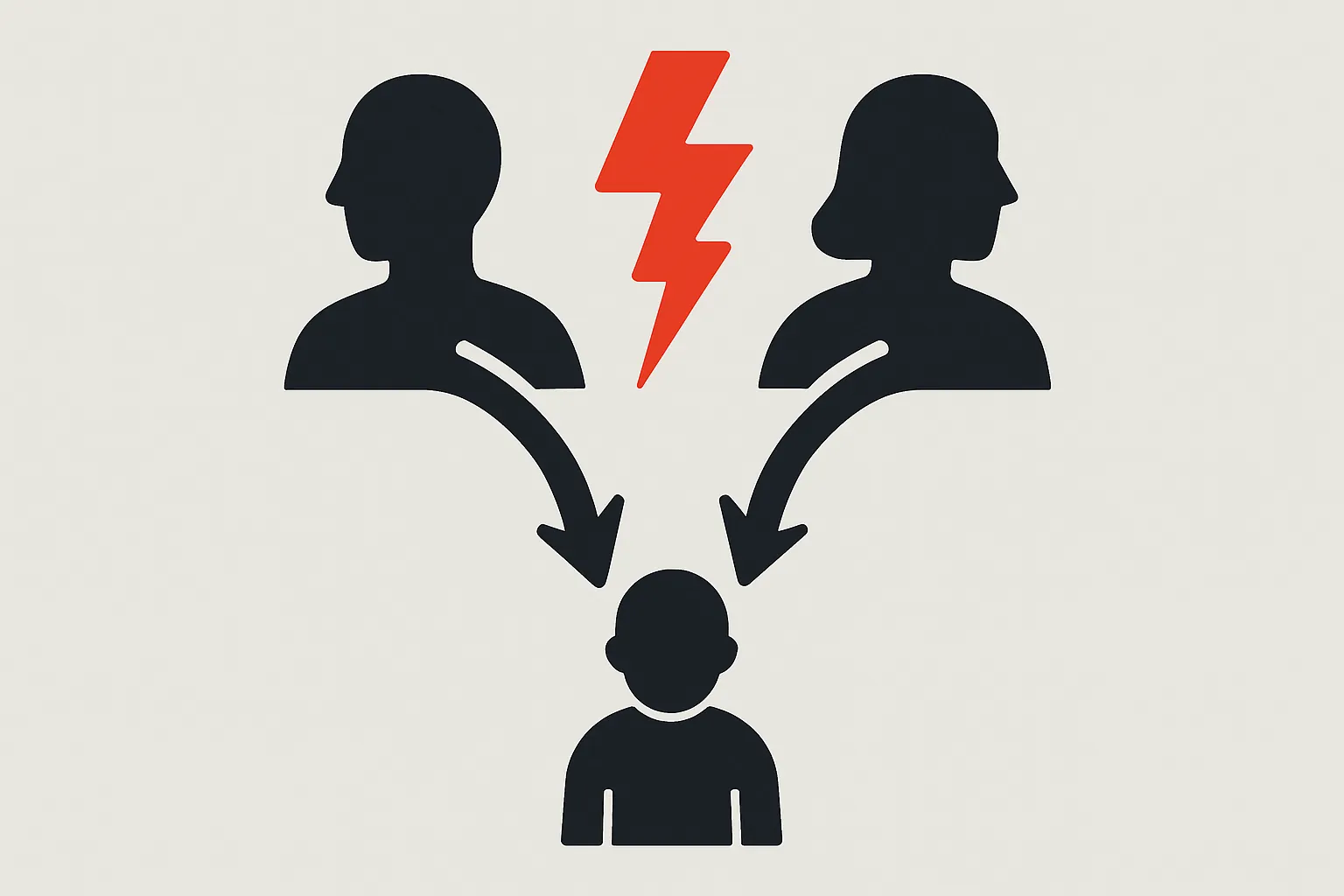
In Salvador Minuchin's structural family therapy, detouring describes a boundary pathology in which a couple's unresolved conflict is redirected onto a child. When the child develops problem behavior or symptoms, the parents temporarily unite around managing that child, avoiding direct marital confrontation—so the symptom comes to stabilize the marriage. Minuchin distinguished detouring-attacking (the child is scapegoated and blamed) from detouring-supporting (the child is cast as fragile and overprotected). Clinicians realign the family's boundaries and strengthen the spousal subsystem through reframing, boundary making, unbalancing, and bringing the avoided conflict into the room.
The Hidden War Behind a Child's Symptom
Most clinicians who work with families know the pattern. A couple arrives with an "identified patient"—a child labeled as the problem—and the more acute the child's behavior becomes, the more the parents' own conflict seems to recede beneath the surface. "We have no problems as a couple," they'll say, "it's all about our child." The question worth sitting with is whether that statement is clinically true, or whether it is the symptom itself talking.
Salvador Minuchin named this phenomenon detouring. It describes a boundary pathology in which conflict within the spousal subsystem, left unresolved, is rerouted onto a child rather than worked through between the partners. As clinicians, our task is to see past the visible symptom and recognize that the couple's apparently stable alliance is often a fragile false peace—one that depends on the child staying sick. This article frames detouring through the lens of structural family therapy and lays out the practical interventions that loosen its grip.
How Detouring Works: Conflict Doesn't Vanish, It Relocates
In structural family therapy, the family is a living system. When tension between the partners rises past what they feel able to tolerate directly, the system recruits a third party to preserve its homeostasis—and the most available, least powerful candidate is usually a child. Detouring can be understood as an unconsciously negotiated defense against direct marital confrontation.
In this arrangement the child takes on the role of the one who keeps the marriage intact. When the child acts up or falls ill, the parents stop fighting and unite—however briefly—to manage, soothe, or control that child. The child's symptom acquires a function: it stabilizes the parents' relationship. A clinician who misses this paradox and pursues symptom removal alone will often watch one of two things happen the moment the symptom lifts—the marital conflict erupts, or a sibling develops a fresh symptom in a textbook case of symptom substitution. The system protects its equilibrium.
Two Clinical Subtypes of Detouring
Minuchin distinguished two presentations of detouring. Identifying which one a family relies on matters, because it points to a different focus of intervention.
| Dimension | Detouring-Attacking | Detouring-Supporting |
|---|---|---|
| Core dynamic | The child is defined as the cause of the problem and blamed | The child is defined as fragile and in need of protection and overprotected |
| Parental stance | Parents unite to control and punish the child, sidestepping their own conflict (scapegoating) | Parents emphasize the child's weakness or pathology and present themselves as devoted caregivers |
| Child's response | Defiance, aggression, delinquency—an acting-out trajectory | Somatic complaints, eating problems, school refusal—a regressive, dependent trajectory |
| Treatment focus | Lift the negative label on the child; revise the parents' controlling style | Build the child's autonomy; loosen parental enmeshment and overinvolvement |
Table 1. Clinical features of attacking versus supporting detouring.
Structural Interventions for the Therapy Room
Once you recognize that a couple's conflict is being detoured through a child, the work shifts toward realigning the family's boundaries and restoring a workable hierarchy. The following strategies are ready to apply in session.
1. Reframing the Problem
Redefine the presenting complaint from a systemic vantage point. Rather than "the child won't listen," the problem becomes "the parents are struggling to coordinate with each other, and the child is anxious in the middle of it." Reframing lifts the patient burden off the child and invites the parents to turn their attention toward their own relationship—often for the first time.
2. Boundary Making and Strengthening the Spousal Subsystem
Establish the physical and psychological boundaries that keep the child out of the parents' conflict. When a child tries to insert themselves into the parents' exchange during session, intervene clearly: "Right now your mom and dad are talking—can you hold on a moment?" Outside the room, assign tasks that protect the couple as a unit, such as regular time together, to rebuild the cohesion of the spousal subsystem.
3. Unbalancing
To disrupt a rigid equilibrium, the therapist deliberately sides with—or lends weight to—one family member. In an attacking-detouring family, you might temporarily align with the perpetually blamed child; in another, you might shore up the authority of a demoralized, sidelined parent. The point is not fairness but movement: tilting the system off its fixed balance so a new structure can form.
4. Bringing the Conflict Into the Room
Guide the parents to address their conflict directly, with each other, instead of routing it through the child. A directive does this work: "Set the discussion about your child aside for a moment—tell your partner directly what has been hurting you." Enacting the avoided conflict in session gives the couple a chance to face and metabolize what they have been steering around.
Observation Is Where Effective Treatment Begins
Working with detouring depends on catching the fine-grained interactional patterns between family members. Who interrupts whom, and when? Where does the child's gaze travel the instant the parents begin to argue? The diagnostic signal lives in these nonverbal cues and split-second shifts in the conversation. Yet tracking a family's live dynamics while simultaneously producing a complete record of the session is close to impossible.
This is the practical tension behind any structural family session, and it's worth being intentional about how you capture it. Many clinicians now lean on session recording and transcription tools to preserve the moment-to-moment flow for later review—revisiting the precise exchange where the detour happened, or bringing an objective record into supervision. Used within your jurisdiction's consent and confidentiality requirements, a reliable record frees your attention during the hour for what only a clinician can do: watch the system move. Modalia AI, a security-first partner for counselors, supports this work with transcription, case conceptualization, and documentation so that the observing can stay with you and the record-keeping doesn't.
Effective treatment starts with accurate observation. The structural therapist functions as a kind of director, reorganizing the family's structure in real time—and that work is far easier to sustain when the session's details aren't lost the moment they pass. In your next family session, watch the conversation patterns once more. Behind the child's symptom, you may begin to hear the parents' voices.
References
- 1.
Frequently asked questions
What is detouring in structural family therapy?
Detouring is a boundary pathology described by Salvador Minuchin in which an unresolved conflict within the couple is rerouted onto a child instead of being addressed between the partners. The child's problem behavior or symptom becomes a focus that lets the parents avoid direct confrontation, so the symptom ends up stabilizing the marriage.
What is the difference between attacking and supporting detouring?
In detouring-attacking, the parents unite to blame, control, or punish the child as the cause of the problem, and the child tends to act out. In detouring-supporting, the parents cast the child as fragile and overprotect them, and the child tends toward regression, dependence, or somatic and school-related difficulties.
Why does removing the child's symptom often fail in these families?
Because the symptom serves a stabilizing function for the couple. If a clinician eliminates the symptom without addressing the underlying marital conflict, the conflict may erupt directly or a sibling may develop a new symptom—a pattern known as symptom substitution. Lasting change requires realigning boundaries and strengthening the spousal subsystem.
Which structural interventions help with detouring?
Key interventions include reframing the problem in systemic terms, boundary making to keep the child out of the parents' conflict while strengthening the couple, unbalancing to disrupt a rigid family equilibrium, and bringing the avoided conflict directly into the session so the partners address it with each other.
This article was written and reviewed using Modalia AI's clinical guidelines, with professional human review before publication.
Related articles
 Case Conceptualization
Breaking the "Yes, But" Game: A Transactional Analysis Guide for Therapists
Every suggestion you offer gets met with "Yes, but..." Here's the TA structure behind that stall—and four clinical moves to break it.
7 min read Case Conceptualization
Yalom's The Gift of Therapy: Passages Every New Counselor Should Copy by Hand
Irvin Yalom's prescription for therapists who fear silence: meet your client as a "fellow traveler" and let the here-and-now become the heart of the work.
6 min read Case Conceptualization
Working With Silence in Therapy: What Client Silence Means and How to Hold It
Silence in session isn't empty space. Learn to read its clinical meaning, tell productive from defensive silence, and use it as a therapeutic tool.
6 min read