Minuchin's Enactment: Restructuring Family Interaction in Real Time
Turn your office into a stage for change with Minuchin's enactment technique. A 3-step process for restructuring dysfunctional family interaction in the room.
Key takeaway
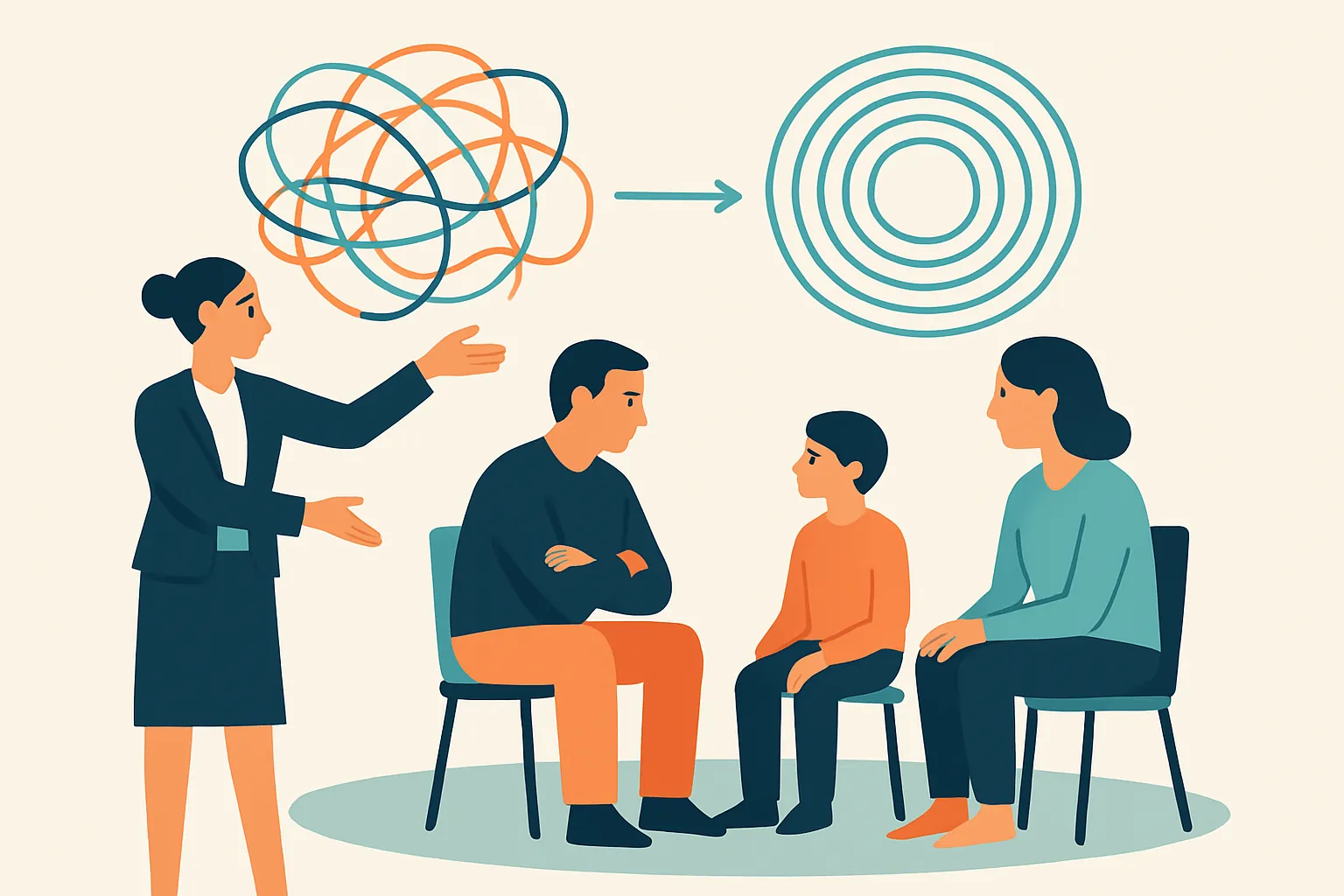
In family therapy, clients often only "report" past conflicts in words, leaving the clinician dependent on subjective accounts. Enactment—a core technique of Structural Family Therapy—brings the family's dysfunctional interaction patterns into the "here and now" of the consulting room, where the therapist can intervene directly and restructure the system. Developed by Salvador Minuchin, it unfolds in three stages: observing spontaneous interaction, inviting a scenario, and restructuring toward new patterns. The therapist works less as a listener and more as a director, focusing on the process of interaction rather than the content of what is said.
"Would You Try That Conversation Right Here, Right Now?" — Minuchin's Enactment Technique
When a family walks through your door, what do they usually do first? In most cases, they get busy reporting. "He yelled at me last week." "She completely ignored what I said." The session fills up with verbal re-tellings of events that happened somewhere else, at some other time. And it is easy, in that moment, to slip into the role of a judge weighing competing testimony—or to find yourself wading through memories you can never independently verify. It is inefficient, and it is exhausting.
Salvador Minuchin, a founder of Structural Family Therapy, offered a different instruction: don't ask the family to describe their dance—get them to dance it in the room. This is the heart of enactment. Enactment is not role-play for its own sake. It is a clinical tool for bringing the family's dysfunctional interaction patterns into the here and now of the consulting room, so that the therapist can intervene directly and begin restructuring the system. If you have ever wanted to work with the process of an interaction rather than its content, enactment is the technique worth mastering.
The Three Stages of Enactment: From Observation to Restructuring
Enactment is more than telling a couple to "go ahead and argue." It requires careful clinical judgment and a staged approach. Through enactment, Minuchin sought to surface—and then modify—a family's hidden hierarchy, boundaries, and alliances. Here is a three-stage process you can apply directly in session.
Stage 1: Observing Spontaneous Interaction
The first task is to catch the family interacting naturally. Early in a session, members tend to speak to the therapist. Your move is to redirect them to speak to each other. When a mother says, "He just won't study," you reply, "Would you say that worry directly to your son?" Then you watch closely what happens next: the son's avoidance, the father's interruption, the mother's critical tone. You are drawing a mental map of how this family actually moves.
Stage 2: Setting the Scene and Inviting the Interaction
Next, you move beyond casual conversation and give specific directions designed to surface the core conflict pattern. You choose the theme most likely to bring the dysfunction into view, and you set the stage. Here you take on the role of a director. For example: "Dad, instead of lecturing about her coming home late the way you usually do, I'd like you to tell her only about the worry underneath it. And I'd like you to look at your father and listen all the way through." By assigning concrete rules, you help the family attempt an interaction that differs from their default.
Stage 3: Restructuring Toward New Patterns
This is the real goal. When the family inevitably slides back into familiar loops—blame-and-defend, avoid-and-pursue—you intervene actively to interrupt the flow and have them rehearse a new way of communicating. You might block the interrupting father so the mother and son can finish their exchange (strengthening a boundary), or create space so a silenced child can finally speak (adjusting the hierarchy). In that moment the family has a corrective emotional experience: "Oh—we actually can talk to each other differently."
Talk Therapy vs. Enactment: Comparing the Clinical Payoff
Many early-career clinicians hesitate to use enactment, and the reason is usually a fear of losing control. When a family genuinely raises their voices or shows raw emotion in the room, it is easy to feel overwhelmed. But hearing about a conflict and seeing it unfold are worlds apart in diagnostic and therapeutic precision. The table below makes the contrast explicit.
| Dimension | Report-Based (Talk Therapy) | Enactment-Based |
|---|---|---|
| Focus | Content of past events; the "facts" | The interaction process in the here and now |
| Therapist role | Listener, mediator, analyst | Director, coach, boundary-setter |
| Basis for assessment | Client's subjective account and memory | Behavior patterns the therapist witnesses directly |
| Mechanism of change | Cognitive change through insight | Structural change through lived experience |
| Key limitation | Information distorted by family defenses | High therapist energy; countertransference to manage |
Table 1. Clinical characteristics of report-based versus enactment-based therapy.
As the table shows, enactment is one of the most effective ways to get past a family's defenses. Advising a family a hundred times to "respect each other" rarely lands. Helping them successfully complete one exchange of genuine eye contact and uninterrupted listening, right there in the room, is a far more powerful therapeutic factor. The work asks the clinician to build a capacity to tolerate high tension in the room—a form of therapeutic holding.
Capturing the Moment: Conclusion and Recommendations
Minuchin's enactment technique transforms the consulting room from a place of conversation into a laboratory for rehearsing change. If a family case has stalled, or if a client's words feel like they are circling without landing, try the bold move: "Would you try saying that, directly, right here and now?" In that moment—when the client's expression, tone of voice, and body orientation all shift—you will find the point where the real work begins.
The catch is that enactment makes the clinician very busy. You have to track the nonverbal behavior of several people at once, intervene in the moment, and never lose the thread of a shifting dynamic. Drop your head to take notes and you can miss the very interaction you were trying to observe.
- 💡 Recommendation 1: In your next family session, attempt at least one enactment—redirect members to speak directly to each other rather than to you.
- 💡 Recommendation 2: During an enactment, let go of the compulsion to write and stay fully present with the family's dynamics. A security-first AI documentation partner like Modalia AI can transcribe the session and help separate multi-speaker dialogue, so subtle context—"the mother sighed the moment the father cut her off"—is preserved for later analysis rather than lost to your notepad.
- 💡 Recommendation 3: In peer supervision, rehearse enactment scenes as role-plays to train your timing for when and how to intervene.
The quality of therapy rests on how deeply the clinician is willing to engage with the client's world. May you become the skilled director who, without getting lost in the family's intricate choreography, guides them into a new rhythm.
References
- 1.
- 2.
Frequently asked questions
What is enactment in Structural Family Therapy?
Enactment is a core technique of Salvador Minuchin's Structural Family Therapy in which the therapist directs family members to interact with each other in the room, rather than report past conflicts. By bringing dysfunctional patterns into the here and now, the clinician can observe the family's hierarchy, boundaries, and alliances directly and intervene to restructure them.
How is enactment different from regular talk therapy?
Talk therapy relies on clients' subjective accounts of events that happened elsewhere, leaving change to depend largely on insight. Enactment focuses on the live interaction process, gives the therapist behavior they witness firsthand, and produces structural change through lived corrective experience rather than verbal report alone.
What role does the therapist play during an enactment?
The therapist works as a director rather than a passive listener—setting the scene, assigning concrete rules for the interaction, and actively intervening when the family slips back into familiar loops. This requires the capacity to tolerate high tension in the room and to manage one's own countertransference.
When should I avoid using enactment?
Use clinical judgment when there is a risk of escalation that cannot be safely contained, when there are concerns about intimidation or coercion between members, or when a member is too dysregulated to engage. In those cases, prioritize safety and stabilization first, and reserve enactment for moments when the room can hold the intensity.
This article was written and reviewed using Modalia AI's clinical guidelines, with professional human review before publication.
Related articles
 Case Conceptualization
Breaking the "Yes, But" Game: A Transactional Analysis Guide for Therapists
Every suggestion you offer gets met with "Yes, but..." Here's the TA structure behind that stall—and four clinical moves to break it.
7 min read Case Conceptualization
Yalom's The Gift of Therapy: Passages Every New Counselor Should Copy by Hand
Irvin Yalom's prescription for therapists who fear silence: meet your client as a "fellow traveler" and let the here-and-now become the heart of the work.
6 min read Case Conceptualization
Working With Silence in Therapy: What Client Silence Means and How to Hold It
Silence in session isn't empty space. Learn to read its clinical meaning, tell productive from defensive silence, and use it as a therapeutic tool.
6 min read