Minuchin's Enmeshed Family: A Structural Case Conceptualization When Personal Boundaries Disappear
Diagnose the structural problems hidden behind an "enmeshed" family that mistakes closeness for love, and learn Minuchin-based strategies for rebuilding healthy boundaries.
Key takeaway
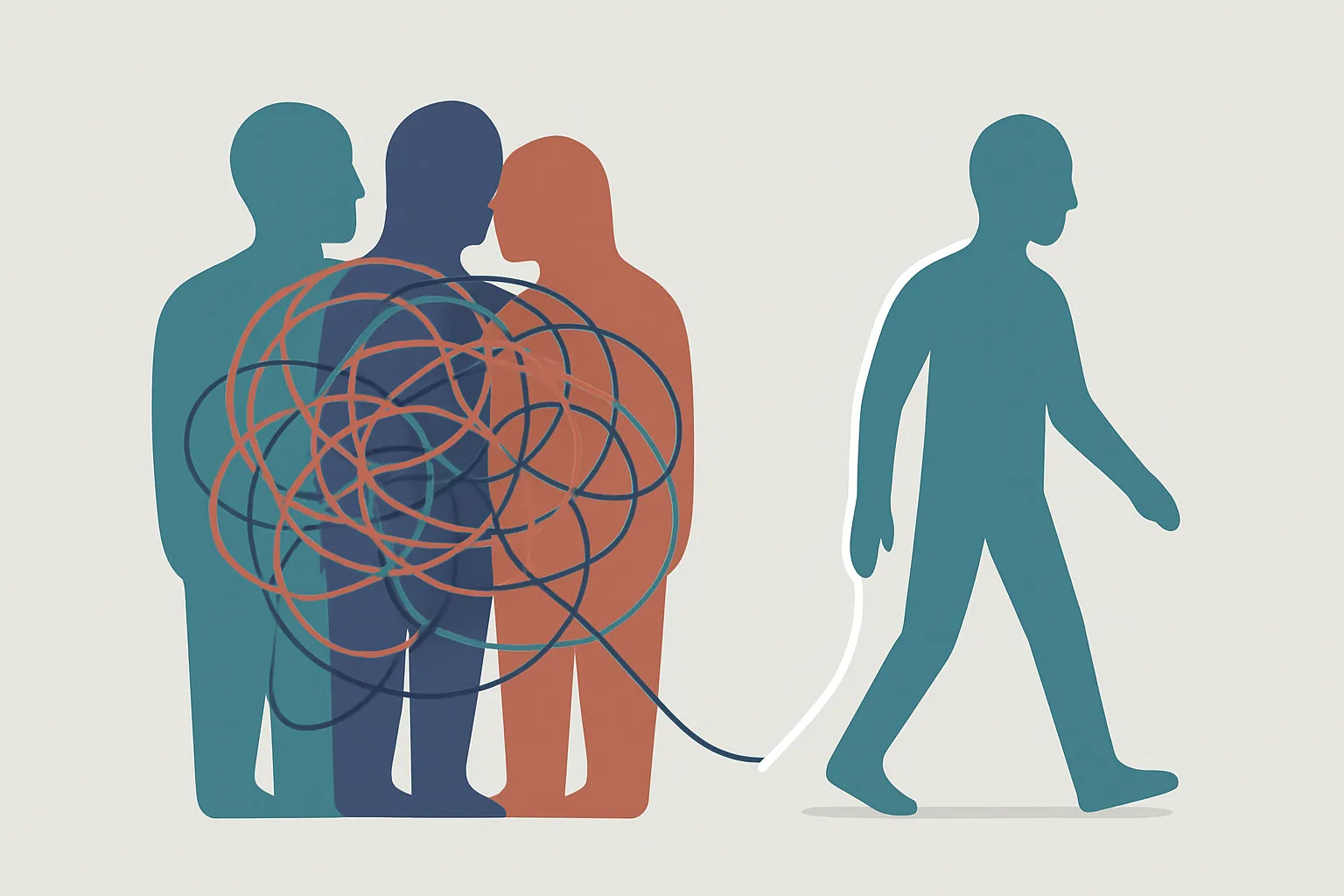
Salvador Minuchin's concept of the enmeshed family describes a system in which psychological distance between members is so collapsed that individual emotional independence becomes impossible. Unlike healthy families with clear boundaries, enmeshed families operate with diffuse boundaries, producing frequent emotional contagion and treating a member's autonomous choices as betrayal. Structural family therapy does not aim to dissolve the family but to restructure it—using boundary making, enactment, and intensity to clarify blurred boundaries and restore each subsystem's proper function.
When "Love" Becomes Suffocation: Reading the Structure Behind the Closeness
Some of the families who walk into our offices look almost unusually harmonious. Every member shares every feeling, there are no secrets, and no one appears to be left out. Yet as therapy progresses, many clinicians begin to sense a quiet, hard-to-name frustration. The identified patient's depression or anxiety doesn't budge. The family insists, "Our only problem is that we love each other too much"—while individual autonomy is, in fact, being slowly suffocated. This is the classic picture of what Salvador Minuchin called the enmeshed family.
In clinical work we regularly meet families who confuse intimacy with enmeshment. As clinicians, how do we distinguish this subtle but decisive difference—and help a client recover a healthy self inside the family system? The challenge sharpens in collectivist or Confucian-influenced cultures, where enmeshed relationships are easily reframed not as pathology but as devotion, filial duty, or family loyalty, making clinical intervention more delicate. This article looks at how to conceptualize the enmeshed family through the lens of structural family therapy, and at the concrete intervention strategies that follow from that formulation.
Clinical Features and Structural Diagnosis: Where the Boundary Vanishes
The defining feature of the enmeshed family is the blurring of boundaries. This goes beyond simply getting along well: the psychological distance between members has collapsed to the point that individual emotional independence is no longer possible. In structural family therapy, healthy families maintain clear boundaries, whereas enmeshed families operate with diffuse boundaries. As a result, a shift in one member's emotional state transfers instantly and excessively to the others—a phenomenon known as emotional contagion.
When assessing a client, the following signals should raise the question of enmeshment:
- Family members speak for one another or routinely finish each other's sentences.
- A child's independent decisions (career, marriage, moving out) are experienced as betrayal or an attack on the family.
- Conflict avoidance is strong, and individual dissatisfaction is suppressed to preserve a surface-level peace.
The table below contrasts the structural characteristics of healthy and enmeshed families from a clinical standpoint. Use it to locate where a client's family currently sits.
Table 1. Structural Comparison: Healthy Family vs. Enmeshed Family
| Dimension | Healthy Family (Clear Boundary) | Enmeshed Family (Diffuse Boundary) |
|---|---|---|
| Autonomy | Individual thoughts and feelings are respected | Difference is perceived as a threat |
| Belonging | Stable support and genuine solidarity | Forced loyalty and guilt-based cohesion |
| Problem solving | Conflict resolved through direct communication | Indirect communication; triangulation |
| In session | The client leads their own narrative | The family appoints itself the client's spokesperson |
Case Conceptualization and Intervention: Restructuring the System
When working with an enmeshed family, the clinician's goal is not to dissolve the family but to restructure it—clarifying diffuse boundaries so that each subsystem (couple, parent–child, sibling) can function properly. Three classic structural techniques support this work.
1. Boundary Making
This technique creates physical and psychological distance within the session itself. When a mother starts to answer on her child's behalf, the clinician intervenes gently but firmly: "I'd like to pause here for a moment—can we give David the space to put his own feelings into words?" The clinician may also rearrange seating to place physical distance between parent and child, or use their own presence to interrupt over-involved interactions. The point is to give the client a lived experience of "I have the right to speak as a separate person."
2. Enactment
Here the clinician invites the family to interact the way they actually do outside the room: "When this argument happens at home, can you show me right here how it unfolds?" Enmeshed families quickly reveal how they interrupt one another and become emotionally entangled. The clinician observes the live process, intervenes at the decisive moment, and coaches the family toward new interaction patterns. This is far more powerful therapeutically than simply listening to a retold story.
3. Intensity
Enmeshed families tend to smother conflict. The clinician must deliberately surface the buried tension to disturb the system's equilibrium, delivering emotionally charged messages with repetition: "What your daughter is telling you is that she feels suffocated—not by your love, but by control. What is it like to hear that?" The aim is for the family to recognize that their habitual avoidance can no longer solve the problem.
Sharpening the Work: The Power of Documentation and Analysis
Working with enmeshed families is demanding for the clinician, too. When several members talk at once and subtle nonverbal pressure circulates around the room, tracking every dynamic in real time is genuinely difficult. In structural family therapy—where transference and countertransference run especially strong—protecting your own objectivity matters more than anything. This is where modern tools can raise the quality of the work.
A growing number of clinicians now use secure, AI-assisted documentation and session-transcript tools that show particular strength in complex, multi-party sessions:
- Speaker separation and pattern analysis: Accurate transcription can capture who interrupted whom and who dominated a given topic—valuable data for analyzing the enactment process after the fact.
- Catching nonverbal cues and nuance: Reviewing the transcript afterward lets you notice the micro-shifts in affect you missed live—and the moments when you yourself got pulled into the enmeshed system (countertransference).
- More efficient supervision prep: An accurate transcript is one of the best ways to convey family dynamics vividly to a supervisor. By cutting documentation time, you free up more energy for case conceptualization and treatment planning.
Modalia AI is built for exactly this kind of work—a security-first AI partner for counselors that supports transcription, case conceptualization, and documentation while keeping client data protected.
Ultimately, the "restructuring" Minuchin described begins with the clinician's sharp observation and precise intervention. The journey is one of rescuing the individual who is suffocating under the banner of "we are one," and helping the family become genuinely healthy—separate, yet together. With sound theory and efficient tools alongside you, you can be the steady lighthouse that families need. This week, it may be worth taking another look at the boundaries inside the family who just walked into your office.
References
- 1.
Frequently asked questions
What is an enmeshed family according to Minuchin?
In Salvador Minuchin's structural family therapy, an enmeshed family is one in which boundaries between members have become diffuse and psychological distance has collapsed, making individual emotional independence nearly impossible. Members over-involve themselves in one another's feelings, and a single person's emotional state transfers instantly to the rest through emotional contagion.
How is enmeshment different from healthy intimacy?
Healthy intimacy rests on clear boundaries: members feel close while still respecting one another's separate thoughts, feelings, and choices. Enmeshment replaces that respect with fused identities, where difference is treated as a threat and autonomous decisions are experienced as betrayal. The presence or absence of clear, flexible boundaries is the key clinical distinction.
What are the main intervention strategies for an enmeshed family?
Structural family therapy aims to restructure rather than dissolve the family. Three core techniques are boundary making (creating space so individuals speak for themselves), enactment (having the family demonstrate their real-life interaction so new patterns can be coached), and intensity (deliberately surfacing buried conflict to disrupt the system's avoidant equilibrium).
Why is enmeshment harder to treat in collectivist cultures?
In collectivist or Confucian-influenced cultures, enmeshed relationships are often reframed as devotion, filial duty, or family loyalty rather than recognized as a structural problem. This cultural framing can make families—and sometimes clinicians—reluctant to label fused dynamics as something to change, so intervention requires extra sensitivity to context and values.
This article was written and reviewed using Modalia AI's clinical guidelines, with professional human review before publication.
Related articles
 Case Conceptualization
Breaking the "Yes, But" Game: A Transactional Analysis Guide for Therapists
Every suggestion you offer gets met with "Yes, but..." Here's the TA structure behind that stall—and four clinical moves to break it.
7 min read Case Conceptualization
Yalom's The Gift of Therapy: Passages Every New Counselor Should Copy by Hand
Irvin Yalom's prescription for therapists who fear silence: meet your client as a "fellow traveler" and let the here-and-now become the heart of the work.
6 min read Case Conceptualization
Working With Silence in Therapy: What Client Silence Means and How to Hold It
Silence in session isn't empty space. Learn to read its clinical meaning, tell productive from defensive silence, and use it as a therapeutic tool.
6 min read