Reading the MMPI-2 6-8/8-6 Code Type: Distinguishing Paranoid Thinking from the Schizophrenia Spectrum
How to read the MMPI-2 6-8/8-6 code type—differentiating paranoid traits from early psychosis, plus practical strategies for a fragile working alliance.
Key takeaway
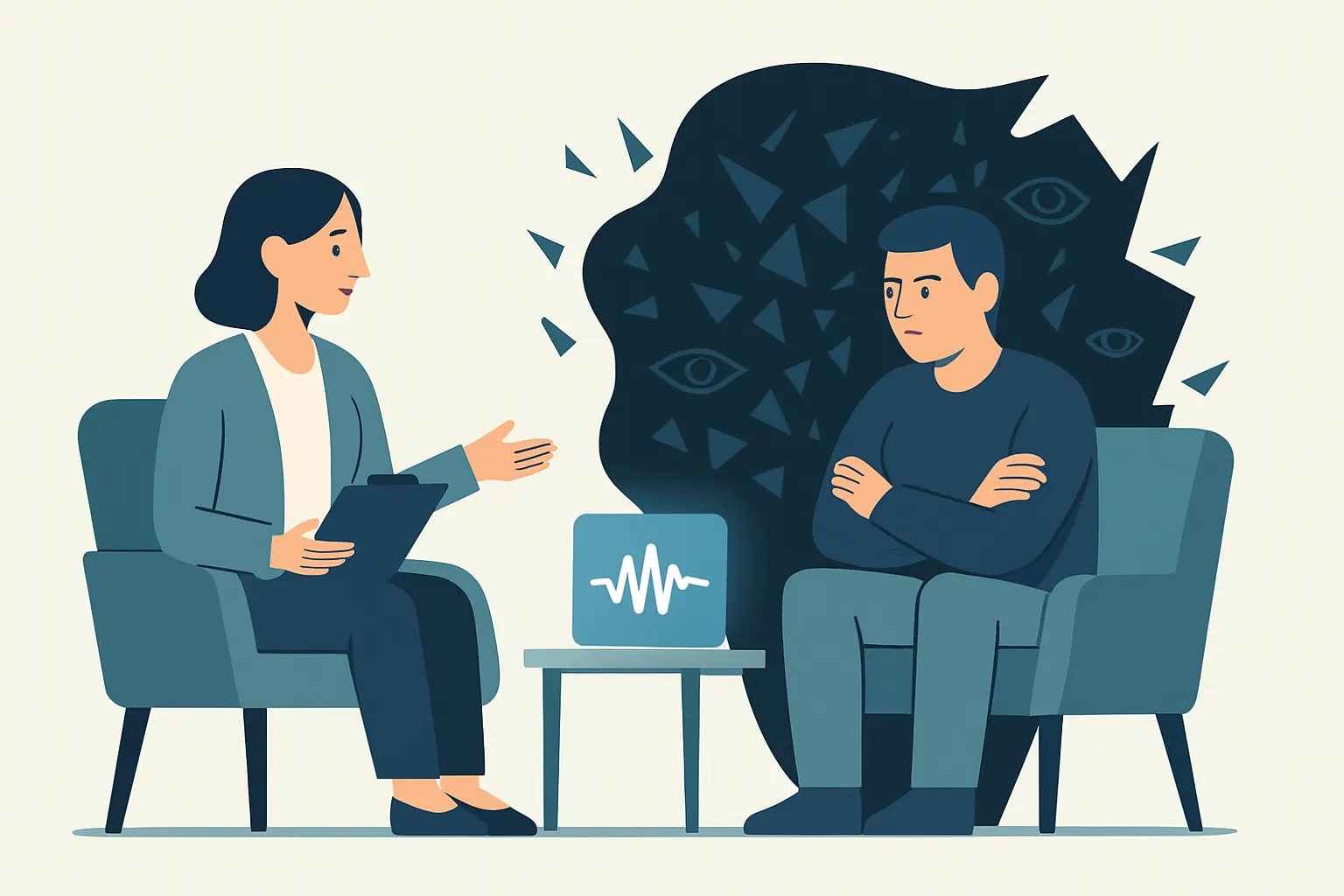
On the MMPI-2, a co-elevated 6-8 code type pairs hostile distrust of the world (Scale 6) with a breakdown in cognitive integration (Scale 8), and it typically signals more severe pathology than either scale alone. A relatively low Scale 7—the "paranoid valley"—raises concern for chronic schizophrenia, and the underlying anger makes the working alliance hard to establish. Sound differentiation weighs the relative height of the scales, validity indicators, the nature of core symptoms, and the logic of the thought process. In session, clinicians do best by standing psychologically alongside the client, offering a clearly structured frame, and using a security-first AI documentation tool to reduce the note-taking burden so attention stays on the relationship.
When Distrust Hides Something Larger
You know the moment. A client scans the room before sitting down, then sharpens at the smallest gesture—"Are you analyzing me right now?" The question underneath, for the clinician, is colder: Is this temperamental sensitivity, or the leading edge of psychosis? Few profiles make that question harder to answer than the MMPI-2 6-8/8-6 code type, where Scale 6 (Pa) and Scale 8 (Sc) rise together. Deep distrust of others fuses with disorganized, idiosyncratic thinking. The result is a client who is genuinely difficult to ally with—and, if you're not careful, one in whom early signs of psychosis can slip past unnoticed.
The clinical challenge is twofold. First, drawing the line between frank delusion and reality-based anxiety. Second, a quieter dilemma: with these clients, the simple act of taking notes can read as surveillance, and the rapport you're working to build can fracture in real time. This article walks through the psychological dynamics of the 6-8 code type, the key points that separate it from a paranoid personality presentation, and concrete strategies for working safely within a fragile alliance.
1. The Dynamics: Distrust Meets Disorganization
When Scale 6 and Scale 8 elevate together, two processes are running at once inside the client: a hostile mistrust of the world and a breakdown in cognitive integration. That combination usually points to more serious pathology than a single-scale elevation would.
Compromised reality testing
A high Scale 8 reflects loosened logical thinking, difficulty sustaining attention, and a slipping grip on consensual reality. Add Scale 6's reliance on projection as a defense, and the client externalizes internal chaos—attributing it to forces outside the self. This is the soil in which persecutory ideation grows: "Someone is controlling me," "The world is out to harm me."
Emotional incongruity and social withdrawal
These clients often long for connection while simultaneously bracing for betrayal, and the fear wins—they withdraw. The pattern is sharpest when Scale 7 (Pt) sits relatively low, producing the classic "V" of the paranoid valley (6-8 high, 7 low). A low Scale 7 suggests the person feels little anxiety about their beliefs, which often means a delusional system has consolidated and stabilized. That configuration warrants serious consideration of chronic schizophrenia.
Latent anger and aggression
This is not passive withdrawal. Under Scale 6's influence, considerable anger sits just below the surface. An offhand clarifying question can land as an attack, and hostility may surface without warning. For these clients, the clinician's management of countertransference matters as much as any technique.
2. Schizophrenia Spectrum vs. Paranoid Personality: Key Differentiators
A 6-8 code type is not, by itself, a diagnosis of schizophrenia. It can reflect a transient response to severe stress, or pathology that lives at the personality level. The table below organizes the indicators worth comparing before drawing a conclusion.
| Dimension | Suggests Schizophrenia | Suggests Paranoid Personality Disorder |
|---|---|---|
| Scale configuration | Scale 8 markedly higher than Scale 6 (8 > 6); Scale 7 relatively low (paranoid valley) | Scale 6 ≥ Scale 8; Scale K may be somewhat elevated |
| Validity scales | F very high (≈80–90T or above); VRIN/TRIN may be normal (not random responding) | F mildly elevated or normal; L and K used to justify the self |
| Core symptoms | Bizarre thoughts, auditory hallucinations, disorganized speech; Harris-Lingoes Sc3, Sc6 elevated | Suspiciousness, grudge-holding, jealousy, litigiousness; reality testing intact but interpretation biased |
| Thought process | Loosening of associations, thought blocking | Logical reasoning built on a false premise (systematized delusion) |
Table 1. Comparing clinical presentations within the MMPI-2 6-8 code type.
The single most informative contrast is often the thought process row. A paranoid-personality client reasons coherently from a distorted premise; the conclusions follow logically once you accept the starting belief. A client on the schizophrenia spectrum shows the strain in the connective tissue of thought itself—associations loosen, threads break. The MMPI-2 numbers narrow the field, but it's the interview that confirms which picture you're looking at.
3. In the Room: Practical Strategy and the Role of AI Documentation
Working with a 6-8 client calls for a particular kind of finesse—warmth that's too eager invites suspicion, while neutrality that's too flat reads as rejection. A few approaches translate well into practice.
Stand side-by-side, not face-to-face
Direct eye contact and a confrontational posture can feel threatening. Position yourself psychologically alongside the client, looking out at the world from where they stand. Something like: "It sounds like the world has been making things very hard for you. I'd like to understand that situation with you." The move is to focus on the distress the beliefs produce without either endorsing or directly disputing their content.
Offer structure and clear boundaries
Ambiguity is fuel for paranoid cognition. Be unusually explicit about the frame—session length, fees, the limits of confidentiality. A predictable environment lowers baseline anxiety and gives trust something solid to form around.
The note-taking dilemma—and where AI helps
Writing in a notepad in front of a 6-8 client can be costly: "What is he writing down, and what's he going to do with it?" Yet you also can't afford to lose the specifics—the disorganized speech, the precise content of the delusional material. This is where a security-first AI documentation tool can resolve the tension rather than add to it.
- Presence over paperwork. With transcription handled in the background, you can set the pen down and attend fully to the client's gaze and micro-expressions—exactly what rapport depends on.
- Language-pattern analysis. An AI session transcript captures tangential, derailed, or grammatically fractured speech verbatim. Reviewing it afterward gives you an objective read on the degree of associative looseness or flight of ideas.
- Objective tracking over time. Comparing how delusional statements shift session to session creates a timeline you can use to monitor medication response or detect deterioration early.
Used this way, Modalia AI functions as a security-first partner for clinicians—handling transcription, supporting case conceptualization, and easing the documentation load—so your attention stays where it belongs: on observing and connecting.
Conclusion: Precise Assessment Is the Compass for Care
The MMPI-2 6-8 code type is among the most demanding presentations a clinician encounters. Behind the sharp suspicion and the strange behavior, though, is usually a desperate effort to hold a fragmenting self together. We see the client clearly not by reading scale scores in isolation, but by integrating them with the validity-scale configuration, subscale analysis, and the nonverbal cues that surface in the interview.
With clients whose paranoid features run strong, it's worth deliberately adopting modern tools—AI documentation that lifts the recording burden—so that the essence of the work, attunement and observation, can take center stage. When careful assessment, a safe therapeutic stance, and efficient tools come together, the path that leads a client out of confusion and back toward the world grows a little wider.
References
- 1.
- 2.
Frequently asked questions
What does a 6-8/8-6 code type on the MMPI-2 indicate?
It reflects co-elevation of Scale 6 (Pa) and Scale 8 (Sc)—hostile distrust combined with disorganized, idiosyncratic thinking. This pairing typically signals more severe pathology than either scale alone and is associated with impaired reality testing, social withdrawal, and latent anger.
What is the "paranoid valley" and why does it matter?
The paranoid valley is a "V"-shaped configuration in which Scales 6 and 8 are elevated while Scale 7 (Pt) sits relatively low. The low Scale 7 suggests little anxiety about the beliefs, which often means a delusional system has consolidated—raising concern for chronic schizophrenia.
How do I distinguish schizophrenia from paranoid personality disorder in this profile?
Weigh the relative height of the scales (8 > 6 vs. 6 ≥ 8), validity indicators (a very high F vs. mild elevation), and especially the thought process. Schizophrenia tends to show loosened associations and thought blocking, while paranoid personality reasons logically from a false premise with reality testing intact.
How can AI documentation help when note-taking damages rapport?
With 6-8 clients, visible note-taking can read as surveillance. A security-first AI transcription tool runs in the background so the clinician can stay present, while still capturing disorganized speech verbatim for later analysis and tracking how delusional content changes across sessions.
This article was written and reviewed using Modalia AI's clinical guidelines, with professional human review before publication.
Related articles
 Case Conceptualization
Breaking the "Yes, But" Game: A Transactional Analysis Guide for Therapists
Every suggestion you offer gets met with "Yes, but..." Here's the TA structure behind that stall—and four clinical moves to break it.
7 min read Case Conceptualization
Yalom's The Gift of Therapy: Passages Every New Counselor Should Copy by Hand
Irvin Yalom's prescription for therapists who fear silence: meet your client as a "fellow traveler" and let the here-and-now become the heart of the work.
6 min read Case Conceptualization
Working With Silence in Therapy: What Client Silence Means and How to Hold It
Silence in session isn't empty space. Learn to read its clinical meaning, tell productive from defensive silence, and use it as a therapeutic tool.
6 min read