Reading the MMPI-2 'Smile Pattern': What a V-Shaped L-F-K Profile Really Means
A high-L, low-F, high-K 'smile' on the MMPI-2 isn't simply faking-good. Learn to distinguish naivety, situational defense, and neurotic denial—and how to respond clinically.
Key takeaway
When the MMPI-2 validity scales form a 'V' or 'smile' pattern (high L and K, low F), it is rarely a clean signal of dishonesty. The configuration can reflect three distinct things: naive self-satisfaction in a client with low psychological insight, deliberate impression management in an evaluative setting, or neurotic denial and repression of conflict the client cannot tolerate. When a markedly elevated K accompanies a clinical-scale Conversion V (high Hs and Hy, lower D), suspect that psychological distress is being expressed somatically. With these defended clients, validation works better than confrontation, and the clinician's task is to reconcile the test data with nonverbal cues observed in session.
"I'm really fine, doctor": reading the truth behind a smiling MMPI-2 profile
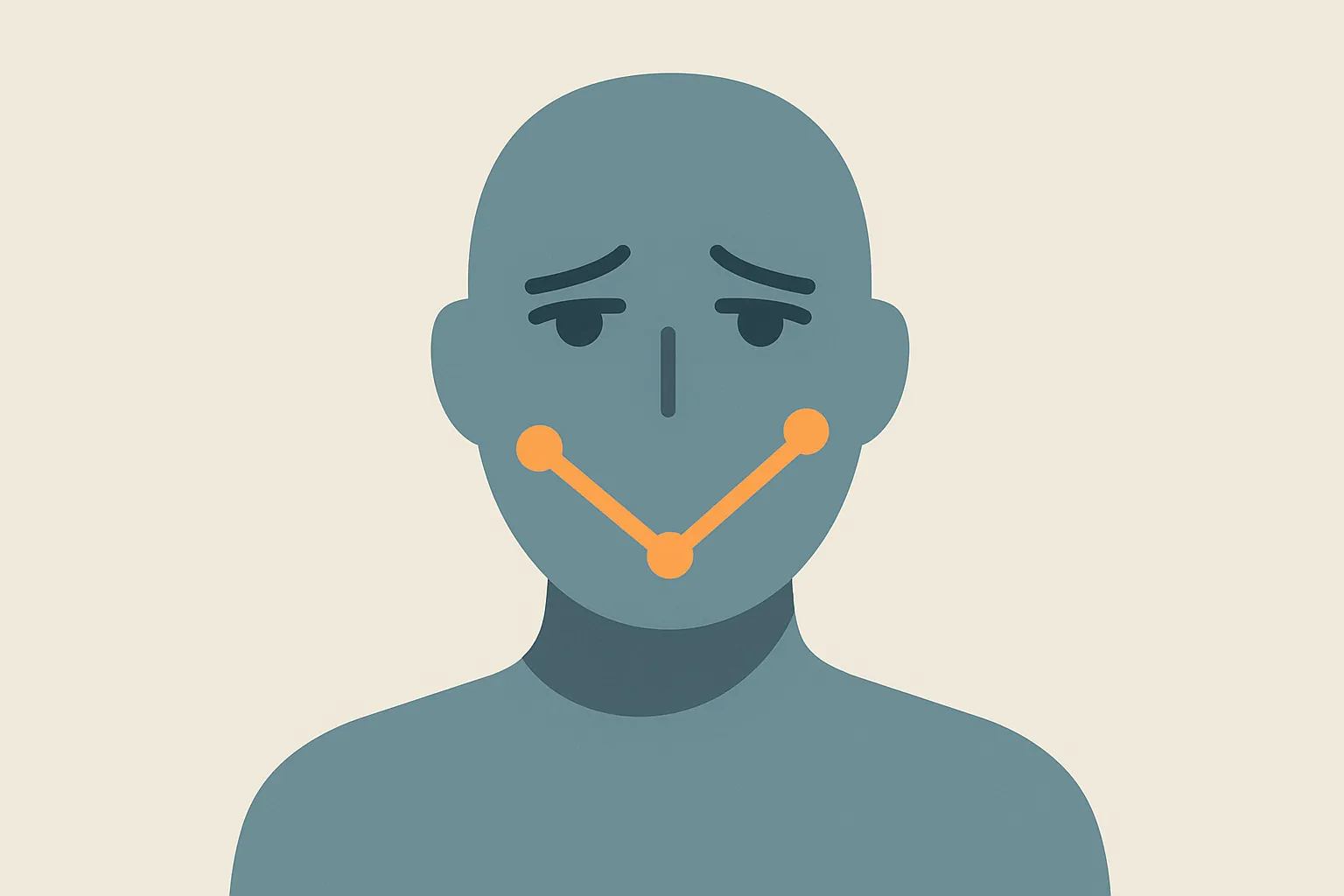
One of the more disorienting moments in clinical practice is when a client arrives clearly burdened—reporting distress, conflict, or impaired functioning—yet the test data come back looking "perfectly normal," or even improbably healthy. On the MMPI-2, this often shows up in the validity scales: L (Lie), F (Infrequency), and K (Correction) arranged in a 'V' shape, with L and K elevated and F suppressed. Because the line traces the shape of a smiling mouth, it's sometimes called the smile pattern.
The question is what that smile means. Is it genuine well-being, or a well-built shield aimed at the evaluator? Clinicians tend to err in one of two directions here—prematurely concluding the client is "faking it," or missing the quiet desperation tucked behind the defense. This article walks through how to read the ambiguous V-shaped validity profile with more precision, and how to use it as a way into the work rather than a wall against it.
The core dynamic: "faking good" is not one thing
When L, F, and K form a V, the first interpretation that comes to mind is a favorable self-presentation, or "faking good." But a clinician should resist collapsing this into "the client is lying." Depending on the client's circumstances and ego strength, the same configuration can carry at least three quite different clinical meanings.
1. Naive self-satisfaction
Here the client genuinely does not register significant distress and sincerely sees themselves as moral, competent, and socially well-adapted. This is common in clients with limited psychological-mindedness, less exposure to introspective frameworks, or rigidly held moral or religious values. They aren't lying—they are reporting the ideal self they actually believe in.
2. Situational defensiveness
Clients in evaluative contexts—custody disputes, pre-employment or fitness-for-duty screening, court-ordered assessment—consciously work to conceal flaws. In these settings the V pattern can be a strategic, even adaptive, choice. When defense is purely situational, the clinical scales usually show little meaningful elevation.
3. Neurotic denial and repression
This is the configuration that warrants the most clinical care. The client cannot tolerate underlying anxiety or conflict, so they unconsciously repress and deny it. On the surface they insist nothing is wrong; underneath, they may be carrying somatic symptoms or dissociated anxiety. These cases are often the most urgent to engage and, simultaneously, the most resistant.
Transient defense or enduring trait? A comparative read
Facing a V-shaped profile, the clinician has to decide whether they are looking at a temporary, state-driven defense or a stable characterological style. Two things help disambiguate: the relative heights of L, F, and K, and how the validity pattern pairs with the clinical scales. The table below sketches the distinctions (T-scores are approximate guideposts, not cutoffs).
| Profile type | L (Lie) | F (Infrequency) | K (Correction) | Clinical implication |
|---|---|---|---|---|
| Adaptive / normal V | T 50–60 (average to mildly high) | T 40–50 (average to mildly low) | T 55–65 (moderately high) | Good ego strength and coping. Tends to manage problems independently. |
| Conscious defense (faking good) | T ≥ 65 (very high) | T < 40 (very low) | T ≥ 65 (very high) | Deliberately concealing flaws. Sensitive to evaluation; may be guarded or uncooperative. |
| Neurotic defense (repression) | ~T 60 | ~T 45 | T ≥ 70 (markedly high) | Disowns psychological distress. Check for a clinical-scale Conversion V—co-elevation of Scale 1 (Hs) and Scale 3 (Hy). |
Table 1. Subtypes of the V-shaped MMPI-2 validity configuration.
Practical strategies for the smile-pattern client
When the test result contradicts the presenting complaint, the clinician is in a bind. Asking "Your results look normal—so why are you here?" is a fast way to rupture rapport. Three approaches tend to work better with a V-shaped defense.
1. Check for a clinical-scale Conversion V
Look at whether the validity-scale V coincides with a Conversion V on the clinical profile—Scale 1 (Hypochondriasis) and Scale 3 (Hysteria) elevated with Scale 2 (Depression) lower between them. When this co-occurs, the odds are high that the client is expressing psychological conflict in the language of the body rather than the language of emotion. Reframing early goals around "easing physical discomfort and managing stress" rather than "resolving a psychological problem" lowers initial resistance.
2. Lead with validation, not confrontation
Confronting the defense of a high-K client tends to backfire. Instead, name and credit their effort to cope and their resilience first. An interpretive comment such as—"Looking at these results, it seems you work hard to stay steady even under real pressure. You may look composed on the outside, and carry a lot of tension on the inside at the same time"—offers a safe space for the client to lower the shield on their own terms.
3. Reconcile the test data with nonverbal cues
When the MMPI-2 says "I'm fine," pay close attention to tone of voice, frequent sighs, speech rate, and micro-shifts in facial expression. A self-report inventory can be controlled; in-the-moment reactions in session are far harder to manage. Catching the tremor or hesitation in the instant a client says "it's nothing" is what lets you bridge the gap between the numbers and the affect underneath them.
Conclusion: defense is not deception—it's how the client survived
The 'V' traced by L, F, and K is not a lie-detector reading. It can be the wall a client built, with great effort, to protect themselves from a threatening world. The clinician's role is not to tear that wall down by force, but to help the client feel safe enough to unlatch it from the inside. The therapeutic alliance begins in earnest the moment we read the adaptive effort hidden behind the scores.
The more defended the client, the more the meaning lives in the subtle texture of what's said in the room. A client may report "no problems" while pausing, hesitating, and falling silent dozens of times across a session. To avoid losing that verbal–nonverbal mismatch, many clinicians now lean on AI-assisted session transcription and documentation tools (such as Otter, Nabla, or a security-first option like Modalia AI) to capture speech patterns, the frequency of pauses, and emotion-laden language as objective text. Used well, these tools act as a kind of secondary set of ears—helping bridge the gap between the MMPI-2 profile and what actually unfolds in session.
One thing to try this week: if a case feels stalled or oddly surface-level, pull the MMPI-2 profile again and ask whether a 'smiling V' might be holding back something the client can't yet say—and what question you'd need to prepare to hear the truth behind the smile.
References
- 1.
- 2.
Frequently asked questions
What does a V-shaped (smile pattern) MMPI-2 validity profile mean?
It refers to elevated L and K scales with a suppressed F scale, producing a line that resembles a smiling mouth. It often signals a favorable self-presentation, but the meaning ranges from naive self-satisfaction to deliberate impression management to unconscious neurotic denial—so it should never be read as simple dishonesty without further analysis.
How do I tell deliberate 'faking good' from neurotic repression?
Compare the relative heights of L, F, and K and how they pair with the clinical scales. Conscious faking good typically shows very high L and K (T ≥ 65) with very low F and few clinical-scale elevations. Neurotic repression tends to show a markedly high K (T ≥ 70) alongside a clinical-scale Conversion V—co-elevated Scale 1 (Hs) and Scale 3 (Hy).
What is a Conversion V and why does it matter here?
A Conversion V is a clinical-scale pattern with Scales 1 (Hs) and 3 (Hy) elevated and Scale 2 (D) lower between them. When it co-occurs with a defensive validity profile, it suggests the client is channeling psychological conflict into physical symptoms, which should reshape early treatment goals toward symptom relief and stress management.
How should I approach a client with a defensive, high-K profile?
Lead with validation rather than confrontation. Acknowledge their coping effort and resilience first, then gently note the possible gap between outward composure and inner tension. Confronting the defense directly tends to increase guardedness and damage the working alliance.
This article was written and reviewed using Modalia AI's clinical guidelines, with professional human review before publication.
Related articles
 Case Conceptualization
Breaking the "Yes, But" Game: A Transactional Analysis Guide for Therapists
Every suggestion you offer gets met with "Yes, but..." Here's the TA structure behind that stall—and four clinical moves to break it.
7 min read Case Conceptualization
Yalom's The Gift of Therapy: Passages Every New Counselor Should Copy by Hand
Irvin Yalom's prescription for therapists who fear silence: meet your client as a "fellow traveler" and let the here-and-now become the heart of the work.
6 min read Case Conceptualization
Working With Silence in Therapy: What Client Silence Means and How to Hold It
Silence in session isn't empty space. Learn to read its clinical meaning, tell productive from defensive silence, and use it as a therapeutic tool.
6 min read