Beyond Squares and Circles: Modernizing Genogram Symbols for Divorce, Blended, and LGBTQ+ Families
How to update genogram notation for divorce, remarriage, and LGBTQ+ and chosen families—plus a clinician's guide to expanded symbols that sharpen assessment.
Key takeaway
The traditional genogram symbols codified by Bowen and McGoldrick in the 1970s struggle to capture the diversity of 21st-century families—blended households after divorce and remarriage, LGBTQ+ clients, and chosen families. By adopting an expanded notation system—symbols that distinguish gender identity from assigned sex, relationship lines that separate cohabitation from legal divorce, and ways to map emotional bonds beyond biology—clinicians strengthen the working alliance while capturing richer clinical data. This guide also covers how AI-assisted documentation tools can help reconstruct complex family histories after the session.
Beyond Squares and Circles: Why a Changing Family Needs an Evolving Map
Have you ever listened to a client narrate a tangled family history and realized the standard genogram symbols simply couldn't hold the dynamics in front of you? The genogram systematized by Murray Bowen and Monica McGoldrick in the 1970s remains an indispensable tool in family work—but the families we see today rarely fit the traditional "nuclear" mold. Rising divorce rates, the normalization of blended households, and the visibility of LGBTQ+ families all demand a new clinical vocabulary.
A genogram is not a family tree or a record of lineage. It is a therapeutic map—a way to visualize emotional currents and intergenerational transmission. When we reach for a symbol that ignores a client's gender identity, or flatten the layered custody arrangements of a blended family into a single line, we don't just lose precision. We risk eroding rapport and missing the very clinical cues that make the genogram worth drawing. This article walks through how to build a more accurate, more ethical genogram that reflects the diversity of contemporary family life—and the clinical insight that comes with it.
1. Understanding Modern Family Structures—and Why the Genogram Has to Stretch
In practice, we meet far more families that fall outside any "standard" category than inside it. From a family systems perspective, boundaries and subsystems have become markedly more fluid. Reflecting that reality accurately on the page sends the client an unspoken but powerful message: your family, as it actually is, belongs here.
Depicting divorce and remarriage with precision
For decades, divorce was captured by little more than two slashes (//) signaling a severed tie. Contemporary practice asks for more: the distinction between legal and emotional divorce, current cohabitation status, and the shape of any co-parenting arrangement. In a blended family, for instance, whether a stepparent–child relationship is a legal one through adoption or a de facto bond formed through cohabitation can completely reshape the household's dynamics and conflict patterns.
Reflecting LGBTQ+ identities and gender diversity
The binary of square-for-male and circle-for-female cannot represent transgender, nonbinary, or intersex clients. Distinguishing a client's assigned sex at birth from their gender identity on the genogram is a baseline expression of multicultural competence. It is also clinically essential: it lets you visualize information about gender dysphoria, minority stress, or social stigma that may be central to the presenting concern.
Including assisted reproduction and non-biological families
As conception through fertility treatment, surrogacy, and donor gametes becomes more common, biological and rearing parents increasingly are not the same people. Equally important is the chosen family—people who are not blood relatives but provide deeper emotional support than the family of origin. Mapping these bonds helps you see the full picture of a client's resources and support network.
2. A Practical Guide to Expanded Genogram Symbols
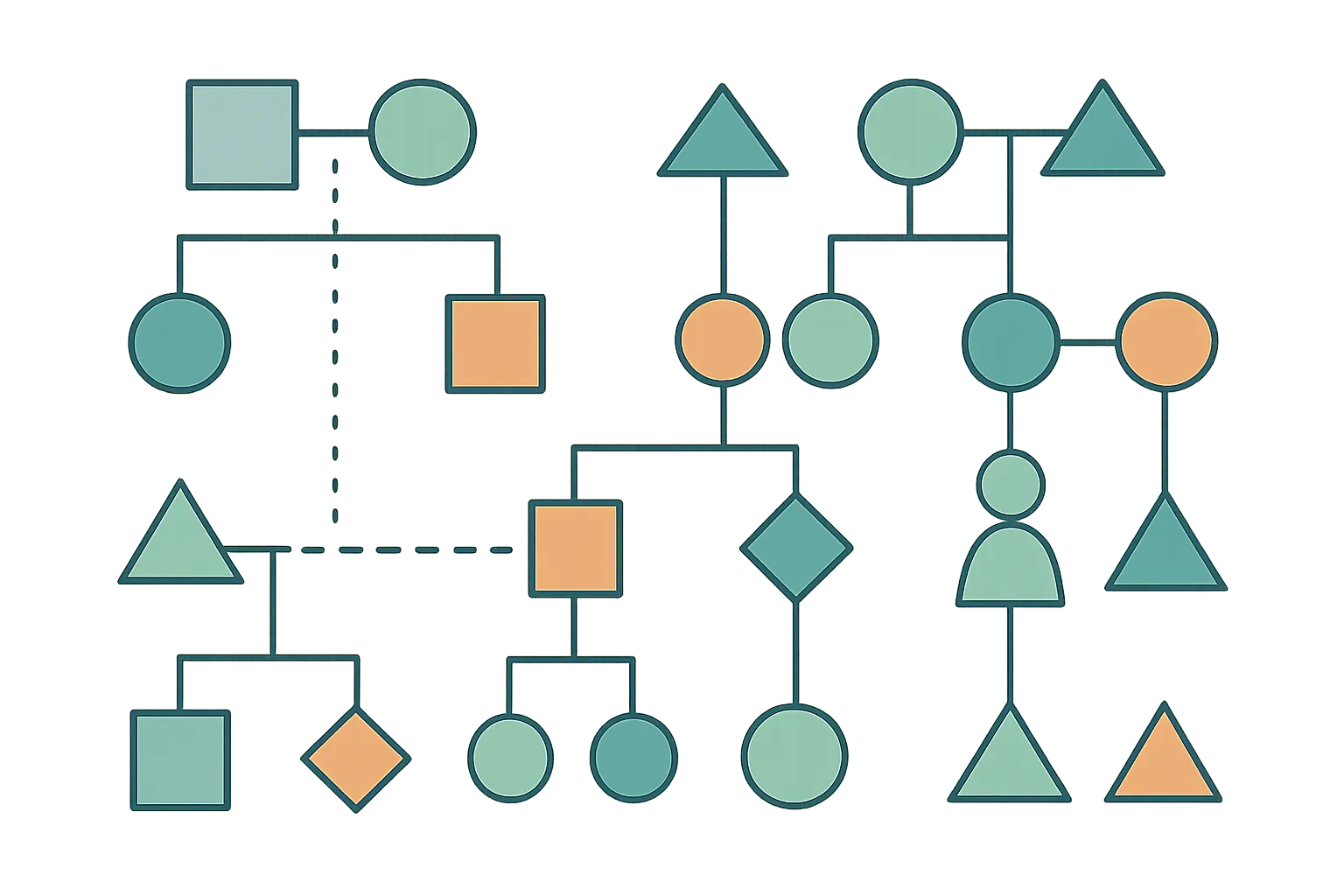
To keep your records accurate, it helps to compare the traditional notation against its modern extensions side by side. The table below summarizes the key shifts you can put to use immediately. (Symbols are described in words here so they render cleanly across any CMS; reproduce the corresponding glyphs—square, circle, diamond, inverted triangle—in your charting software or by hand.)
| Category | Traditional Limitation | Modern Expansion |
|---|---|---|
| Divorce & separation | A single or double slash marking only the rupture | • Separation: single slash + separation date • Divorce: double slash + date finalized • Cohabiting after divorce: dotted line bridging the double slash |
| Remarriage & blended families | A new spouse line simply appended | • Common-law/cohabiting union: dashed connecting line • Custody: place the child's line closer to the custodial parent, or annotate explicitly |
| LGBTQ+ & gender diversity | Only the male (square) / female (circle) binary | • Transgender man: circle nested inside a square • Transgender woman: square nested inside a circle • Nonbinary/queer: a diamond or inverted triangle |
| Quality of relationship | Reduced to a straight line (close) or zigzag (conflict) | • Abuse (physical/emotional): zigzag arrow with directionality • Repairing after estrangement: dotted line spanning a broken line • Enmeshment/fusion: triple solid line |
Table 1. A comparison of traditional and expanded genogram notation for sharper clinical insight.
3. Putting a More Complex Genogram to Work
Knowing the expanded symbols matters less than weaving them into the session itself. Don't let the act of drawing intricate notation pull you out of the clinical flow—and once it's drawn, the genogram should let you generate therapeutic hypotheses.
Use the drawing process as an intervention
Treat the act of constructing the genogram as a therapeutic intervention in its own right. Try asking, "This symbol is often used to represent a transgender person—what feels like the most fitting symbol for you?" Offering clients the chance to define themselves on the page strengthens the working alliance and reinforces their sense of agency.
Layer your relationship lines
In families shaped by divorce and remarriage, the emotional relationship often matters more than the legal one. A bond with a stepmother may be closer than with a biological mother; unresolved conflict with an ex-partner may bleed into the current marriage. Using color-coded pens—black for legal ties, green for emotional closeness, red for conflict—lets you draw these as distinct layers, which makes clinical analysis far easier.
Use AI tools to capture detail and streamline documentation
When a family is large and the relationships are complex—half-siblings, polyamorous configurations, multiple households—and the client is speaking quickly, drawing an accurate genogram in real time becomes nearly impossible. How do you avoid losing a statement like "My second son from my first husband lives with me, but my current husband's daughter is being raised by his ex-wife..."?
This is where AI-assisted session documentation and transcription becomes a powerful support. During the session, you stay present—making eye contact, attending to affect—while the AI captures the spoken record. Afterward, you review the transcript to verify the factual scaffolding (dates of birth, timing of divorces, length of cohabitation) and refine the genogram accordingly. Modern tools that perform speaker separation and surface key terms can dramatically cut the time it takes to structure a complex web of family members. Modalia AI is built for exactly this kind of work—a security-first partner for counselors that handles transcription, case conceptualization support, and documentation so the clinical thinking stays with you.
Conclusion: A Vessel That Holds the Whole of a Client's Life
A genogram is more than a diagram. It is the history a client has lived and the sum of the relationships they carry now. Choosing symbols that reflect contemporary family forms signals something profound: the therapist's commitment to understanding the client's life as it is, without bias.
Step away from an outdated symbol set and start drawing a genogram capacious enough to hold each client's particular story. It may feel unfamiliar and effortful at first. Begin with a few small practices:
- ✅ Update your symbols. Keep a quick reference for LGBTQ+ and diverse-family notation at your desk and use it when the moment calls for it.
- ✅ Change your questions. Instead of "Are your parents married?", ask openly: "Who is in your family, and how are they connected to one another?"
- ✅ Lean on your tools. To avoid missing the detail in a complex narrative, build a routine of using AI-assisted transcription to revise and complete the genogram after the session.
With a genogram precise enough to honor a changing family, your work can offer clients deeper insight—and deeper comfort.
References
- 1.
- 2.
Frequently asked questions
Why aren't traditional genogram symbols enough for today's clients?
The square/circle binary and single-line conventions codified in the 1970s can't represent transgender, nonbinary, or intersex clients, distinguish legal from emotional divorce, or map cohabitation, co-parenting, and chosen families. Using outdated notation risks both weakening rapport and missing meaningful clinical data.
How do you represent a transgender or nonbinary client on a genogram?
A common convention nests one shape inside another—a circle within a square for a transgender man, a square within a circle for a transgender woman—while a diamond or inverted triangle can denote nonbinary or queer identity. Best practice is to distinguish assigned sex at birth from gender identity and to invite the client to choose the symbol that fits them.
How can I keep up with a complex family history during a live session?
Rather than drawing intricate notation in real time, stay present with the client and use AI-assisted transcription to capture the spoken record. Afterward, review the transcript to verify dates and relationships and refine the genogram—tools with speaker separation and keyword extraction make structuring complex families much faster.
This article was written and reviewed using Modalia AI's clinical guidelines, with professional human review before publication.
Related articles
 Case Conceptualization
Breaking the "Yes, But" Game: A Transactional Analysis Guide for Therapists
Every suggestion you offer gets met with "Yes, but..." Here's the TA structure behind that stall—and four clinical moves to break it.
7 min read Case Conceptualization
Yalom's The Gift of Therapy: Passages Every New Counselor Should Copy by Hand
Irvin Yalom's prescription for therapists who fear silence: meet your client as a "fellow traveler" and let the here-and-now become the heart of the work.
6 min read Case Conceptualization
Working With Silence in Therapy: What Client Silence Means and How to Hold It
Silence in session isn't empty space. Learn to read its clinical meaning, tell productive from defensive silence, and use it as a therapeutic tool.
6 min read