When the Past Repeats: Reading Multigenerational Trauma in the Genogram
How to trace inherited trauma through three generations, read the family's emotional map in a genogram, and help clients break the cycle.
Key takeaway
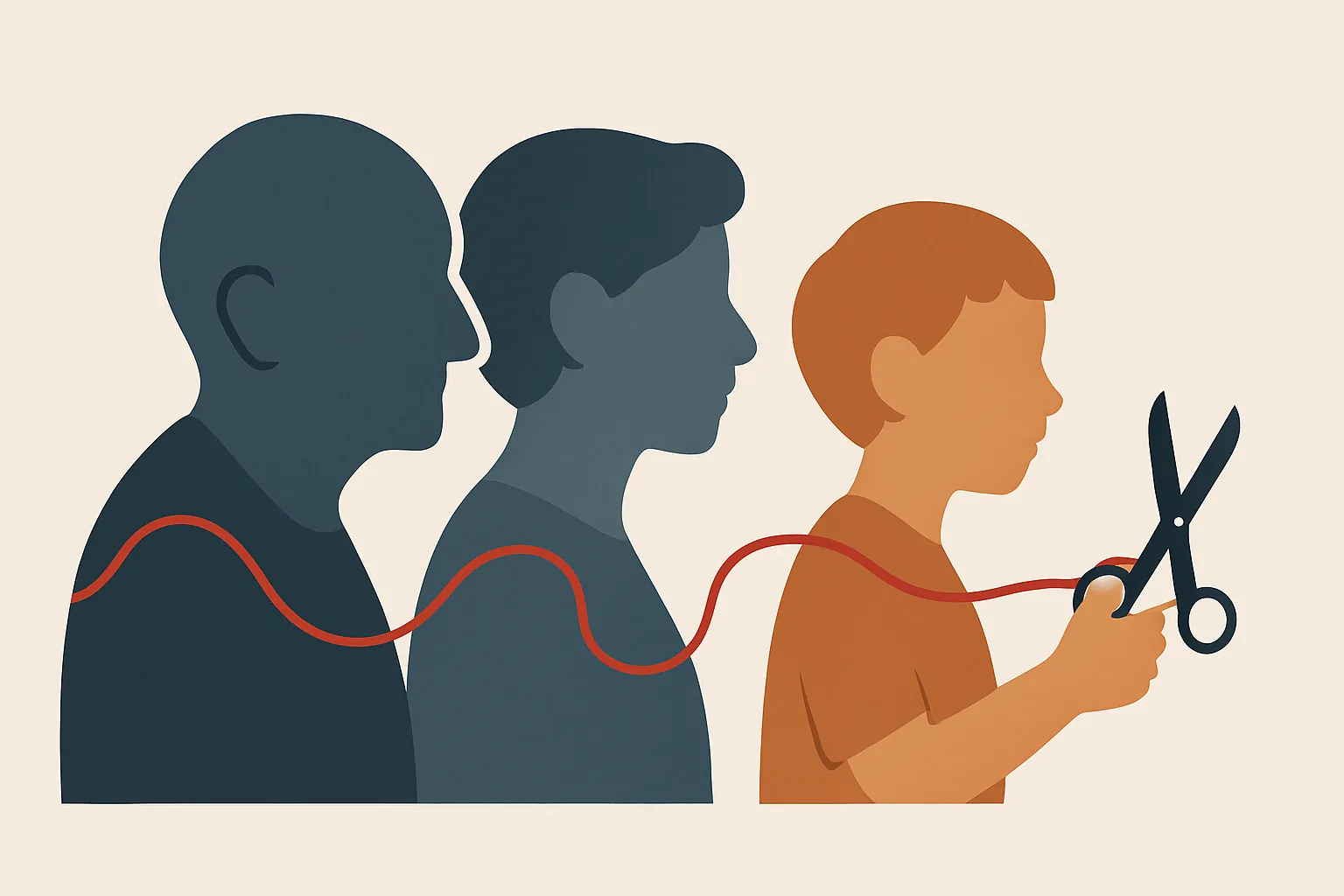
Some clients carry a depth of helplessness or anxiety that present-day stressors alone can't explain. Drawing on Bowen's family systems theory, this guide shows how unresolved emotional pain transmits across generations through biological (epigenetic), psychodynamic (projective identification), and family-systems (triangulation, fusion, cut-off) pathways. The genogram becomes the clinician's central tool for tracing these patterns, and targeted interventions—ritual reconstruction, detriangulation, and narrative re-authoring—help clients step out of the inherited cycle.
Where Did the Client's Pain Begin? Tracing the Invisible Thread of Multigenerational Trauma
Every clinician knows the client who walks in carrying a weight that the present can't account for—a depth of helplessness or anxiety that outlasts any current stressor. When a client says, "I swore I'd never live the way my parents did, and then I woke up and realized I'm doing exactly the same thing," we're hearing something more than learned behavior or imitation. We're hearing the pull of multigenerational transmission of trauma.
As Murray Bowen's family systems theory emphasizes, emotional problems left unresolved in one generation don't simply disappear. They travel forward—like a kind of ghost—and surface as symptoms in the next. Recognizing these patterns is often the key that unlocks a stalled treatment. But sorting the essential transmission pathway out of a tangle of family dynamics is hard work, even for seasoned clinicians. This article walks through how to use the genogram to identify the repeating loop and design interventions that help a client move toward healing.
1. How Trauma Is Inherited: Understanding the Mechanisms
To distinguish whether a client's symptom reflects individual pathology or a family-system inheritance, we need a clear picture of how trauma travels. Contemporary clinical research describes this across biological, psychological, and relational dimensions. The goal isn't to assign blame to parents—it's to objectify the origin of the symptom so the client can set down some of their shame. That reframing is the first therapeutic move.
Primary Transmission Pathways and Their Clinical Markers
Transmission rarely runs along a single track; it's a layered interaction. The table below compares the mechanisms worth watching for in session.
| Lens | Key Theory / Concept | What to Watch for in Session (Clinical Focus) |
|---|---|---|
| Biological | Epigenetics; altered HPA-axis sensitivity | Physiological hyperarousal to stress, a constitutionally high baseline of anxiety, unexplained somatic symptoms |
| Psychodynamic | Projective identification; "ghosts in the nursery" (Fraiberg) | A parent projecting unresolved fear or rage onto the child; the child acting out the parent's repressed affect |
| Family Systems | Multigenerational transmission process (Bowen); triangulation | Chronic family anxiety, alternating fusion and cut-off, a recurring pattern of scapegoating one member |
Table 1. A comparison of the primary pathways of multigenerational trauma transmission and their clinical markers.
With this framework in mind, the clinician listens for signs of repetition compulsion woven into the client's narrative. The work is to surface the linkages—for example, a grandparent's wartime terror hardening into a parent's overprotectiveness, which in turn emerges as the client's agoraphobia a generation later.
2. Reading Patterns with the Genogram—and Where to Intervene
A genogram is not just a family tree; it is the family's emotional map. To use it well in clinical practice, you have to go beyond cataloguing facts (marriages, divorces, deaths) and capture the emotional currents running beneath them—including phenomena like the anniversary reaction.
Three Things a Clinician Must Not Miss in Genogram Analysis
-
The functional role of the symptom. Ask what a given symptom does within the family. If a child's school refusal quiets the parents' marital conflict, the behavior may not be the child's individual problem at all—it may be an unconscious attempt to regulate the anxiety of the whole system.
-
Tracking emotional cut-off and fusion. Pay attention to relationships that are either intensely enmeshed or completely severed. As Bowen noted, cut-off is not resolution—it's a powerful emotional reaction that avoids conflict rather than working through it. On the far side of a cut-off relationship, you'll often find excessive fusion in the next generation.
-
The timing of the re-enactment. Check whether the client's symptoms emerged at the same age a parent or grandparent experienced their own trauma. A statement like "I hit the age my mother was when she divorced, and suddenly I found myself resenting my husband" is strong evidence of multigenerational transmission.
3. Breaking the Chain: Differentiation and Restructuring
Once you've mapped the flow of trauma, the work shifts to changing its course. The clinician helps the client differentiate—to separate the self from the family's history—and to rebuild a life on their own terms.
Techniques You Can Apply in Session
-
Reconstructing family rituals. Recurring negative rituals—say, the predictable blowup that erupts every time the extended family gathers for a holiday—can be reshaped into rituals of mourning or affirmation. Rather than maintaining silence around a traumatic event, it helps to put it into words and commemorate it within a safe, structured setting.
-
Detriangulation training. Coach the client to set boundaries so they stop serving as the mediator or emotional dumping ground between parents or other family members. The core move is drawing a psychological line: "That is a problem between my mother and father—not mine to carry."
-
Narrative re-authoring. Deconstruct the dominant story—"I inherited a depressive bloodline"—and help the client locate an alternative narrative: "a tenacious capacity to survive in difficult conditions." Reframing the inheritance as resilience strengthens the client's resources.
Conclusion: From Pattern to Insight
Working with multigenerational trauma is long-haul work. Surfacing the vast shadow of family history behind a client's presenting concern demands real insight and energy from the clinician. We're asked to find meaningful patterns across three or four generations and countless events.
This is where the accuracy of your clinical records matters. An offhand remark in session—"my aunt went through the same thing when she was young"—can turn out, weeks later, to be the decisive clue in a genogram analysis. The details we capture today are the evidence we reason from tomorrow.
An Action Plan for Therapists:
- Choose one current client who shows a repeating relational pattern.
- Redraw that client's three-generation genogram, and mark the emotional currents beneath the surface events—literally, in red—rather than only the facts.
- Revisit your existing notes for that case and look for the fine-grained clue you may have missed the first time.
References
- 1.
- 2.
Frequently asked questions
What is multigenerational transmission of trauma?
It's the process by which unresolved emotional pain and patterns pass from one generation to the next. Bowen's family systems theory frames it as a multigenerational transmission process, and it operates through biological (epigenetic), psychodynamic (projective identification), and relational (triangulation, fusion, cut-off) pathways rather than through any single mechanism.
How does a genogram help identify inherited trauma?
A genogram functions as the family's emotional map, not just a family tree. Beyond recording facts like marriages and deaths, it lets clinicians trace the functional role of symptoms, patterns of emotional cut-off and fusion, and whether a client's symptoms emerged at the same age a parent or grandparent experienced their own trauma—an anniversary reaction that signals transmission.
What interventions help break an intergenerational cycle?
Three approaches are especially useful: reconstructing destructive family rituals into rituals of mourning or affirmation, detriangulation training so the client stops mediating others' conflicts, and narrative re-authoring that reframes an inherited 'bloodline' story as evidence of resilience and survival.
Why emphasize accurate clinical records when working with family history?
Multigenerational work requires tracking patterns across three or four generations and many events. An offhand client remark can become the decisive clue in a later genogram analysis, so precise notes preserve the evidence base you reason from over the long arc of treatment.
This article was written and reviewed using Modalia AI's clinical guidelines, with professional human review before publication.
Related articles
 Case Conceptualization
Breaking the "Yes, But" Game: A Transactional Analysis Guide for Therapists
Every suggestion you offer gets met with "Yes, but..." Here's the TA structure behind that stall—and four clinical moves to break it.
7 min read Case Conceptualization
Yalom's The Gift of Therapy: Passages Every New Counselor Should Copy by Hand
Irvin Yalom's prescription for therapists who fear silence: meet your client as a "fellow traveler" and let the here-and-now become the heart of the work.
6 min read Case Conceptualization
Working With Silence in Therapy: What Client Silence Means and How to Hold It
Silence in session isn't empty space. Learn to read its clinical meaning, tell productive from defensive silence, and use it as a therapeutic tool.
6 min read