When a Teen Says "You Don't Get Me": Staying Non-Defensive Under Provocation
Why adolescent clients provoke us, what Winnicott's "survival of the object" reveals, and a 3-step non-defensive approach that deepens the alliance.
Key takeaway
An adolescent client's provocation is rarely simple defiance—it's an unconscious test of whether the counselor is a trustworthy object who can survive attack without retaliating or collapsing. Drawing on Winnicott's concept of the survival of the object, projective identification, and the imbalance of the adolescent brain, this article explains why teens hurl their most hostile lines at the people they most need to trust. The clinical move is a non-defensive stance: pause before reacting, read the relational need beneath the content, and re-enter the conversation with honesty and curiosity—turning a rupture into a deepening of the therapeutic alliance.
"You don't get me, and you never will."
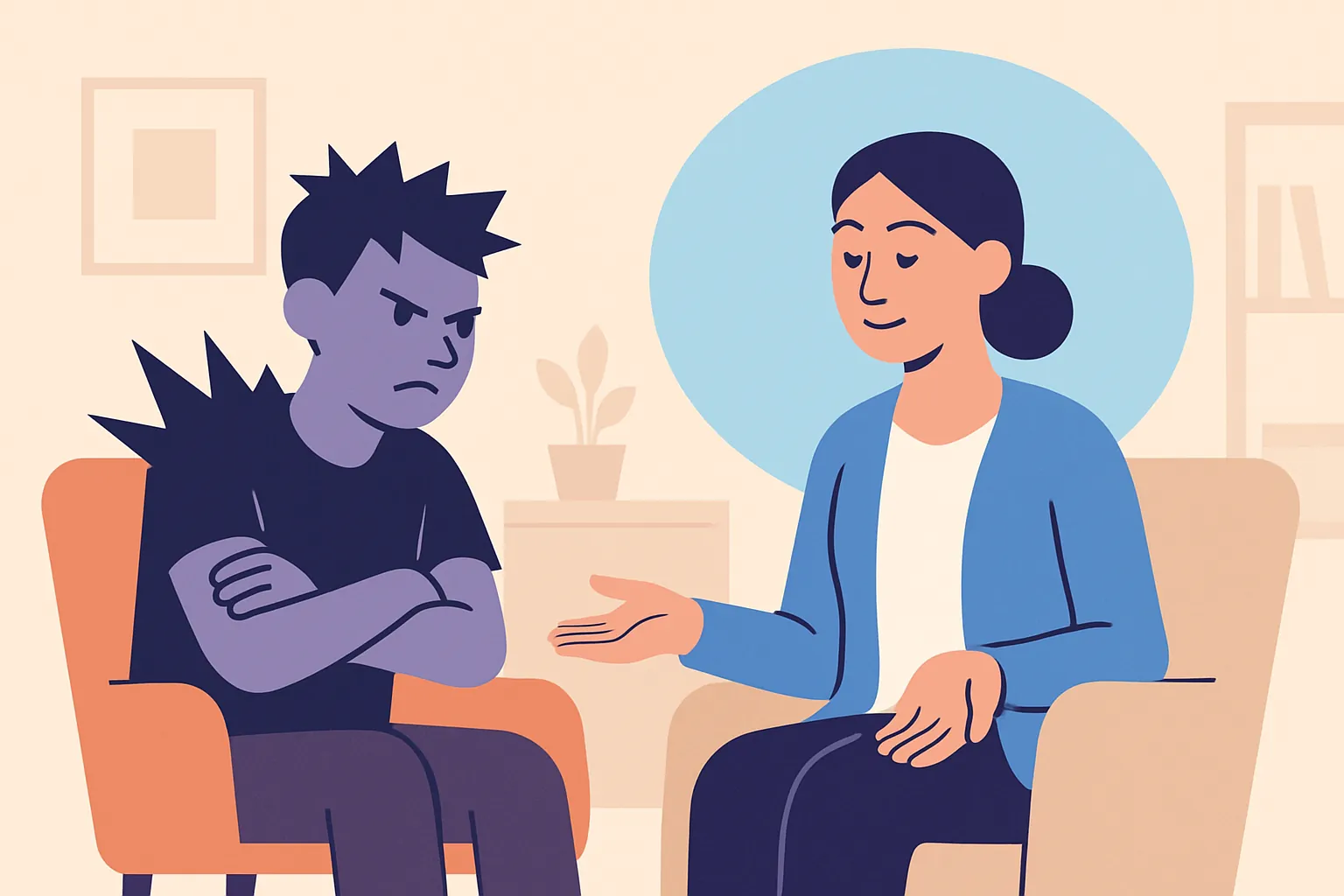
A teenager slams the door, drops into the chair, folds their arms, and says it before you've finished saying hello: "You're just like everyone else. You're paid to pretend to listen. You don't know the first thing about me."
If you've worked with adolescents, you know what happens in your own body in that moment. Your heart rate climbs. Your face warms. Or a flat wave of helplessness rolls in. The line lands especially hard when it comes from a teen you believed you had a solid rapport with—it can feel like a direct strike at your competence and your sincerity. We're trained professionals, so we work to stay composed. But under pressure it's easy to slip into the countertransference trap: explaining ourselves, defending our intentions, or sliding into a faintly lecturing tone.
In adolescent work, provocation is both a hazard and an opening. How you handle this single moment can fracture the alliance—or become the hinge on which real therapeutic growth turns. This article unpacks the psychology beneath the provocation and lays out a concrete, in-the-room non-defensive stance that lets you hold your center as a clinician without going cold or going to war.
Why adolescents test us
To stop taking the sharp words personally, you have to understand what's actually running underneath them. This is rarely "just attitude." More often it's a survival maneuver dressed up as an attack.
The survival of the object
Donald Winnicott (D.W. Winnicott) framed adolescent aggression as a test of the survival of the object. Unconsciously, the client attacks and tries to "destroy" the therapist—and watches what happens next. If the therapist retaliates (gets angry) or collapses (visibly wounded, withdrawn, smaller), the test fails. But if the therapist survives—stays present, stays whole, neither punishing nor crumbling—the client can begin to experience them as a real, trustworthy other. In effect, the most hostile line is a question: "You're going to abandon me too, aren't you?" asked in the only language that feels safe enough to risk.
Projective identification
Adolescents routinely off-load feelings they can't yet hold—chaos, rage, shame—onto the people around them. "You don't understand me" is often a translation of an internal scream: "I don't understand myself and it terrifies me—please feel this with me." The discomfort and disorientation that rise in you during these exchanges aren't noise to suppress. They're clinical data—a live readout of the client's internal state. Naming that to yourself ("I'm feeling shut out and useless right now—that may be exactly what they live with") turns a reaction into information.
A brain still under construction
Neurodevelopment stacks the deck. The adolescent amygdala is highly reactive while the prefrontal cortex—the brake system for impulse and appraisal—is still being wired. Teens read emotional signal far more keenly than logical argument. They will catch the micro-shift in your expression or the defensive edge in your voice with uncanny accuracy, and amplify it into rejection or contempt. The content of your words matters less than the affect they detect underneath.
Defensive vs. non-defensive: the decisive difference
So how do we respond? Many of us reach for explanation or psychoeducation to manage the moment—and to a teen, that often reads as defending ourselves. A non-defensive stance absorbs the provocation without being knocked off balance. It's receptive, not passive; steady, not rigid.
| Defensive response | Non-defensive response | |
|---|---|---|
| Internal stance | "I'm being disrespected." / "I need to reassert my authority." / "I have to clear up this misunderstanding." | "This kid is in real pain." / "What made them this angry?" / "They're testing me." |
| Typical behavior | Justifying, persuading, rebutting with logic, going silent to avoid | Validating affect, staying curious, holding the aggression, opening a meta-conversation |
| Sample line | "You're misreading me—that's not what I meant at all." / "That's not a respectful way to talk to me." | "It sounds like you feel I completely fail to get you—and that's making you furious." / "I think I came across as just someone doing a job for a paycheck. I'd really like to hear more about that." |
| Result | Power struggle, ruptured rapport, premature dropout | A secure base confirmed, a corrective emotional experience, a deeper alliance |
A practical 3-step approach under fire
Knowing the theory is one thing; hearing "You're useless, this is pointless" and going blank is another. Here's a sequence you can run in real time.
Step 1: Press pause
Don't answer the attack on contact. Hold three to five seconds of silence and take a breath. That brief gap lets your own prefrontal cortex come back online and re-appraise: "This is not an attack on me—it's an expression of their pain." And the pause itself is therapeutic. A teen braced for you to fire back, and instead met with a calm, unhurried presence, is having a new relational experience in that very moment.
Step 2: Work the process and the feeling, not the content
Don't argue the literal claim. "You're just paid to do this" is not an invitation to defend your fee structure. Read the relational need behind it. The client is caught between a longing to genuinely connect and a fear of being let down. Reflect that, not the facts:
"I wonder if part of you worries that because this is a paid relationship, my care can't be real—that it might be fake. That would be a painful thing to sit with."
Step 3: Re-enter with honesty and curiosity
Admitting that you, too, can be caught off guard paradoxically strengthens your standing. Don't perform the flawless expert—be the curious colleague:
"Honestly, when you said that, I felt a jolt—like maybe I'd missed something important. Can you tell me a bit more about what that 'not being understood' actually feels like? I'm asking because I really do want to get you right."
Using your records for clinical insight
Right after an emotionally charged session, the details blur. What exactly did I say back? When precisely did their expression change? Capturing the fine-grained nuance beneath a teen's provocation—and reviewing your own countertransference with some objectivity—depends on having an accurate record of what actually happened in the room.
This is where structured documentation and review tools earn their place in adolescent work. Whether you use a session-recording and transcription workflow, a practice-management platform (e.g., SimplePractice and similar tools), or simply disciplined post-session notes, the goal is the same: stay fully present to the client's eyes and nonverbal signals in the moment, and offload the recall to the record afterward. A security-first AI partner like Modalia AI can support this by handling transcription and session documentation so your attention stays on the relationship—not on scribbling.
- Objective self-review: A transcript lets you see precisely how your tone shifted when you were provoked, and whether you cut the client off defensively—patterns memory tends to smooth over.
- Pattern analysis: Across sessions, you can spot where a client reliably resists or provokes around a specific theme, rather than relying on impression.
- Sharper supervision: Bringing actual dialogue—not a memory-distorted retelling—lets your supervisor give you far more precise feedback.
A teenager's "You don't get me" is, paradoxically, often a distress flare: Please know me. Please don't give up on me. With a non-defensive stance and a disciplined way of reviewing your work, you can meet the genuine longing hidden inside the sharpest words. You are not doing this work alone.
FAQ
References
- 1.
Frequently asked questions
Why do adolescent clients attack the therapist they seem to trust?
Unconsciously, the provocation is a test. Drawing on Winnicott's "survival of the object," the client attacks to see whether you'll retaliate or collapse. When you survive—staying present without punishing or crumbling—they can begin to experience you as a trustworthy other. The most hostile line is often the question "Will you abandon me too?"
What does a non-defensive stance actually mean in session?
It means absorbing the provocation without being knocked off balance—receptive but steady. Instead of justifying yourself, rebutting with logic, or withdrawing, you validate the affect, stay curious, hold the aggression, and reflect the relational need beneath the content. It is firmness without retaliation, not passivity.
How should I respond in the moment to "You're just paid to listen"?
Don't defend your fee. Pause three to five seconds, then reflect the fear underneath—often a worry that paid care can't be genuine. Something like: "I wonder if part of you worries my care can't be real." Then re-enter with honest curiosity to learn what "not being understood" feels like for them.
How do session records help with provocative adolescent cases?
Right after a charged session, details blur. An accurate transcript or disciplined note lets you review how your tone shifted under provocation, whether you cut the client off, and what themes reliably trigger resistance. It also gives your supervisor real dialogue to work from rather than a memory-distorted retelling.
This article was written and reviewed using Modalia AI's clinical guidelines, with professional human review before publication.
Related articles
 Case Conceptualization
Breaking the "Yes, But" Game: A Transactional Analysis Guide for Therapists
Every suggestion you offer gets met with "Yes, but..." Here's the TA structure behind that stall—and four clinical moves to break it.
7 min read Case Conceptualization
Yalom's The Gift of Therapy: Passages Every New Counselor Should Copy by Hand
Irvin Yalom's prescription for therapists who fear silence: meet your client as a "fellow traveler" and let the here-and-now become the heart of the work.
6 min read Case Conceptualization
Working With Silence in Therapy: What Client Silence Means and How to Hold It
Silence in session isn't empty space. Learn to read its clinical meaning, tell productive from defensive silence, and use it as a therapeutic tool.
6 min read