Reading the Body: How Posture, Gaze, and Breath Reveal What Clients Can't Say
Decode the clinical meaning behind a client's posture, gaze, and breathing—plus how AI documentation frees you to fully attend to the body in the room.
Key takeaway
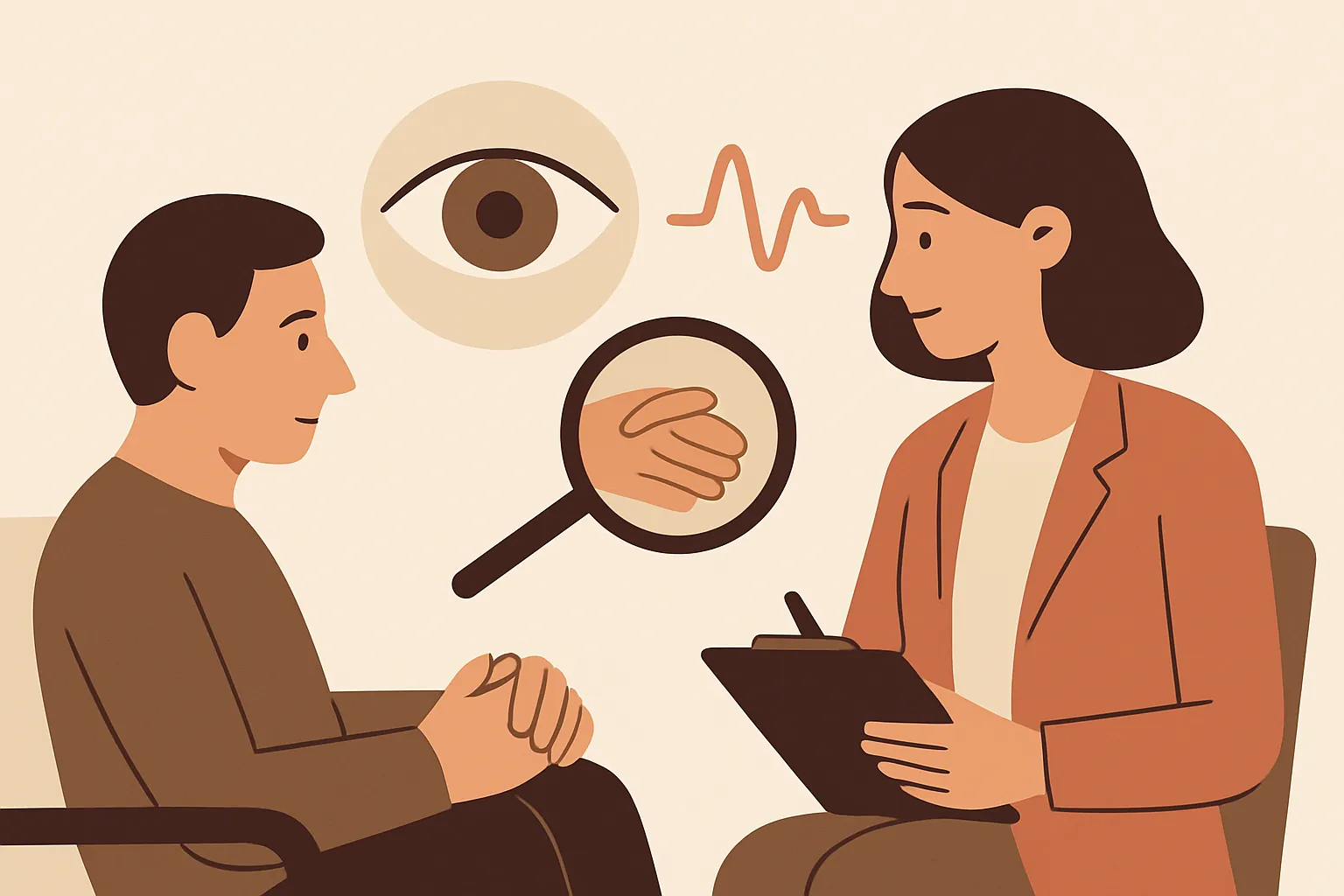
In session, a client's posture, gaze, and breathing carry clinical information as important as anything they say aloud. For trauma survivors and clients with alexithymia, these nonverbal signals are often the key to treatment, and Polyvagal Theory frames them as autonomic survival responses rather than mere habit. The clinical skill lies in catching incongruence between words and body, then translating it into therapeutic technique—neutral description, mirroring, and co-regulation. AI-assisted documentation removes the note-taking burden so the clinician can stay fully present to those signals.
The Client Is Speaking, Even in Silence
Have you ever finished a session realizing you captured every word but missed the moment that actually mattered? From our earliest training we're taught that all behavior is communication—yet in the room, simply tracking the presenting problem and the verbal report can consume all of our attention. While we're mapping the chronology of events and running through diagnostic criteria, it's easy to miss the micro-tremor in the hands or the half-second the eyes dropped to the floor.
For trauma survivors and clients living with alexithymia, nonverbal communication often is the treatment—the channel that carries what language can't. We don't need to invoke Mehrabian's well-worn statistics to know this intuitively. When a client says "I'm fine" while a hand closes over the chest, the truth lives in the hand, not the sentence.
This article looks at how to read and therapeutically use the signals a client sends through posture, gaze, and breath—and offers a practical way to capture those observations without sacrificing your presence in the room.
The Body as a Map of the Nervous System
Contemporary neurobiology, and Stephen Porges's Polyvagal Theory in particular, reframes nonverbal behavior not as habit but as autonomic survival response. A client's collapsed, rounded shoulders may not be poor posture at all—it can be a dorsal vagal shutdown, the body's way of protecting itself from a perceived threat by withdrawing and going still.
The clinician's job is to read the body the way a detective reads a room. The table below summarizes three high-frequency, easily overlooked nonverbal indicators and the clinical hypotheses they invite.
| Domain | What you observe | Clinical hypothesis |
|---|---|---|
| Posture | Arms crossed, legs crossed, torso leaning back | Defensiveness, distrust of the clinician, or an attempt to guard against vulnerability |
| Leaning in, open and oriented toward the clinician | Rapport, engagement, dependency needs, or positive transference | |
| Gaze | Sustained gaze avoidance or staring at the floor | Shame, social anxiety, or a precursor to dissociation |
| Unusually intense, fixed eye contact | Hypervigilance, hostility, or an effort to control the clinician's reactions | |
| Breath | Shallow, rapid, chest-driven breathing | Sympathetic activation (fight-or-flight), acute anxiety, or the onset of panic |
| Long sighs or held breath mid-sentence | Suppressed anger, helplessness, or a momentary shutdown of overwhelming affect |
Table 1. A guide to nonverbal indicators and their clinical interpretation.
The decisive skill here is catching incongruence. When the words say "I'm really happy about it" but the eyes don't engage and the breath stops, the clinician should weight the body over the content and adjust the intervention accordingly. That mismatch is some of the most accurate data we get.
From Observation to Therapeutic Change
Noticing a cue is only the beginning. Bluntly naming it—"You're bouncing your leg right now"—can put a client on the defensive. The more skillful move is to bring it into the process and use it to deepen the client's own awareness.
1. Immediacy and reflection to build awareness
The safest and most effective approach, both ethically and technically, is value-neutral description: "I noticed that as you started talking about your mother, your voice got quieter and your eyes moved down. What are you noticing in your body right now?" The aim is to help the client connect bodily sensation to emotion, rather than to interpret on their behalf.
2. Mirroring for empathic attunement
Subtly matching a client's posture or breathing rate builds powerful, largely unconscious rapport. When a client becomes agitated—speech speeding up, breath turning ragged—and the clinician deliberately slows their own breathing and settles their posture, resonance can help the client's nervous system settle alongside yours. This is co-regulation in action.
3. Pattern recognition to surface core beliefs
Track the nonverbal patterns that recur around specific themes (a spouse, a supervisor, a particular memory). When your notes start to show "every time topic A comes up, the client bites their lip," you're looking at a thread that likely connects to a core belief or an unresolved trauma.
Better Records, Deeper Attention: The Role of AI
Most clinicians know nonverbal cues matter; the reason they're hard to act on is the limits of multitasking. To catch a flicker in the eyes, you have to be looking at the client. But to remember the substance of the hour, we're often looking down at a notepad. How do we resolve that bind?
A clear trend in the field is to offload that cognitive load onto technology, where AI-assisted documentation can function as a genuine co-therapist:
- Sessions where you can actually watch. When transcription and summarization are handled by an AI tool, you can give the client's eyes, expression, and gestures your full attention for the entire hour—which makes for far deeper work with transference and countertransference.
- Turning nonverbal context into data. The latest tools don't just convert speech to text; some analyze vocal pitch, length of silences, and speech rate, giving you a way to review—after the fact—the signals you couldn't catch in real time. Widely available transcription tools such as Otter.ai or Notta illustrate how accessible this has become, and security-first clinical platforms like Modalia AI extend it to case conceptualization and progress notes.
- Ethical, efficient documentation. Cutting the time spent writing notes helps prevent burnout and frees up energy for the higher-order thinking that case conceptualization demands.
Used well, technology doesn't make therapy mechanical—it buys back time for the most human parts of the work: eye contact and empathy. Healing begins in the moment you notice a subtle shift in a client's breath. So in your next session, consider setting the pen down, letting the recorder run, and holding the client's gaze a little longer. The real story is often the one told in the silence.
References
- 1.
- 2.
Frequently asked questions
What does Polyvagal Theory say about a client's nonverbal behavior?
Stephen Porges's Polyvagal Theory frames nonverbal behavior as autonomic survival responses rather than habit. Collapsed posture and withdrawal can reflect a dorsal vagal shutdown, while shallow, rapid breathing signals sympathetic fight-or-flight activation. Reading these states helps the clinician gauge a client's level of safety and adjust the intervention.
How do I address a nonverbal cue without making the client defensive?
Use value-neutral description rather than interpretation. Instead of 'You're being defensive,' try 'I noticed your voice got quieter and your eyes moved down—what are you noticing in your body right now?' This brings the cue into the process and invites the client's own awareness, which keeps the working alliance intact.
What is co-regulation, and how do I use it in session?
Co-regulation is the process by which one nervous system helps settle another. When a client becomes agitated, the clinician can deliberately slow their breathing and settle their posture; through resonance, the client's nervous system often follows. Subtle mirroring of posture and breath rate supports this attunement.
How does AI documentation help with reading nonverbal signals?
AI-assisted transcription and summarization remove the need to look down and write, so you can attend fully to the client's face, gaze, and gestures. Some tools also analyze vocal pitch, silences, and speech rate, letting you review nonverbal context after the session and reducing the documentation burden that drives burnout.
This article was written and reviewed using Modalia AI's clinical guidelines, with professional human review before publication.
Related articles
 Case Conceptualization
Breaking the "Yes, But" Game: A Transactional Analysis Guide for Therapists
Every suggestion you offer gets met with "Yes, but..." Here's the TA structure behind that stall—and four clinical moves to break it.
7 min read Case Conceptualization
Yalom's The Gift of Therapy: Passages Every New Counselor Should Copy by Hand
Irvin Yalom's prescription for therapists who fear silence: meet your client as a "fellow traveler" and let the here-and-now become the heart of the work.
6 min read Case Conceptualization
Working With Silence in Therapy: What Client Silence Means and How to Hold It
Silence in session isn't empty space. Learn to read its clinical meaning, tell productive from defensive silence, and use it as a therapeutic tool.
6 min read