"You Never Understand Me": 5 Nonverbal Skills to Build Rapport in the First 10 Minutes
Five evidence-based nonverbal techniques to earn a client's trust in the first 10 minutes of a session and seize the golden window for rapport.
Key takeaway
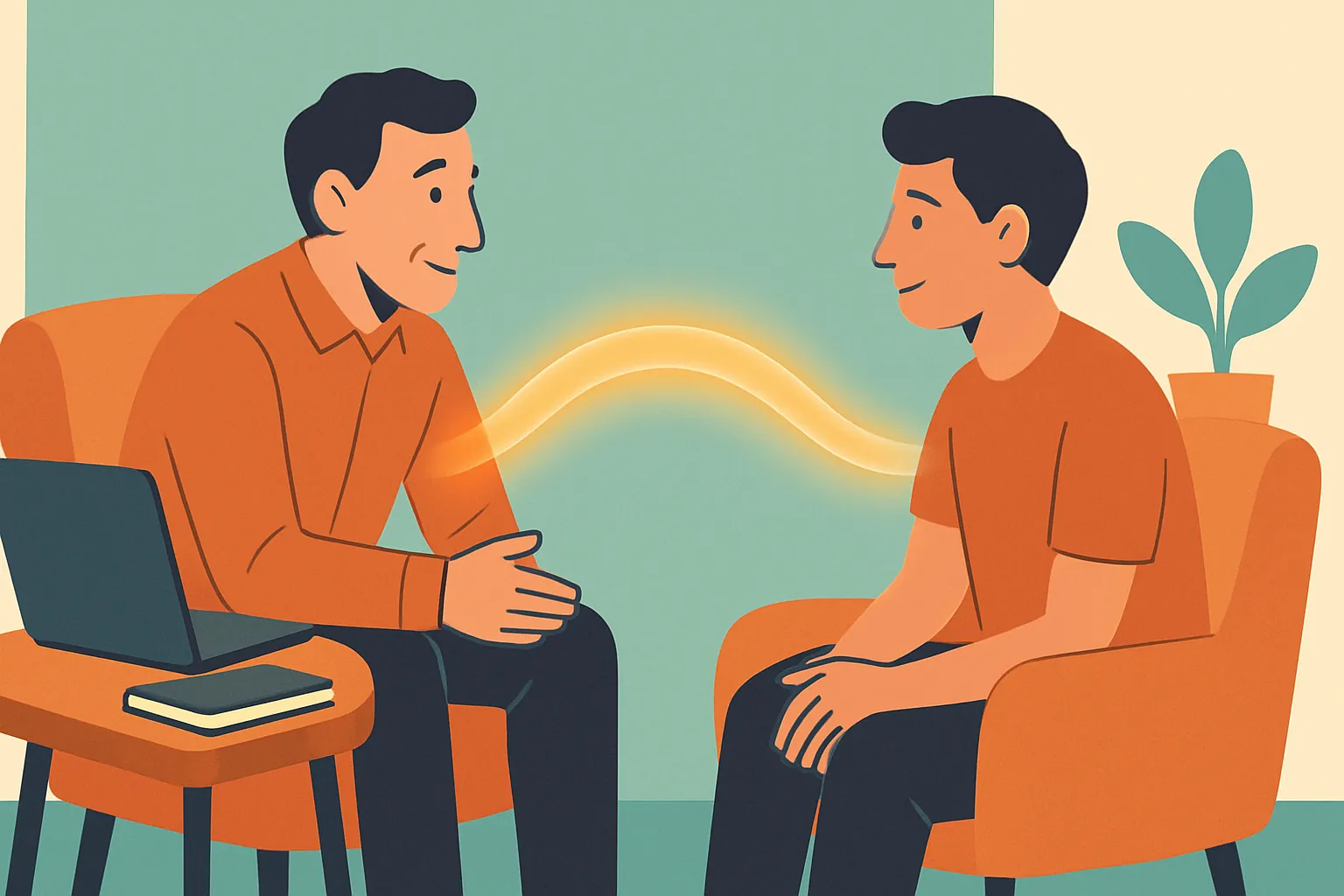
The opening 10 minutes of a session are the golden window for rapport—the moment a client decides whether they feel safe. Albert Mehrabian's research suggests that only about 7% of emotional communication is carried by words, while the rest is shaped by vocal and visual cues. A clinician's posture, facial expression, and use of silence are not passive reactions; they activate mirror neurons and, through the lens of Polyvagal Theory, shift the client's nervous system into a social-engagement state. This article walks through five clinically grounded techniques—Egan's SOLER, affective mirroring, silence and pacing, micro-expression attunement, and proxemics—so you can lift your eyes from the notepad and stay fully present with the person in front of you.
When You Dread Hearing "You Don't Get Me": The Golden 10 Minutes of Early Rapport
Where are your eyes during the first ten minutes after a client settles into the chair? If you're honest, are you looking at them—or at the blank fields of an intake form and the glow of your laptop screen? Few moments sting a clinician more than an offhand "I don't think you really understand me." It can land harder than any technical misstep, because it tells you the foundation didn't take.
We spend years studying theory and verbal intervention, yet the signals that make a client feel safe and understood usually come not from what we say but from how we hold ourselves. Albert Mehrabian's well-known work suggests that when feelings and attitudes are being communicated, only about 7% of the message is carried by the words themselves; the remaining 93% rides on tone of voice and visual cues. For clients with strong defenses, those who struggle to put feelings into words, and children and adolescents, this nonverbal channel often decides whether the working alliance forms at all.
To bring clinical insight to bear, you need a "third eye" for the subtle tremor, the direction of a gaze, the shift in breathing. What follows are five clinically grounded nonverbal skills that lower unconscious resistance and help you build genuine trust inside the first ten minutes.
The Language of Silence: Why Nonverbal Cues Are a Clinical Intervention
Nonverbal communication in therapy is far more than friendly reaction. Neurobiologically, it engages mirror neurons, creating a sense of resonance—a felt experience in the client of "this person feels what I feel." Through the lens of Polyvagal Theory, a clinician's steady prosody and settled expression help shift the client's nervous system into the social-engagement system, calming the fight-or-flight response.
Yet many clinicians miss these cues, distracted by the pressure to document or to line up the next question. The cost becomes clearer when you compare common nonverbal missteps with the client's likely internal response.
| Channel | Clinician's nonverbal behavior (misstep) | Client's likely interpretation |
|---|---|---|
| Eye contact | Buried in notes, or avoiding the gaze | "Is my story boring? They're just mechanically writing." (alienation) |
| Posture | Arms crossed, leaning back | "They're judging me. They're the authority here." (defenses rise) |
| Response timing | Firing the next question the instant they finish | "They just want to hand me a fix—no room to sit with what I feel." |
| Expression / mirroring | Flat affect, or a forced smile, during painful material | "My pain isn't landing. They're only pretending to care." (trust erodes) |
Table 1. How a clinician's nonverbal behavior shapes transference and countertransference responses.
So what can you put into practice immediately?
-
Use SOLER Strategically (Egan's SOLER)
Gerard Egan's SOLER framework is the most basic—and most powerful—body language toolkit. S (Squarely): face the client directly, but at an angle that doesn't feel confrontational. O (Open): keep an open posture, arms and legs uncrossed. L (Lean): lean your upper body slightly forward when they share something important, signaling engagement. E (Eye contact): maintain soft, steady eye contact. R (Relaxed): stay relaxed yourself, so you can contain the client's anxiety rather than absorb and mirror it back. Consciously checking these five points during the first five minutes can meaningfully raise a client's sense of safety.
-
Mirroring and Matching
Subtly echoing a client's posture, gestures, and even the pace of their breathing builds an unconscious sense of connection. If they sink back into the chair, slow your own tempo and ease your posture. If they lower their voice to share something private, drop your tone and volume to match. The caution: mechanical imitation can read as mockery. Aim instead for affective mirroring—tuning your nonverbal response to the client's emotional register, not copying their movements like a mirror.
-
Tolerating Silence and Pacing
Many early-career clinicians can't sit with silence, so they fill it with a question. But silence is the corridor a client walks down to reach their inner world. When they stop speaking, stay with the pause for three to five seconds—offered with a nod or a warm gaze. It carries a powerful message: "Whether you speak or stay silent, I am here." Matching your timing to the client's rhythm of speech and thought—pacing—communicates respect more clearly than any words.
-
Catching and Responding to Micro-expressions
Watch for the moments when words and face don't match—the double-bind message. A client says "I'm fine," but their brow tightens or the corner of their mouth trembles. Respond to the expression, not the words. And before you name it—"You say you're okay, but I sense how hard this is"—let your own face respond first. Affect attunement means your expression softens with their pain, registering it, before you put it into language.
-
Managing Physical Space and Distance (Proxemics)
Comfortable distance varies with personality and trauma history. If a client pulls their chair back early on, don't push closer—honor the space. Conversely, with a client whose needs lean toward dependence, minimizing barriers like a desk or table can increase psychological accessibility. Even small things—the lighting in the room, a gesture toward where the tissues sit—become part of an attentive, caring vocabulary.
The Freedom to Look Your Client in the Eye
A clinician's most powerful instrument is the self. Yet the most common, and most practical, reason we fail to stay with a client's nonverbal signals is, paradoxically, the administrative and ethical duty of documentation. In the decisive ten minutes when you should be catching a faint tremor, if your eyes are fixed on the keyboard, the golden window for rapport slips by in silence. It's time to free the writing hand and recover the watching eyes.
To resolve this tension, a growing number of clinicians are turning to AI-assisted transcription and analysis. While an AI tool accurately converts the conversation to text and separates speakers, you stay focused on nothing but your client's eyes and breath. This is more than an efficiency gain—it's a clinical choice that lets the here-and-now meeting with your client become whole.
Modalia AI is built for exactly this: a security-first partner for counselors that handles session transcription, case conceptualization support, and documentation, so the record-keeping doesn't pull your attention away from the person in the room.
In your next session, why not set the pen down and deliberately practice just one of these five skills? The key that opens a client's heart isn't polished eloquence—it's the sincerity in your gaze and the warmth in how you sit with them.
Action items for practicing clinicians
- 🛑 Stop: For the first ten minutes of your next session, put the pen down, hold the SOLER posture, and look your client in the eye.
- 👀 Observe: Track changes in gestures and expression—not just words—and note them after the session ends.
- 🤖 Try: Hand a session recording to an AI transcription tool and see firsthand how reclaiming that documentation time affects the quality of your work.
References
- 1.
- 2.
- 3.
Frequently asked questions
Is the "7% rule" from Mehrabian's research often misunderstood?
Yes. Mehrabian's findings apply specifically to communicating feelings and attitudes—not all communication. In emotionally charged moments, tone and visual cues carry most of the message, which is precisely why nonverbal attunement matters so much in early sessions. It does not mean only 7% of all spoken content is meaningful.
Won't mirroring a client feel manipulative or fake?
It can, if you copy movements mechanically. The goal is affective mirroring—aligning your tone, pace, and expression with the client's emotional state rather than imitating gestures. Done with genuine attunement, it registers as being understood, not mimicked.
How long should I hold a silence before speaking?
A pause of roughly three to five seconds, supported by a nod or warm gaze, is often enough to let a client move inward without feeling abandoned. Pace it to the individual; some clients need longer silences, while others experience extended pauses as anxiety-provoking.
How do I stay present nonverbally while still keeping accurate records?
Separate the tasks. During the session, prioritize observation and presence; reserve detailed documentation for afterward, or use a secure AI transcription tool so the conversation is captured for you. This frees your attention for the client's gaze, breathing, and micro-expressions in real time.
This article was written and reviewed using Modalia AI's clinical guidelines, with professional human review before publication.
Related articles
 Case Conceptualization
Breaking the "Yes, But" Game: A Transactional Analysis Guide for Therapists
Every suggestion you offer gets met with "Yes, but..." Here's the TA structure behind that stall—and four clinical moves to break it.
7 min read Case Conceptualization
Yalom's The Gift of Therapy: Passages Every New Counselor Should Copy by Hand
Irvin Yalom's prescription for therapists who fear silence: meet your client as a "fellow traveler" and let the here-and-now become the heart of the work.
6 min read Case Conceptualization
Working With Silence in Therapy: What Client Silence Means and How to Hold It
Silence in session isn't empty space. Learn to read its clinical meaning, tell productive from defensive silence, and use it as a therapeutic tool.
6 min read