How to Weave Nonviolent Communication (NVC) Into a Counseling Session
A clinician's guide to applying NVC's four steps—observation, feeling, need, request—inside the session, with scripts, the difference from empathic reflection, and ethical limits.
Key takeaway
Nonviolent Communication (NVC) is a model that reads a client's words and behavior as the expression of needs that are either met or frustrated. This article shows how to apply the four components—observation, feeling, need, and request (OFNR)—one sentence at a time within a session, offers scripts for translating blame into an underlying need, and clarifies how NVC differs from empathic reflection. It also marks the clinical boundaries—holding needs as tentative hypotheses rather than verdicts, and prioritizing safety in crisis or trauma work—so you can try it in practice right away.
When a client says, "I don't think you're really on my side," how do you respond? Meet it with an interpretation or an evaluation and defenses go up; sit in silence and the sense of disconnection deepens. Nonviolent Communication (NVC) offers a clinical language for exactly these moments—a way to unpack a client's words into observation, feeling, need, and request, and to rebuild connection inside the room. This piece walks through how to bring NVC's four components into session, how it differs from empathic reflection, and where its limits lie, written from one clinician to another.
What Is Nonviolent Communication (NVC)?
Nonviolent Communication (NVC) is a communication model developed by clinical psychologist Marshall Rosenberg beginning in the 1960s. Its core premise is simple: everything a person says or does is an expression of a need—either met or frustrated—and even words that land as blame have a universal need underneath them (Rosenberg, 2015).
What makes NVC useful in clinical work is that it trains us to swap evaluative language for observational language. "The client is uncooperative" is an evaluation; "In the last two sessions, the client didn't bring in the agreed homework" is an observation. The habit of separating observation from evaluation maps directly onto the accuracy of your case conceptualization.
The Four Components of NVC: Observation, Feeling, Need, Request
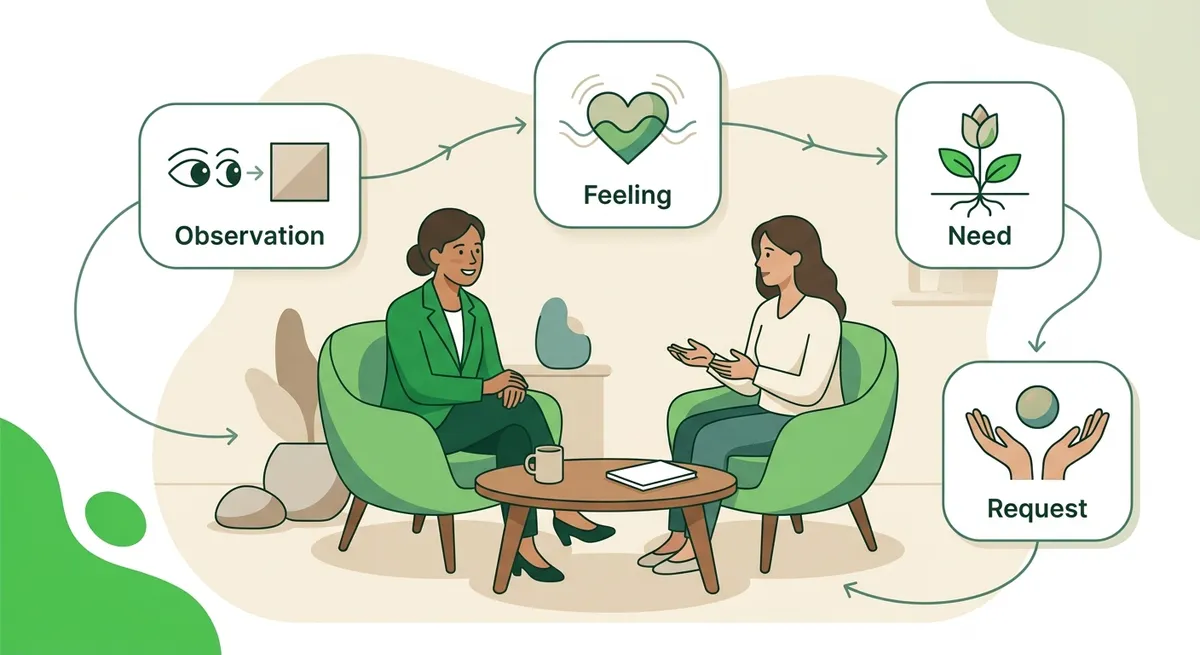
NVC is built from four components, often abbreviated OFNR. You can try them one sentence at a time within a session.
- Observation: Describe the facts with judgment stripped out. Not "You were late," but "You arrived about 20 minutes after our 3:00 start time."
- Feeling: Name an emotion, not a thought. "I felt dismissed" is an evaluation in disguise; "hurt" or "frustrated" are closer to actual feelings.
- Need: Locate the universal need beneath the feeling—respect, safety, autonomy, connection, and so on.
- Request: Make a concrete, refusable ask rather than a demand. Not "Be on time from now on," but "Would it be possible to arrive about five minutes before we start next session?"
You don't have to pack all four into a single sentence. In session, it usually works to name the observation and feeling first, then explore the need together.
NVC Scripts You Can Use in Session
Imagine a client who, in a heightened state, says, "Nobody ever listens to me." (The exchange below is a fictional composite drawn from several sessions.)
Client: "It's the same with my family, and it'll end up the same here too."
Counselor (reflecting observation + feeling + need): "You just said it'll 'end up the same here too' (observation). Right now it sounds like you're exhausted and quite alone (feeling). I wonder if there's a strong wish for someone to really hear you all the way through (need)?"
Here the counselor doesn't argue with the client's accusation; instead, they translate the need underneath it—to be understood, to feel connected. When you use NVC for your own self-expression, shift into "I-statements." To a protest like "You keep cutting me off," you might respond: "When I add something in the middle (observation), it broke your train of thought and that was frustrating (feeling). You wanted the space to finish your thought completely (need). Would it be okay if I listened all the way through and then reflected back (request)?"
How Is NVC Different From Empathic Reflection?
In practice, NVC is often compared to traditional reflection and empathy techniques. They aren't mutually exclusive, but their emphases differ. Where classic reflection weights mirroring a client's feeling back to them, NVC goes one layer deeper—to the need beneath the feeling.
| Dimension | Empathic Reflection | Nonviolent Communication (NVC) |
|---|---|---|
| Focus | Accurately naming the feeling | The feeling plus the need beneath it |
| Handling blame | Accepting the emotion | Translating blame into a frustrated need |
| Self-expression | Addressed relatively little | Structured through I-statements |
Once you reach the level of need, clients often discover for themselves, "So that's what I actually wanted." This dovetails naturally with the values exploration of motivational interviewing (MI).
Cautions and Ethical Boundaries
NVC is not a cure-all, and a few clinical cautions apply.
First, declaring a need too quickly can itself feel controlling. A tentative form—"I wonder if you were hoping for…?"—is safer than a verdict like "So you have a need for…." Second, in any session where crisis or self-harm risk is present, safety assessment and crisis intervention take precedence over NVC's needs exploration. Third, pressing a trauma client to name feelings too fast carries a risk of reactivation; stabilization has to come first.
The research on NVC's effects is worth noting. In a field study of a three-day NVC training for health-care professionals, participants increased their use of NVC skills in everyday conversation, became better able to put negative emotions into words during conflict, and reported reductions in empathic distress (Wacker & Dziobek, 2018). Because this is a single study, though, it's best to bring NVC into your clinical work gradually and within supervision.
Using Session Records to Check Your NVC Patterns
NVC is a language habit that settles into the body through repeated practice. That's why the biggest gains come from self-supervision after a session—looking back at "how much evaluative language did I use?" and "did I offer needs as hypotheses rather than verdicts?"
The catch is that if transcribing the session by hand right afterward eats up too much time, this very review tends to get put off. A tool that organizes your session records—such as Modalia AI's session-transcript automation—can give you back the room to re-read your own utterances and weigh your ratio of observation to evaluation. The point isn't the tool; it's the process of updating your own language habits one session at a time.
Separating observation from evaluation, and translating the need beneath the blame, won't be finished overnight. Refining just one sentence per session into NVC is plenty. May that small shift change something—both your connection with clients and your own risk of burnout.
References
- 1.
- 2.
Frequently asked questions
What are the four components of Nonviolent Communication?
NVC has four components, often abbreviated OFNR: observation (the facts, with judgment removed), feeling (a named emotion rather than a thought), need (the universal need beneath the feeling, such as respect or connection), and request (a concrete, refusable ask rather than a demand). In session you don't have to use all four at once—naming the observation and feeling first, then exploring the need together, tends to flow most naturally.
How is NVC different from empathic reflection?
Empathic reflection emphasizes mirroring a client's feeling back to them accurately. NVC goes one layer deeper to the need beneath the feeling, and it also gives you a structure—I-statements—for your own self-expression and for translating a client's blame into a frustrated, universal need. The two aren't mutually exclusive; they differ mainly in emphasis.
When should I avoid using NVC in a session?
When crisis or self-harm risk is present, safety assessment and crisis intervention take priority over needs exploration—reach for your local crisis line or emergency services as your setting requires. With trauma clients, pressing for fast emotional labeling can risk reactivation, so stabilization comes first. And avoid declaring a client's need as a verdict; a tentative hypothesis ("I wonder if you were hoping for…?") is safer.
This article was written and reviewed using Modalia AI's clinical guidelines, with professional human review before publication.
Related articles
 Case Conceptualization
Breaking the "Yes, But" Game: A Transactional Analysis Guide for Therapists
Every suggestion you offer gets met with "Yes, but..." Here's the TA structure behind that stall—and four clinical moves to break it.
7 min read Case Conceptualization
Yalom's The Gift of Therapy: Passages Every New Counselor Should Copy by Hand
Irvin Yalom's prescription for therapists who fear silence: meet your client as a "fellow traveler" and let the here-and-now become the heart of the work.
6 min read Case Conceptualization
Working With Silence in Therapy: What Client Silence Means and How to Hold It
Silence in session isn't empty space. Learn to read its clinical meaning, tell productive from defensive silence, and use it as a therapeutic tool.
6 min read