"What Would You Know?" Building Rapport with Resistant Teen Clients Using the One-Down Strategy
Resistant adolescents soften when you drop the expert armor. Here's how the One-Down strategy lowers defenses and builds rapport in teen therapy.
Key takeaway
Adolescent resistance is a developmental defense that protects autonomy—not a personal attack on the clinician. The harder a counselor clings to the expert (One-up) position, the more it fuels a power struggle; deliberately taking a One-down stance and treating the teen as the expert on their own life lowers the defensive wall. Three practical moves—asking the client to teach you their world, openly empathizing with involuntary attendance, and exploring the function behind problem behavior—build the working alliance, and research suggests teens actually perceive such clinicians as more trustworthy and competent, not less.
"How Could You Possibly Get It?": The Quiet Power of the One-Down Stance 🗝️
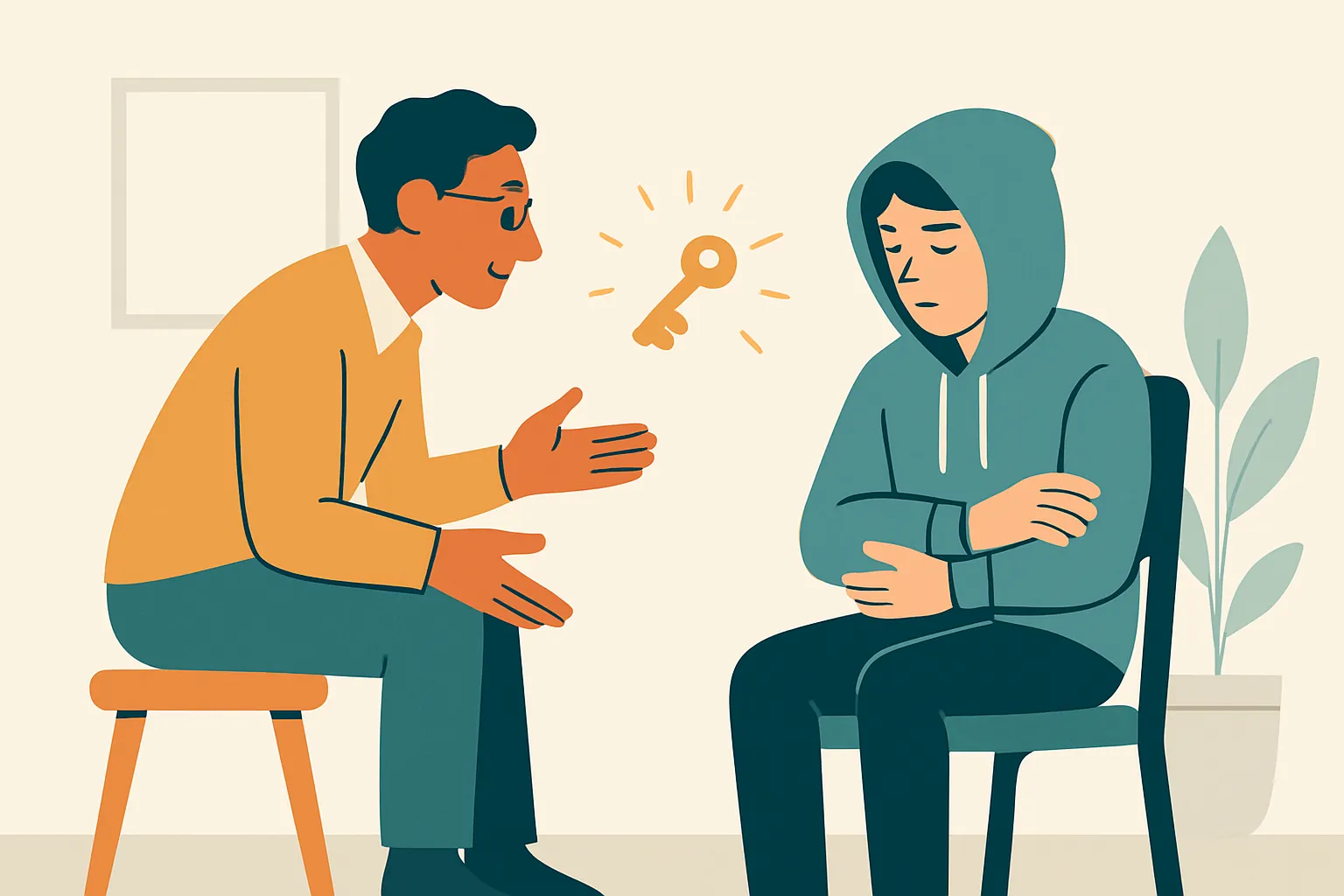
You know the look. A teenager comes through the door with the hood up, the phone buzzing, arms folded—and every question you ask gets the same flat reply: "I don't know." "No reason." "What would you even know about it?" This kind of resistance is one of the most common walls we hit in adolescent work, and one of the fastest ways for even seasoned clinicians to feel deskilled and to start noticing their own countertransference creep in.
In that moment, a lot of us quietly panic: I'm losing control of this session. I'm not showing them I know what I'm doing. But here's the paradox worth sitting with: the instant you take off the "expert" armor and step into a One-down position, that fortress of a teenager often starts to open. This post is a close look at one of the most powerful paradoxical interventions for building rapport with resistant adolescents—the One-down strategy.
Why Teenagers Resist Us: The Psychology of the Power Struggle
A core developmental task of adolescence is securing autonomy. To a teen, a counselor can easily read as one more controlling adult—another authority figure in the lineage of demanding teachers and hovering parents. Seen that way, their resistance is rarely a personal attack on you. It's a developmentally appropriate defense mechanism in service of protecting their autonomy.
Clinically, the trap is this: the more firmly you occupy the seat of the "helping expert" (One-up), the more your client gets pushed into the role of the "problem kid who needs fixing" (One-down). That asymmetry almost guarantees a power struggle.
The antidote is to flip the geometry on purpose. Borrowed from family therapy and solution-focused work, the One-down strategy has the clinician deliberately take the "not-knowing," "here-to-learn," or even "slightly out of my depth" position. When you step back and treat the client as the expert on their own life, they lose the thing they were bracing against—and the wall comes down.
Table 1. Traditional Expert Stance vs. Strategic One-Down Stance
| Traditional Expert (One-up) | Strategic One-Down | |
|---|---|---|
| Core premise | "I know the solution to your problem." | "I know almost nothing about your world." |
| Who leads | Clinician drives and interrogates | Client is invited to teach |
| How the client reads you | Evaluator, teacher, controller | Curious listener, learner |
| When resistance appears | Persuade or analyze (resistance rises) | Acknowledge it; voice your own uncertainty (resistance falls) |
Three One-Down Techniques You Can Use This Week
So how do you actually do One-down in the room? It's not simply saying "I don't know." It's the more refined skill of honoring the client's authority while drawing out their own insight. Here are three moves you can put to work immediately.
1. Genuine Curiosity: The Columbo Approach
When a client references a game, an online subculture, or slang you don't recognize, resist the urge to nod along as if you follow—or worse, to wave it off as "not the important part." Instead, hand them the role of teacher:
"I honestly don't know much about that—can you walk me through it? From where you were standing, what made that moment so infuriating?"
When you lower yourself and elevate the client to the one explaining the world to you, a teen feels a flush of competence and tends to open up on their own. As a bonus, it quietly builds their self-efficacy.
2. Acknowledge Their Right to Resist; Empathize with Being Dragged In
For a client who was marched in against their will, "counseling is going to be good for you" backfires every time. Far more disarming is to name the obvious and own your own discomfort:
"Honestly, I'd bet the last thing you wanted was to be here. If I were you, getting stuck in a room with some stranger I'd never met to talk about my life—I'd hate it too. I'm a little worried I'm just one more annoying adult to you."
The goal is to shift how the client perceives you—from a target to attack to a fairly harmless person who's actually a bit on the back foot.
3. Treat the Client as the Expert on Their Own Behavior
When a teen presents a so-called problem behavior—skipping, defiance, taking a risky stand—resist the reflex to correct it. Get curious about its function for them instead:
"Wow—standing up to your parents like that in the heat of the moment? That takes real nerve. How did you even get yourself to do it? I think I'd have been too scared."
A response like that lowers the defenses and invites the client to explore, in their own words, the motivation underneath the behavior.
Managing Your Own Anxiety—and Why Capturing the Session Matters
The hardest part of working One-down, for most clinicians, is the nagging fear: Won't I look incompetent? The research points the other way. Adolescents tend to rate counselors who genuinely listen and adopt a learner's posture as more trustworthy and more professionally credible—not less. The moment you put down the reins, the therapeutic alliance paradoxically gets stronger.
But holding a One-down position well demands intense presence and a fine ear for nuance. To catch the loaded piece of slang, the flicker across the face, the text hiding inside a shrugged "no reason," you have to stay fully in the interaction instead of disappearing into your notes.
This is exactly where Modalia AI can act as a quiet co-therapist. As a security-first AI partner built for counselors, it handles the transcription and documentation in the background so you can keep your eyes up and stay with the client.
- Maximize the nonverbal channel. When you stop writing and give the client your undivided attention, the authenticity that makes One-down work actually lands. With the record handled for you, you're free to catch and respond to subtle resistance signals in real time.
- Review the language and patterns later. An accurate session transcript lets you go back afterward and notice "ah—that's the context this word was carrying." That kind of review is gold for crafting sharper, better-attuned One-down questions next session.
- Bring objective material to supervision. A precise transcript beats memory-based notes when you sit down with a supervisor to examine your own countertransference and plan stronger interventions—always within an ethical, secure, privacy-first workflow.
A Closing Thought
"What would you know?" may not be an attack at all. Heard differently, it's a paradoxical invitation: "Please—actually try to understand me." With the next teen who walks in, consider setting the expert's coat aside for a while and becoming the most curious student in the room. Let the careful record of that delicate conversation be handled for you, and trust your warm curiosity to be the key that turns the lock.
FAQ
References
- 1.
- 2.
- 3.
Frequently asked questions
What is the One-down strategy in adolescent counseling?
It's a paradoxical stance, drawn from family and solution-focused therapy, in which the clinician deliberately steps out of the 'expert' role and adopts a not-knowing, here-to-learn posture—treating the teen as the expert on their own life. With no authority figure to push against, the client's defenses tend to lower and the working alliance strengthens.
Doesn't taking a One-down position make me look incompetent to my client?
That's the most common fear, but the evidence runs the other way. Adolescents tend to rate clinicians who genuinely listen and take a learner's stance as more trustworthy and more professionally credible. Lowering the power differential typically deepens the alliance rather than undermining your authority.
Why do adolescent clients resist counseling in the first place?
Securing autonomy is a central developmental task of adolescence, so a counselor can read as one more controlling adult. Resistance is usually a developmentally appropriate defense protecting that autonomy—not a personal attack on you. Framing it that way helps you respond with curiosity instead of a power struggle.
How do I use a One-down stance without sounding fake?
Anchor it in genuine curiosity rather than a technique you're performing. Ask the client to teach you their world, honestly name how hard it is to be in the room involuntarily, and explore the function behind a behavior instead of correcting it. Authenticity is what makes the stance land; staying fully present—rather than buried in notes—is what makes it believable.
This article was written and reviewed using Modalia AI's clinical guidelines, with professional human review before publication.
Related articles
 Case Conceptualization
Breaking the "Yes, But" Game: A Transactional Analysis Guide for Therapists
Every suggestion you offer gets met with "Yes, but..." Here's the TA structure behind that stall—and four clinical moves to break it.
7 min read Case Conceptualization
Yalom's The Gift of Therapy: Passages Every New Counselor Should Copy by Hand
Irvin Yalom's prescription for therapists who fear silence: meet your client as a "fellow traveler" and let the here-and-now become the heart of the work.
6 min read Case Conceptualization
Working With Silence in Therapy: What Client Silence Means and How to Hold It
Silence in session isn't empty space. Learn to read its clinical meaning, tell productive from defensive silence, and use it as a therapeutic tool.
6 min read