Beyond the Screen: Building Therapeutic Alliance in Online Video Therapy
Practical, clinically grounded strategies for structuring your telehealth environment, building digital rapport, and staying present with clients on video.
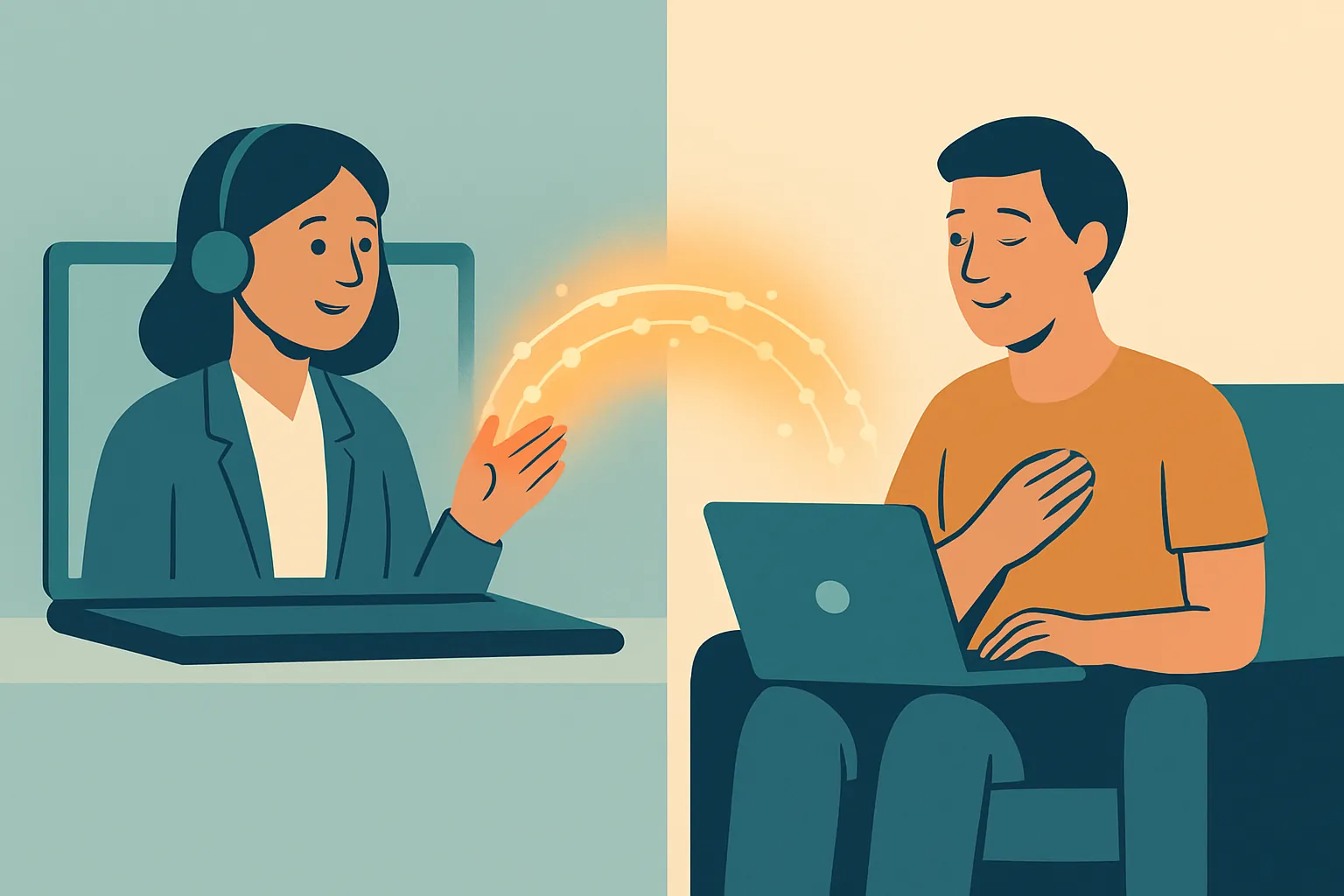
Key takeaway
Online video therapy is now a preferred option for many clients, but recreating the nonverbal communication and felt safety at the heart of the therapeutic alliance depends on a clinician's deliberate 'digital presence.' That means structuring lighting, background, and audio with clinical intent, and building rapport through camera-lens eye contact and amplified verbal and nonverbal tracking. AI-assisted transcription lets clinicians step out of the note-taker role and attend fully to the client's nonverbal cues, while the resulting structured data offers an objective record for supervision.
Is Your Warmth Actually Reaching the Client Through the Screen?
Since the pandemic, counselors and therapists have extended the consulting room from physical space into virtual space at an unprecedented pace. What began as a necessity—telehealth—has settled into a genuine preference for many clients. And yet, sitting in front of the camera, many of us still feel a quiet unease. "Is the client experiencing my silence as empathic attunement, or are they reading it as a frozen connection?" "Am I missing the subtle shifts in their expression on a small, sometimes pixelated screen?"
Those concerns are both natural and ethically sound. The therapeutic alliance is built on nonverbal communication and a felt sense of safety—precisely the channels that a screen tends to flatten. The reassuring news is that research summarized by the American Psychological Association suggests teletherapy can be as effective as in-person care for many presentations. The caveat is that this outcome is not automatic: it depends on the clinician's deliberate cultivation of digital presence.
For experienced clinicians, the task is no longer "how to use Zoom." It is how to translate clinical attunement into a virtual room. This article covers three layers of that work: structuring the online environment for therapeutic effect, building genuine rapport that cuts through the coolness of the screen, and using current technology to protect your attention for the work that matters.
1. Translating the Therapeutic Frame Into a Digital Space
In a physical office, the lighting, the placement of chairs, and sound insulation all do therapeutic work before a word is spoken. Online, this same environmental structuring is the first way you communicate professionalism and offer the client psychological safety. The goal is not simply to "look good on camera"—it is to inspect the setup through a clinical lens.
Optimizing Your Physical and Technical Setup
If your background is cluttered or your face is shadowed by poor lighting, a client may activate defenses without quite knowing why. Audio matters just as much: clear sound is what lets you catch the tremor and shifting tone in a client's voice. The checklist below outlines the elements worth auditing before every session.
| Element | Best Practice | Clinical Rationale |
|---|---|---|
| Lighting & gaze | Front-facing light; camera slightly above eye level | Conveys your expression clearly to build trust; keeps your gaze level and non-imposing rather than looming |
| Background | A plain wall, a tidy bookshelf, or a calm virtual background | Reduces client distraction and protects your privacy (boundary setting) |
| Audio | A headset with a directional microphone | Captures subtle changes in breathing and prevents echo, preserving immersion |
| Privacy | "Do not disturb" mode; a locked door | Demonstrates confidentiality visibly and audibly, lowering client anxiety |
Table 1. Clinical checkpoints for configuring the online therapy environment.
Informed Consent and a Crisis Plan
Structuring the environment is not only physical—the most important layer is the ethical safety net. Before the session begins, confirm the client's current physical location and agree in advance on what you will do if the connection drops (for example, switching to a phone call). This is essential for rapid intervention if risk of self-harm or suicide emerges mid-session.
Keep an up-to-date crisis protocol on hand for each client's locale. In the United States, that includes the 988 Suicide and Crisis Lifeline; across much of the European Union, 112 for emergencies and 116 123 for emotional-support lines; in other regions, your client's local or national crisis line and emergency services. Know which one applies before you need it.
2. Digital Rapport: Reaching Through the Screen
In a virtual room, you lose the ambient "read" of the space—the shared air of an in-person session. To compensate, clinicians have to communicate more explicitly and more actively than they would face to face. One useful frame for this is intentional nonverbal amplification.
-
Practice digital eye contact.
When you look at the client's eyes on your screen, you appear—from their side—to be looking down and away. At the emotionally charged moments, when a client is voicing something vulnerable, consciously look into the camera lens instead. It sends a powerful signal: "I am looking right at you."
-
Make your responses visible.
A small nod that reads clearly in person can disappear on a small video tile. Nod a little more fully than feels natural, and keep your hand gestures inside the camera frame so the client can see that you are tracking them. Increase the frequency of verbal tracking—"mm-hm," "I hear that," "go on"—to keep the audio gaps from registering as disconnection or judgment.
-
Clarify emotion out loud.
Because nonverbal cues are limited, lean on explicit checking rather than your intuition alone. Something as direct as "On screen your expression looks a little heavier just now—would it be okay to ask what you're feeling about what you just said?" reduces misreadings and, paradoxically, deepens trust.
3. The Documentation-vs-Presence Dilemma—and a Technical Fix
One of the hardest parts of online work is doing the notes and the relationship at the same time. The sound of typing while you glance at the screen can read to a client as "you're distracted, you're not with me," and the more you focus on writing, the more easily you miss a meaningful shift in expression. In cases where transference and countertransference are densely interwoven, that loss of full attention is costly.
Using AI So You Can Stay in the Therapist's Chair
Many clinicians are now adopting AI-assisted speech recognition and documentation to dissolve this trade-off. Used well, it goes beyond administrative automation—it lets you remain the therapist in the room rather than the stenographer.
-
The value of a real-time transcript.
Instead of writing everything down by hand, you can let an AI-generated transcript hold the thread of the session. After the session, that gives you far more accurate raw material for case conceptualization than memory alone.
-
Freed attention for nonverbal cues.
When the burden of note-taking lifts, you can attend fully to the client's gaze, micro-tremors, and shifts in posture on screen—using technology to offset the limits of the medium, and sometimes arriving at clinical insight that rivals an in-person session.
-
Objective material for supervision.
An AI-generated session summary and metrics such as talk-time ratio can serve as objective data in supervision, supporting your ongoing professional development.
A note on ethics: any tool that processes session content must meet your confidentiality and data-protection obligations. Modalia AI is built security-first for exactly this work—transcription, case conceptualization, and documentation designed around the privacy that clinical practice demands.
Conclusion: Connection Beyond the Tool
Online video therapy is here to stay, and it dramatically expands access to care. What matters is not Zoom or the camera itself, but how we transmit our clinical expertise and our human warmth through it.
A well-structured environment, an active strategy for digital rapport, and AI that lifts the documentation burden together give you one thing: the freedom to focus entirely on the client. Try these approaches in your next session, and let an AI partner carry the tedious record-keeping. The longer your attention rests on the person in front of you, the stronger the work becomes.
An Action Plan for Therapists
- [Environment check] Before your next session, turn on your webcam and capture your background and lighting from "the client's point of view."
- [Ethics review] Re-read your telehealth consent form and confirm it includes a plan for technical failure and an emergency-contact protocol with the right local crisis numbers.
- [Technology] To reclaim the energy you spend documenting, trial a security-first AI transcription service. The more your gaze stays with the client, the more powerful the healing.
References
- 1.
Frequently asked questions
Is online video therapy as effective as in-person sessions?
Research summarized by the American Psychological Association indicates teletherapy can be as effective as in-person care for many presentations. The key qualifier is that outcomes depend on the clinician's deliberate cultivation of digital presence—structured environment, active rapport-building, and full attention to nonverbal cues.
How do I make eye contact with a client on video?
When you look at the client's image on your screen, you appear to be looking down and away. At emotionally significant moments, consciously look directly into the camera lens instead. This communicates focused, attuned attention even though it feels slightly unnatural at first.
What should a telehealth crisis plan include?
Before each session, confirm the client's current physical location and agree on what to do if the connection drops, such as switching to a phone call. Keep locale-appropriate crisis resources ready—988 in the US, 112 and 116 123 across much of the EU, or the client's local emergency and crisis lines elsewhere.
How can AI transcription help during online therapy?
AI-assisted transcription removes the need to type during sessions, freeing you to attend fully to the client's gaze, posture, and tone. The resulting transcript supports more accurate case conceptualization afterward and can provide objective material—such as talk-time ratios—for supervision. Choose a tool that meets your confidentiality and data-protection obligations.
This article was written and reviewed using Modalia AI's clinical guidelines, with professional human review before publication.
Related articles
 Clinical Skills
How to Write Better Supervision Questions: Getting What You Actually Need from Your Supervisor
Stuck on what to ask in supervision? Use these structured question strategies to turn vague check-ins into focused clinical insight.
7 min read Clinical Skills
From "The Client Seems Depressed" to a Clinical Hypothesis: How Word Choice Elevates Your Case Reports
Turn vague observations into precise clinical hypotheses. A practical guide to terminology and sentence formulas that make your case reports read like expert work.
7 min read Clinical Skills
The Wounded Healer Trap: Why "I Want to Heal Myself" Sinks Your Counseling Grad School SOP
Why admissions faculty flinch at "I want to heal my own wounds"—and how to transform personal pain into a research-grade statement of purpose that gets you in.
6 min read