Open vs. Closed Questions: Using Session Transcripts to Break the Habit
When sessions keep stalling, your questions may be the problem. Learn to turn closed questions into open ones using your own transcripts.
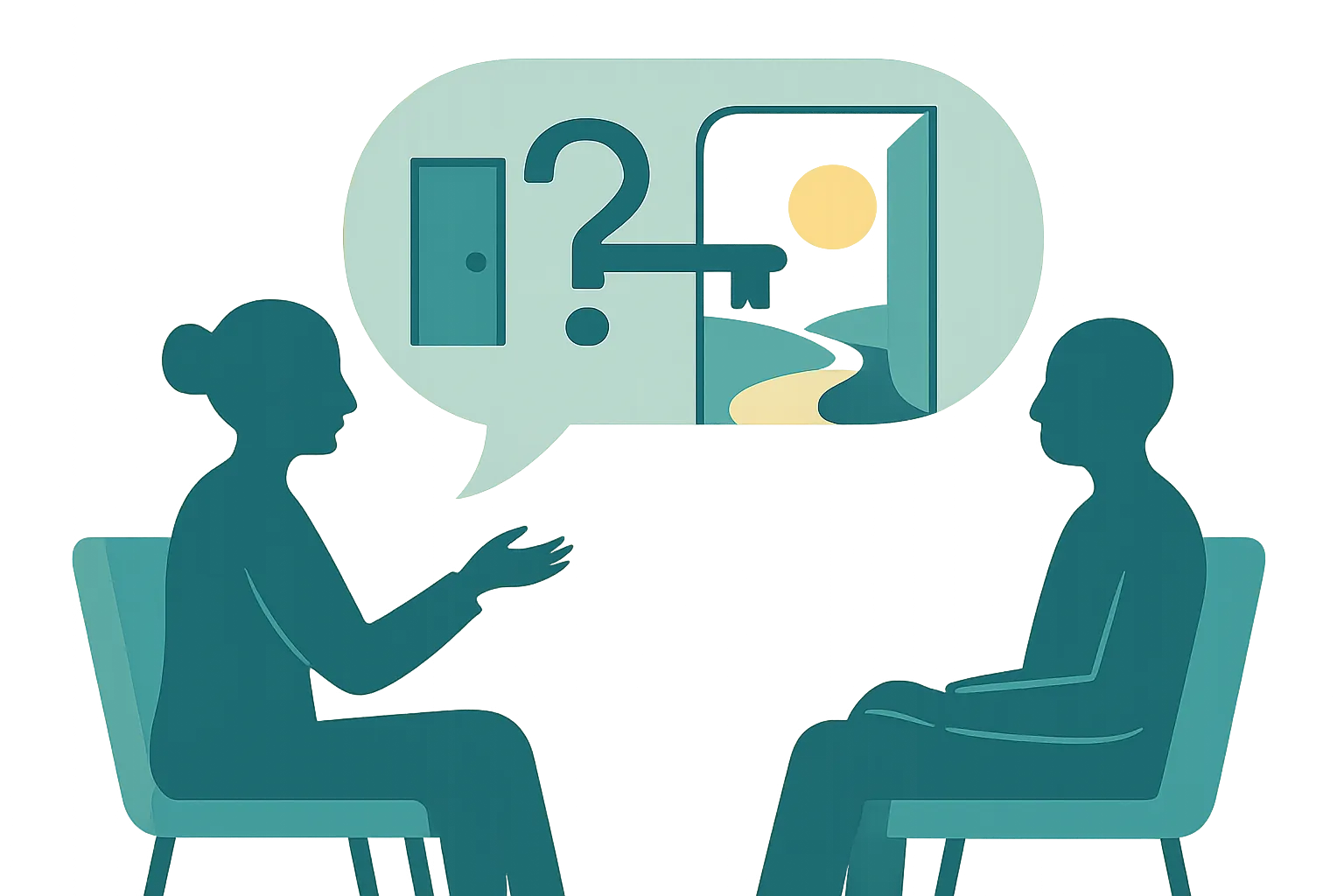
Key takeaway
When you analyze your own session transcripts, the single biggest obstacle to client exploration is often your own closed questions. Closed questions grow out of clinician anxiety and the urge to control, premature attempts to confirm a hypothesis, and an information-gathering mindset—and they quietly override the client's autonomy while blocking the empathic understanding of the client's internal frame of reference that Rogers described. You can shift toward open questions by training yourself to begin with 'What' and 'How,' substituting reflection for questions, and running honest self-supervision against an accurate transcript. The change isn't cosmetic phrasing; it's a move toward a therapeutic stance that respects the client's world on its own terms.
When the Conversation Keeps Stalling, Look at Your Questions First
Have you ever sat in session watching the conversation skim the surface—one-word answers, lengthening silences, your mind scrambling for the next thing to ask the moment the client says "yes" or "no"? That disorienting blank isn't a beginner's problem alone. It catches seasoned clinicians too.
In training and supervision, we write verbatim transcripts to look honestly at our own work. Transcribing a session isn't clerical busywork; it's the most uncomfortable—and most reliable—mirror we have for building clinical insight. And when clinicians actually read those transcripts back, they often discover that the largest barrier to a client's exploration isn't the client's defensiveness at all. It's the counselor's own closed questions.
The therapeutic alliance that drives outcome depends on how deeply and how safely we help clients explore their inner world. This piece looks at why we reach for closed questions, what they cost us clinically, and how to convert them—deliberately and trainably—into open questions that invite insight rather than shut it down.
Why We Keep Reaching for Closed Questions
Everyone knows open questions are "better." Yet transcript after transcript shows the same pattern: under anxiety or countertransference, the closed question slips out anyway. A closed question demands a specific piece of information ("yes/no") or narrows the client's options until they're really just confirming our guess. Three clinical drivers explain the habit.
1. Clinician anxiety and the urge to control
When the structure of a session feels loose, or a silence stretches past comfort, we unconsciously want to take the wheel. A closed question guarantees a definite answer, and that certainty is soothing—to us. But it comes at a price: it overrides the client's autonomy and quietly locks both parties into fixed roles, the counselor as expert-and-fixer, the client as passive respondent.
2. Premature attempts to confirm a hypothesis
Once we've formed a working hypothesis about a client's difficulty, the pull to verify it is strong. Asking "Were you angry then?" forecloses the client's chance to find their own word for the feeling and replaces their experience with our language. That's exactly the move that blocks access to what Carl Rogers called the client's internal frame of reference.
3. An information-gathering mindset
This is fixating on facts long after the intake is over. The goal of therapy isn't to assemble a tidy dossier; it's to understand the subjective meaning those facts carry for this particular client.
Closed vs. Open: A Side-by-Side from the Transcript
One real example beats a hundred lines of theory. Here are closed questions clinicians commonly fall into, how each can be reopened, and the clinical intent behind the change. The table reconstructs patterns frequently flagged in supervision.
| Focus | Closed (Before) | Open (After) | Clinical effect & intent |
|---|---|---|---|
| Affect | "Did that make you depressed?" (→ yes/no) | "What came up for you when that happened?" (→ narrative) | Doesn't impose a feeling ("depressed"); lets the client locate their own emotion word. |
| Relational dynamics | "Do you and your mother not get along?" (→ "Yeah, kind of.") | "How would you describe your relationship with your mother?" (→ qualitative texture) | Moves past a good/bad binary into the complexity and dynamics of the relationship. |
| Coping | "Have you talked to your friends about it?" (→ "No.") | "How have you usually gotten through moments this hard?" (→ resources & patterns) | Stops prescribing the counselor's solution ("tell a friend") and surfaces the client's own coping. |
| Motivation / ambivalence | "Do you want to quit your job?" (→ "Yes.") | "What would staying in this job mean for you, and what would leaving mean?" (→ ambivalence) | Goes beyond a yes/no decision to work the internal conflict and promote insight. |
Table 1. How reopening a closed question changes the clinical intervention.
Three Strategies to Retrain Your Language
Knowing this intellectually is one thing; the familiar closed question still leaps out mid-session. Changing it takes deliberate practice and a little structure. Here are three you can apply right away.
1. Change the opening word: lead with "What" and "How"
Just before you ask, consciously reroute the sentence to start with What or How. "Why" tends to put clients on the defensive, and the "Did you…?" / "Have you…?" frame all but guarantees a one-word answer. The fix isn't softer phrasing—it's swapping a yes/no grammar for an exploratory one.
Tip: When you feel "Were you angry?" forming—pause—and convert it to "What made you angry?" or "How did that situation land for you?"
2. Reflect instead of asking
A flood of questions is often a signal that the clinician is busy planning the next line rather than listening. The moment you feel the urge to fire off another question, try a reflection instead—holding the client's words up like a mirror.
Example: (Client: "This is just so hard.") → (Counselor: "That sounds really hard." / "It seems like you're completely worn out.")
Reflection is the most powerful open invitation there is for a client to keep unfolding the story themselves.
3. Work from an accurate transcript—and supervise yourself
You can't correct a verbal habit you can't see. Memory-based case notes preserve only what the clinician wanted to remember, which is exactly why your closed-question pattern stays invisible in them. A faithful, word-for-word transcript lets you see the contexts in which you reach for closed questions—and that pattern is what you target.
Beyond Technique: A Tool for Listening
Trading closed questions for open ones isn't a phrasing tweak. It's a shift in therapeutic stance: a decision to stop cutting the client's world to fit your frame and to respect it as it is. Look back at the questions you asked in your last session and ask yourself—was I mining for information, or clearing a path for the client's mind to move?
Realistically, though, typing up a full verbatim transcript for every session and analyzing it is close to impossible inside a packed caseload. If transcription and cleanup burn all your energy, there's none left for the part that actually matters: client formulation and self-reflection.
This is where security-first AI tools have started acting as a kind of co-therapist for clinicians. Modalia AI goes beyond plain dictation—handling transcription, speaker separation, and case conceptualization support so the administrative weight lifts and you can stay with the clinical work and the interaction in the room. Used well, it gives you back the attention that paperwork was quietly consuming.
Try this week: pick one case, pull just ten of your own questions—from an AI transcript or a partial transcription—and rewrite each as an open question using the patterns above. That small change can be the key that opens a door to deeper insight for your client.
References
- 1.
Frequently asked questions
What is the difference between an open and a closed question in counseling?
A closed question can be answered with a single word—usually "yes" or "no"—or by choosing from options the clinician supplies, which narrows exploration. An open question (typically beginning with "What" or "How") invites a narrative response, letting the client describe their experience in their own words and surface their own meaning.
Why do experienced counselors still ask closed questions?
Closed questions tend to surface under three pressures: clinician anxiety and the urge to control an ambiguous moment, the temptation to quickly confirm a working hypothesis, and an information-gathering mindset carried past the intake stage. Because they guarantee a definite answer, they offer momentary relief to the clinician—even though they constrain the client.
How can I tell if I rely too much on closed questions?
Work from an accurate, word-for-word session transcript rather than memory-based case notes, which preserve only what you wanted to remember. Reading the transcript back lets you see the specific contexts in which closed questions appear, count them, and identify the pattern you want to change.
What can I do instead of asking another question?
Try a reflection. When you feel the urge to fire off another question, mirror the client's words or affect back to them ("It sounds like you're completely worn out"). Reflection is one of the most powerful open invitations for a client to keep exploring on their own.
This article was written and reviewed using Modalia AI's clinical guidelines, with professional human review before publication.
Related articles
 Clinical Skills
How to Write Better Supervision Questions: Getting What You Actually Need from Your Supervisor
Stuck on what to ask in supervision? Use these structured question strategies to turn vague check-ins into focused clinical insight.
7 min read Clinical Skills
From "The Client Seems Depressed" to a Clinical Hypothesis: How Word Choice Elevates Your Case Reports
Turn vague observations into precise clinical hypotheses. A practical guide to terminology and sentence formulas that make your case reports read like expert work.
7 min read Clinical Skills
The Wounded Healer Trap: Why "I Want to Heal Myself" Sinks Your Counseling Grad School SOP
Why admissions faculty flinch at "I want to heal my own wounds"—and how to transform personal pain into a research-grade statement of purpose that gets you in.
6 min read