Limit Setting in Play Therapy: What to Do When a Child Points a Toy Gun at You
When a child aims a toy gun at you in session, Landreth's ACT model turns a tense moment into therapeutic opportunity. A clinical guide to limit setting.
Key takeaway
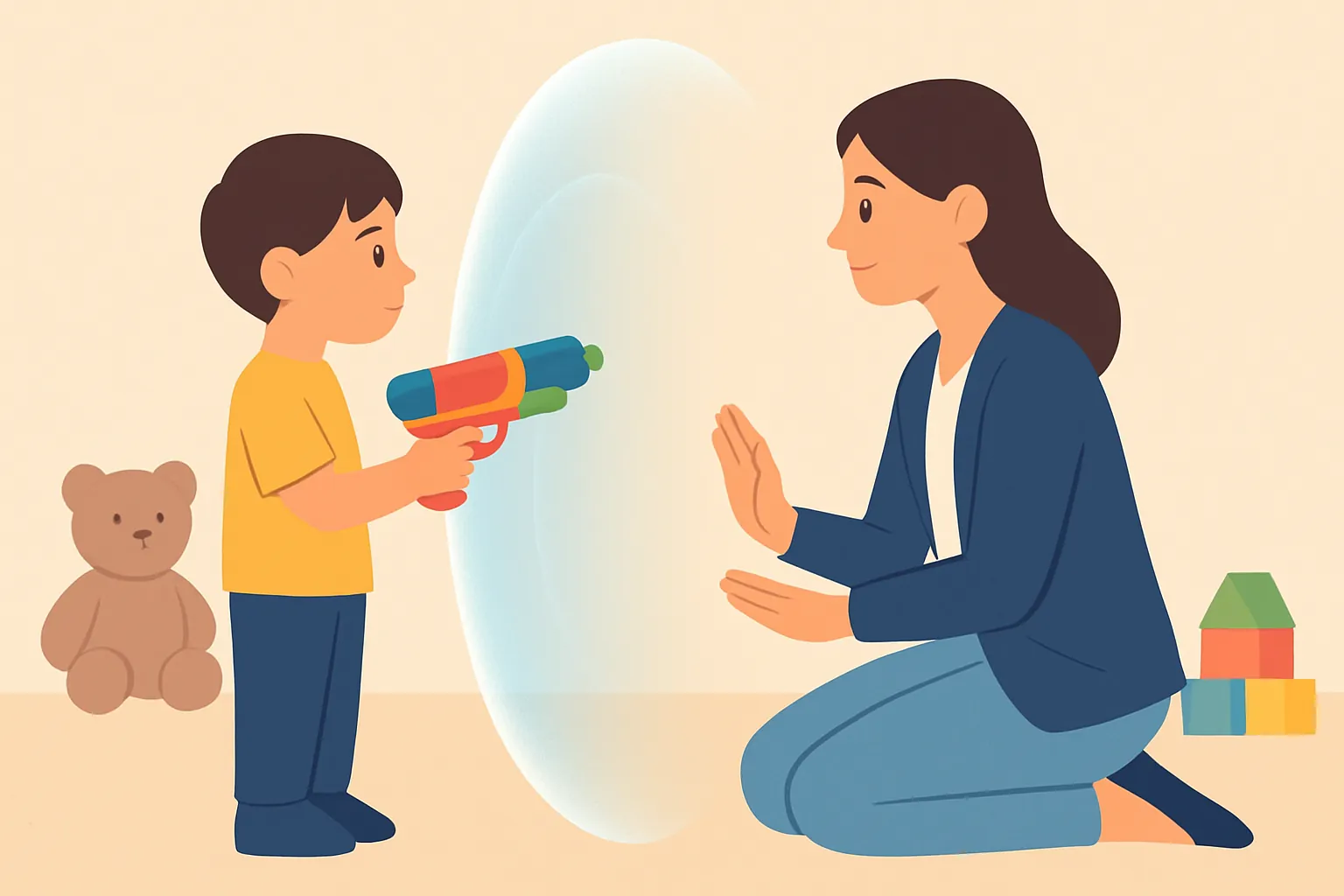
When a child points a toy gun at the therapist, the behavior often reflects a need for power and control, a test of the relationship's safety, or a reenactment of trauma. Landreth's ACT model offers an effective response: acknowledge the feeling first, communicate the limit clearly, then target an acceptable alternative. If the behavior continues, offering the child a choice hands them responsibility and builds self-regulation, and reviewing the session afterward—on your own or in supervision—lets you check your timing, tone, and countertransference objectively.
"Bang! You're dead!" — Turning a Toy Gun Pointed at You Into a Therapeutic Moment
One of the most charged moments in a play therapy room arrives when a child raises a toy gun or knife and aims it directly at the therapist. "Bang! You're dead!" they shout, pulling the trigger—and in that half-second, many early-career clinicians freeze. Do I go along with this? Do I shut it down firmly? The internal debate races by faster than you can name it.
In play therapy, limit setting is not discipline aimed at controlling behavior. It is a core therapeutic technique that provides the child with a sense of safety, strengthens reality testing, and develops self-regulation. Garry Landreth and many other leaders in the field have described therapeutic limits as the anchor that connects the therapeutic relationship to the real world.
But knowing the theory and applying it under pressure are two different things. When a child's aggression turns toward you, the countertransference it stirs—and the ethical and clinical questions it raises—can wear a clinician down. This article walks through concrete techniques for holding a firm boundary when a child tries to attack you, without damaging the relationship in the process.
1. Why Is the Child Aiming at You? Reading the Dynamics Beneath the Behavior
Before imposing any limit, we have to understand the psychological dynamics underneath the act. A child pointing a gun at the therapist is rarely just "acting out"—it is often an intense emotional expression and an attempt at connection. Clinically, this kind of aggressive play tends to fall into three contexts.
- A need for power and control. A child who normally feels suppressed steps into the permissive space of the playroom, becomes the powerful figure (the one holding the gun), overpowers an authority figure (the therapist), and experiences a sense of competence.
- Testing the relationship. "If I attack the therapist, will they abandon me? How far will they let me go?" The child is checking whether this is a safe person and a safe space.
- Reenactment of trauma. Children exposed to abuse or aggressive environments often replay the perpetrator-victim dynamic in play as a way of processing their anxiety.
The governing principle is this: accept the feeling, limit the behavior. The wish to shoot, the wish to win—those need to be fully heard and reflected. But the act of firing at a person calls for a clear limit. The therapist's stance here must never be punitive or reactive; the key is to stay firm but friendly.
2. A Field Guide to Landreth's ACT Model, Step by Step
Most play therapists know the ACT model (Acknowledge, Communicate, Target), yet many struggle to apply it in the moment. Let's map it directly onto the "shooting" scenario. ACT lets you redirect the behavior while protecting the child's self-esteem—and there is a world of difference between a flat "No!" and a true therapeutic limit. The contrast below makes the nuance clear.
| Step | Non-therapeutic response ❌ | Therapeutic limit (ACT) ✅ |
|---|---|---|
| 1. Acknowledge (A) | (Blocking instantly) "Who points a gun at a person?" Ignores the child's need | "You really want to shoot the gun at me." / "You'd love to give me a big surprise." Names and validates the impulse first |
| 2. Communicate (C) | "You'll hurt someone if you shoot. Stop it." Lecturing or scolding | "But people are not for shooting." / "I'm not for shooting." Short, clear, neutral in tone |
| 3. Target (T) | "Go play with something else." No concrete alternative | "You can shoot the bop bag over there instead." / "It's okay to hit that balloon next to me." Offers a specific target for the original impulse |
Table 1. A non-therapeutic response compared with a therapeutic response using the ACT model.
The most important tip here is pace. The instant the child raises and aims the gun, A-C-T needs to flow without a gap: "You want to shoot me (A), but people aren't for shooting (C)—you can shoot that target over there instead (T)."
3. When the Limit Doesn't Hold: Providing a Choice
Sometimes, even after you've applied ACT, the child keeps trying to fire—laughing, or angry. This is usually a test of the therapist's authority, or a sign that impulse control is genuinely overwhelmed. Now you move to providing a choice.
The heart of this step is handing responsibility back to the child. You are not the one stopping them; the child is the one deciding their own behavior.
- Step 4 — Provide a choice. "If you keep shooting at me, we can't play with the gun anymore today." (Brief pause.) "You can choose: keep playing by shooting the bop bag instead of me, or hand me the gun and we'll be done with it. It's your decision."
- Step 5 — Follow through. (If the child shoots again) "You've decided to shoot at me. That means the gun is finished for today." Then calmly collect the gun and place it out of reach—on a high shelf, for example.
Throughout, the therapist holds a neutral stance that demonstrates how an agreed-upon rule works—not a blaming "You're the reason we can't play." If the child cries or tantrums, reflect the feeling—"You're upset that you can't play with the gun anymore"—but do not return the restricted object. The consistency itself is what provides the security of a structured environment.
4. Reviewing and Analyzing the Session — and Where AI Can Help
Whether a limit succeeded or failed often only becomes clear after the session, when you review your session transcript or progress note. Subtle cues you were too rattled to catch in the moment are preserved in the record.
- How was my tone of voice? (Too threatening, or—just as likely—too tentative to sound credible?)
- Was my timing right? (Did I intervene before the trigger was pulled, or scold the child only after the shot?)
- How did the child respond? (Relieved to hear the limit, or escalating into more aggression?)
Optional tool tip: Some clinicians use AI-assisted session transcription to make this review more precise. Instead of relying on memory—"the child shot at me and I stopped them"—speech-to-text can capture the exact wording of your intervention ("...people are not for shooting"), the latency between your statement and the child's reaction, and the pattern of verbal exchange. That makes it easier to check objectively whether you carried out each ACT step, and gives supervision a concrete data point to work from. For tense moments like managing aggression, re-listening to your own intervention is a useful way to examine your countertransference. (A note on privacy: any recording of a session needs informed consent and a security-first tool—this is exactly the kind of documentation work Modalia AI is built to support.)
Conclusion: A Limit Is Not a Wall That Cages a Child—It's a Fence That Keeps Them Safe
The moment a child tries to shoot you with a toy gun is not a crisis. It's a valuable therapeutic opportunity to teach a child about safe boundaries. Children feel far more secure inside firm, predictable limits than they do in unlimited permissiveness.
Try the ACT model and the choice-giving technique in your next session—then document the process carefully and review it.
Action plan for therapists:
- Rehearse it. Pair up with a colleague, role-play a child shooting at you, and practice the ACT language out loud. If it isn't on the tip of your tongue, it won't come out under pressure.
- Rearrange your tools. For children high in aggression, consider keeping toy guns and knives out of sight and bringing them out only when clinically useful.
- Consider recorded review. To avoid missing anything in a high-tension session, use a session-transcription tool to analyze your own limit-setting language—down to the child's breathing and the tremor in your own voice that you'd otherwise never notice.
What happens inside the playroom helps a child adapt to the wider world outside it. To every clinician holding the line in the thick of play therapy: keep up the good work.
References
- 1.
Frequently asked questions
What is the ACT model in play therapy?
ACT stands for Acknowledge, Communicate, Target. Developed within Garry Landreth's child-centered play therapy framework, it is a three-step sequence for setting limits: first acknowledge and reflect the child's feeling or wish, then communicate the limit in short and neutral language, then target an acceptable alternative that lets the child satisfy the original impulse safely.
Should I stop a child immediately when they point a toy gun at me?
Not by shutting the feeling down. The guiding principle is to accept the feeling but limit the behavior. Reflect the child's wish to shoot or to win first, then state clearly that people are not for shooting, and offer a concrete alternative target. A purely prohibitive "No!" misses the therapeutic opportunity and can rupture the relationship.
What do I do if the child keeps shooting after I set a limit?
Move to providing a choice, which hands responsibility back to the child: they can continue playing by shooting an acceptable target, or the gun gets put away. If they shoot again, follow through calmly and consistently—reflect their disappointment but don't return the object. The consistency itself provides a sense of safety.
Why does reviewing a recorded session help with limit setting?
In the moment, clinicians often miss subtle cues—their own tone, the timing of an intervention, the child's reaction. Reviewing a transcript or recording afterward lets you check objectively whether you carried out each ACT step, examine your countertransference, and bring concrete data to supervision. Any recording requires informed consent and a security-first tool.
This article was written and reviewed using Modalia AI's clinical guidelines, with professional human review before publication.
Related articles
 Case Conceptualization
Breaking the "Yes, But" Game: A Transactional Analysis Guide for Therapists
Every suggestion you offer gets met with "Yes, but..." Here's the TA structure behind that stall—and four clinical moves to break it.
7 min read Case Conceptualization
Yalom's The Gift of Therapy: Passages Every New Counselor Should Copy by Hand
Irvin Yalom's prescription for therapists who fear silence: meet your client as a "fellow traveler" and let the here-and-now become the heart of the work.
6 min read Case Conceptualization
Working With Silence in Therapy: What Client Silence Means and How to Hold It
Silence in session isn't empty space. Learn to read its clinical meaning, tell productive from defensive silence, and use it as a therapeutic tool.
6 min read