Polyvagal Theory in Trauma Therapy: Stabilizing the Client's Nervous System
How polyvagal theory explains the "frozen" trauma response—and three physiological interventions that calm a dysregulated nervous system in session.
Key takeaway
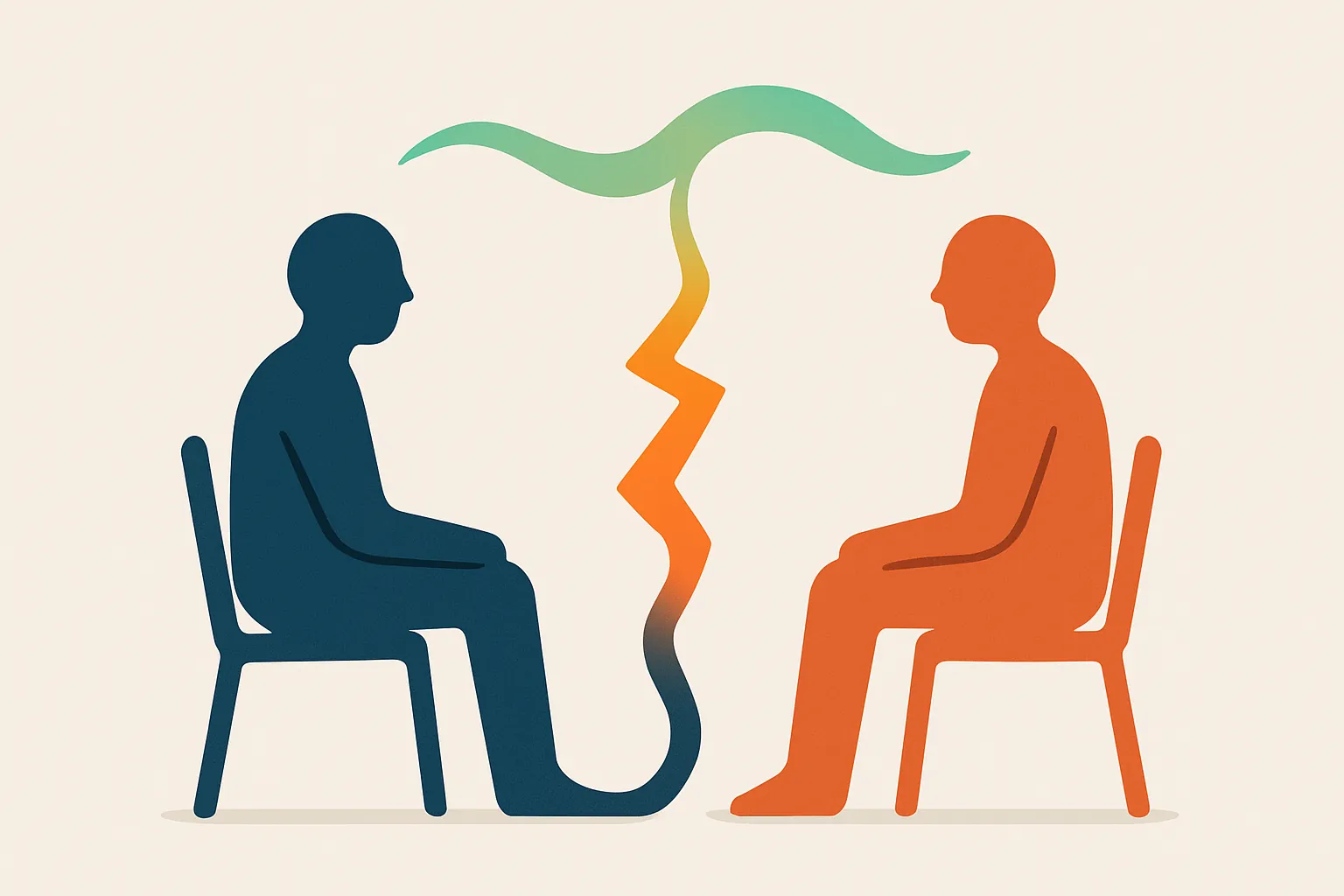
Stephen Porges's polyvagal theory describes the autonomic nervous system as a three-part hierarchy: the ventral vagal state (social engagement and safety), the sympathetic state (fight-or-flight mobilization), and the dorsal vagal state (shutdown and immobilization). A trauma client's hyperarousal or dissociation is not conscious resistance but a physiological state in which the nervous system has locked into a survival-driven defense. Clinically, therapists can help clients map their own nervous-system states, use co-regulation—holding a steady ventral vagal presence so the client's system entrains to it—and apply direct physiological interventions such as extended exhalation and low-pitched humming to tone the vagus nerve.
When Words Aren't Enough: How Polyvagal Theory Reaches the Trauma Client's Nervous System
Every clinician knows the client who doesn't get better the way the textbook says they should. You offer empathic, attuned listening. You try cognitive restructuring. And still the change is glacial. Clients with significant trauma histories often present as if "frozen"—flat, unresponsive—or they detonate at the smallest cue. In those moments it's easy to feel a quiet helplessness: What am I missing? Why does this client still behave as though they're on a battlefield, even in the safety of my office?
The answer may not live in the client's words at all. It may live in the body—specifically, in the autonomic nervous system. Stephen Porges's polyvagal theory shifted the center of gravity in trauma work from the memory of an event to the response of the nervous system. The theory reframes what looks like resistance: the client isn't refusing to engage, their autonomic system has locked into a defensive mode in the service of survival. This article walks through how to apply polyvagal theory in the room—how to help a dysregulated nervous system find its way back toward safety, and how to read the subtle signals that tell you it's happening.
Beyond Fight-or-Flight: The Three-Tier Autonomic Hierarchy
For decades we taught the autonomic nervous system as a binary: the sympathetic branch (the accelerator) and the parasympathetic branch (the brake). Polyvagal theory reorganizes this through an evolutionary lens into a three-part hierarchy. To understand a trauma client, you first need to know which of these three states they're currently living in.
Ventral Vagal — The Social Engagement System
The most recently evolved state, activated when we feel safe. Here the client can read your tone of voice and your facial expressions; attunement becomes possible. Effective therapy depends on the client being able to access and stay in this state, even briefly.
Sympathetic — Mobilization
Engaged when threat is detected. Heart rate climbs, muscles tense, and the fight-or-flight response comes online. Clients with chronic trauma can shift into this tier in an instant, presenting as anxious, enraged, or hyperaroused over a cue that looks trivial from the outside.
Dorsal Vagal — Immobilization
When overwhelm reaches a life-threat threshold, the body chooses shutdown. This is the territory of dissociation, collapse, depression, and the freeze response—the most primitive defense of all. Suspect a dorsal vagal state when a client goes blank, reports feeling numb, or says they can't feel their body in the room.
Distinguishing these three states cleanly is essential to choosing a treatment strategy. The table below contrasts their clinical features.
Table 1 — Autonomic States in Polyvagal Theory: Clinical Features at a Glance
| Nervous-system state | Primary function | Client's subjective experience | Observable signs in session |
|---|---|---|---|
| Ventral vagal | Social engagement; safety and connection | "I am safe." "I am connected." Curiosity, calm | Vocal prosody; natural eye contact; access to humor and play |
| Sympathetic | Mobilization; defense against danger | "I am in danger." "I have to do something." Anxiety, fear, anger | Rapid or heated speech; restlessness; hostility or defensiveness toward the therapist |
| Dorsal vagal | Immobilization; conservation and shutdown | "I feel dead." "I can't do anything." Emptiness, disconnection | Flat, low voice; unfocused gaze; loss of body sensation (numbness) |
Clinical Application: Guiding the Nervous System Toward Safety
So how do you move a client out of dorsal vagal shutdown or sympathetic hyperarousal and toward the ventral vagal state where therapeutic work can actually take hold? Three practical interventions follow directly from the theory.
1. Mapping the Nervous System
This is a collaborative practice of helping clients recognize their own autonomic states—an approach developed in depth by Deb Dana. You might ask: "When you feel safe, what does your body feel like?" or "When you sense a threat, what's the very first signal you notice?" As clients build this map, they come to understand that their shifts in feeling are not a character flaw but a change in physiological state. That reframe is powerful for reducing shame, which is itself a barrier to regulation.
2. Co-Regulation
In trauma, the capacity for self-regulation is often damaged. The therapist's own nervous system then has to serve as an external regulator. When you hold a steady ventral vagal state—offering a calm, prosodic voice and a soft, open face—the client's nervous system can entrain to yours, in part through the social-engagement circuitry that reads safety in another person. This is the moment when your presence itself becomes the most powerful intervention in the room.
3. Toning the Vagal "Brake": Breath and Sound
The vagus nerve runs from the brainstem to the heart, lungs, and gut, which is why the body offers direct, physiological routes to regulation. A long exhale—for example, inhaling for four counts and exhaling for six—engages the parasympathetic system and slows the heart rate. Low-pitched humming or "vooing" vibrates the diaphragm and vocal folds, stimulating the vagus nerve and easing the body toward release. When a client begins to escalate mid-session, pausing the conversation to try one of these physiological practices is often more effective than any verbal reassurance.
Protecting the Therapeutic Container: Presence Over Paperwork
The heart of polyvagal-informed work is the therapist's ability to give the client a felt sense of safety—what Porges calls neuroception of safety. Yet the real-world session makes this hard. Tracking a client's micro-expressions, the catch in their breath, the shift in their vocal tone—while simultaneously documenting the session in detail—is close to impossible. When you bend to your notes, you break eye contact, and to a trauma client a broken gaze can register, beneath awareness, as a small signal of rejection or disconnection.
That tension is worth naming as a clinical issue, not just an administrative one. The more a therapist can put the pen down and stay with the client, the more co-regulation has room to work. How each clinician resolves this—deferring detailed notes to immediately after the session, using a trusted documentation workflow that doesn't pull attention away from the client, or building brief regulation-tracking into the record—matters less than the principle: protect your attention. Your regulated presence is the instrument. Anything that frees you to watch the autonomic signals—a change in skin color, pupil response, the depth of a breath—and to stay in genuine contact is an investment in the therapeutic alliance, not a convenience.
That attentional bandwidth also sharpens your data. Noticing that silences are running longer than they did last week, or that emotional vocabulary has thinned, gives you an observable marker that a client may be sliding toward a dorsal vagal state—something you can name, test against your subjective read, and carry into goals for the next session.
Conclusion: Healing Begins When We Learn the Language of the Nervous System
Trauma is suffering that has lost its words. That is precisely why talk alone runs into a wall. Polyvagal theory teaches us to see the client's state rather than their symptom. Aggression is not a "bad attitude"—it is the sympathetic system fighting to survive. Silence is not "non-compliance"—it is the vagal system shutting down to escape pain. When you can read this physiological language, you can finally offer a trauma client something words could not: genuine safety.
A few ways to put this into practice:
- Regulate yourself first. Before a session, take a minute of slow, extended breathing to settle your own system into a ventral vagal state. Co-regulation starts with you.
- Shift the focus of your observation. In your next session, spend ten extra minutes attending less to the content of the story and more to vocal tone, facial tension, and the depth of the breath.
- Protect your presence. Audit whatever pulls your attention away from the client mid-session—often documentation—and find a workflow that lets you stay in contact. Your therapeutic presence is worth protecting.
To read the distress signals a client's nervous system is sending, and to become the anchor that lets them find their way back to a safe world—that may be the most quietly profound task we do.
References
- 1.
- 2.
Frequently asked questions
What are the three states in polyvagal theory?
Polyvagal theory describes an autonomic hierarchy of three states: the ventral vagal state (social engagement, safety, and connection), the sympathetic state (mobilization, or fight-or-flight in response to threat), and the dorsal vagal state (immobilization, or shutdown, dissociation, and collapse under overwhelming threat).
Why doesn't talk therapy alone work with some trauma clients?
When a client's autonomic system is locked in a sympathetic (hyperaroused) or dorsal vagal (shutdown) state, the brain regions needed for reflection and verbal processing are not fully online. Cognitive and verbal interventions land best once the nervous system has moved toward a ventral vagal state, so physiological regulation often has to come first.
What is co-regulation in a clinical setting?
Co-regulation is the process by which a therapist's regulated nervous system helps stabilize a client whose self-regulation is impaired. By maintaining a calm, prosodic voice and an open, settled presence, the clinician offers a state the client's nervous system can entrain to—making the therapist's presence itself a primary intervention.
Which physiological techniques calm the nervous system in session?
Extended exhalation (for example, a four-count inhale and six-count exhale) engages the parasympathetic system and lowers heart rate, while low-pitched humming or "vooing" vibrates the vocal folds and diaphragm to stimulate the vagus nerve. Pausing for these practices when a client escalates is often more effective than verbal reassurance.
This article was written and reviewed using Modalia AI's clinical guidelines, with professional human review before publication.
Related articles
 Case Conceptualization
Breaking the "Yes, But" Game: A Transactional Analysis Guide for Therapists
Every suggestion you offer gets met with "Yes, but..." Here's the TA structure behind that stall—and four clinical moves to break it.
7 min read Case Conceptualization
Yalom's The Gift of Therapy: Passages Every New Counselor Should Copy by Hand
Irvin Yalom's prescription for therapists who fear silence: meet your client as a "fellow traveler" and let the here-and-now become the heart of the work.
6 min read Case Conceptualization
Working With Silence in Therapy: What Client Silence Means and How to Hold It
Silence in session isn't empty space. Learn to read its clinical meaning, tell productive from defensive silence, and use it as a therapeutic tool.
6 min read