Process Notes vs. the Clinical Record: What Goes Where (and Why It Matters Legally)
Keep your clients—and yourself—protected. Learn how to cleanly separate the formal clinical record from your private process notes, and document defensibly.
Key takeaway
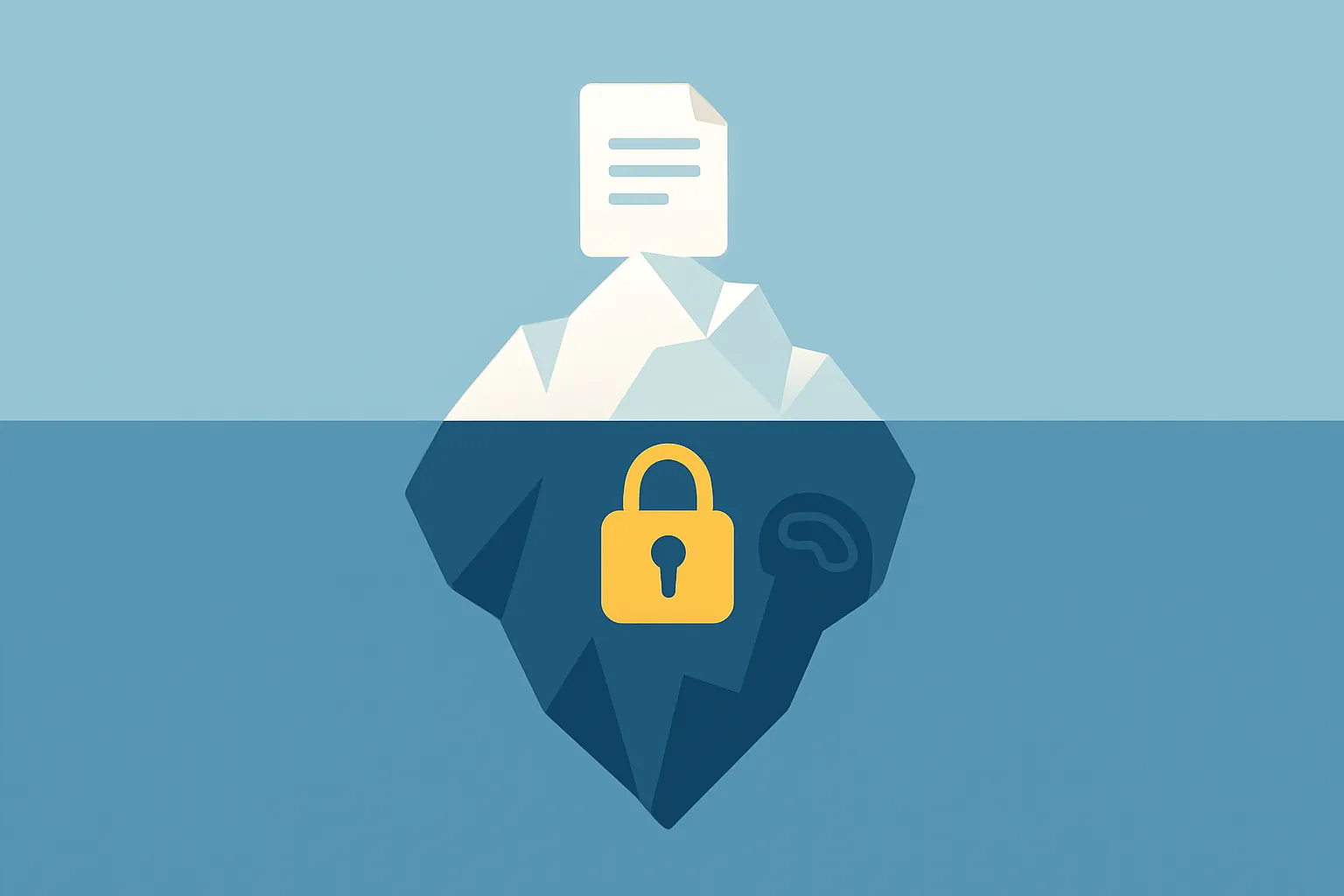
Clinical documentation falls into two categories that serve fundamentally different purposes. The formal clinical record (the progress note) captures objective facts—diagnosis, symptom change, risk assessment, interventions—and may be read by insurers, courts, and treating colleagues; it is best written in behavioral language using a structured format like SOAP or DAP. The process note (or psychotherapy note) is your private space for hypotheses, countertransference, and sensitive client detail; in many jurisdictions it carries heightened protection only if it is stored separately from the formal record and not shared with third parties. Keeping the two cleanly separated protects client privacy and frees the clinician to think freely without legal exposure.
Would your notes hold up in court? A clean-separation strategy for process notes and the clinical record
It's late, and you're still finishing the day's notes—wrestling with the same question every clinician knows intimately: How much of this should I actually write down? Record too much, and you worry about client confidentiality. Record too little, and you fear the continuity of care—and the clinical rationale behind your decisions—will be too thin to stand on.
That tension has only sharpened as clinical records are increasingly subpoenaed as evidence or demanded by insurers. Defensive documentation—writing in a way that protects both client and clinician—has never mattered more. As the person holding a client's most private material, how do we safeguard them while still meeting our professional obligations?
The answer turns on one distinction: the record you show versus the notes you keep for yourself. This article unpacks the decisive difference between the formal clinical record (the progress note) and the process note (sometimes called the psychotherapy note), and offers practices you can apply in your next session.
1. Two documents, two purposes—and why the line matters
To manage documentation efficiently, you first have to understand that these two records exist for genuinely different reasons. Blending them is what makes note-writing drag on—and what creates trouble when a records request lands on your desk.
The formal clinical record (progress note)
This is what lives in the official chart at your practice or agency. Its core is objective fact and symptom-focused description: the treatment plan, changes in symptoms, the client's safety status (risk of harm to self or others), prognosis, and the services delivered. It is a public-facing document in the sense that insurers, courts, and clinicians at a receiving facility may read it during a referral or transfer of care.
The process note (psychotherapy note)
This is the record for your own reflection and analysis: the hypotheses that surfaced mid-session, your read on the client's unconscious dynamics, transference and countertransference, and the granular, sensitive details of a client's private life. In jurisdictions that recognize a distinct category of "psychotherapy notes," these enjoy heightened legal protection only when they are stored separately—physically and electronically—from the formal record and are not disclosed to third parties.1
Separating the two is not red tape. It is applied clinical ethics—putting client privacy first—and it is the safeguard that lets you exercise clinical imagination freely, without every speculative thought becoming a discoverable part of the official chart.
2. At a glance: clinical record vs. process note
When you're unsure what belongs where, the table below is worth keeping nearby. It's also a useful lens for re-auditing the documentation templates your practice or agency uses.
| Formal clinical record | Process note | |
|---|---|---|
| Primary purpose | Proof of treatment, insurance billing, communication with other providers, legal defensibility | Deepening clinical insight, supervision material, memory aid |
| What it contains | Session date/time, diagnosis (DSM/ICD), symptom change, interventions used, plan, risk assessment | Specific dialogue, dream analysis, the clinician's felt sense (countertransference), intimate family secrets, hypothetical interpretations |
| Style | Objective, behavioral language, concise (e.g., "Client reported anxiety") | Subjective, narrative, free-form (e.g., "I sensed anger underneath the client's silence") |
| Who can access it | Client, courts, insurers, treating colleagues—accessible | The author only—generally not accessible to others (though protection varies, and a court order may compel disclosure)1 |
3. A practical guide: documenting safely and effectively
So how do you actually write these two records without doubling your workload? Three strategies experienced clinicians rely on:
Write the formal record in behavioral language (SOAP/DAP)
The clinical record should capture the client's status, not their story. Rather than "The client said she wants to kill her husband," write "Client verbalized heightened hostility and impulsivity toward her spouse." The second version is more clinically precise and far safer if the record is ever read aloud in a deposition. Lean on a recognized structure—SOAP (Subjective, Objective, Assessment, Plan) or DAP (Data, Assessment, Plan)—and keep it concise and fact-based.
With process notes, separate storage is everything
Don't make the common mistake of dropping process notes into the general comments field of your EMR. Use a system that offers a genuinely separate, lockable section, or keep them in a separate encrypted file or a locked physical notebook. Session transcripts and case reports prepared for supervision count as process notes too—treat them with the same care.
Practice the art of not writing it down
Not everything needs to be recorded. Third parties' real names, specific criminal disclosures (outside your mandatory-reporting duties), deeply personal details about sexuality—if these have no direct bearing on the treatment, the default is to leave them out. A useful gut check before you write a sentence: "If this were projected on a screen in a courtroom, would I feel at ease—on my client's behalf and my own?"
4. Putting technology to work: less documentation burden, more insight
A counselor is both a listener and, less romantically, an administrator who is constantly analyzing and recording. When documentation drains your energy and tips you toward burnout, your clients ultimately pay the price. That's why the ethical use of AI to ease this load is drawing real attention.
Producing a transcript by hand from a recording once took hours; AI speech recognition has collapsed that work dramatically. The crucial question is how you use the tool.
Automate the objective layer (the clinical record)
A security-first AI partner like Modalia AI can transcribe a session and surface key statements and themes. That's genuinely useful for capturing the objective facts your formal record needs—session time, presenting concerns, and so on—so you can chart from accurate detail rather than straining to remember.
Redirect your energy toward insight (the process note)
Let the AI handle the flat work of fact-gathering and summarizing. You bring the higher-order thinking: reading and interpreting the dynamics beneath the surface. If the tool records that "the client cried while talking about her mother," your job is to ask whether that was guilt, anger, or grief—and to put that in your process note.
In the end, good clinical documentation is both a shield that protects your client and a blade that sharpens your therapeutic insight. Starting today, keep the formal record and your process notes cleanly separated, and use modern tools wisely—so you become the owner of your documentation rather than its servant. The time you save is time your clinical intuition gets to grow deeper.
Footnotes
-
Legal protections for private therapy notes vary widely by jurisdiction. In the United States, the HIPAA Privacy Rule defines a distinct category of "psychotherapy notes" that, when kept separate from the medical record, are shielded from most routine disclosures. Other frameworks—such as the EU's GDPR or Canada's PIPEDA—govern client data differently and may not recognize the same separate-protection concept. A court order can override these protections. Always confirm the rules that apply where you practice. ↩ ↩2
Frequently asked questions
What's the difference between a process note and a progress note?
A progress note is the formal clinical record—objective, symptom-focused documentation (diagnosis, interventions, risk, plan) that insurers, courts, and other providers may read. A process note is your private record of hypotheses, countertransference, and sensitive detail, kept for your own reflection and supervision. In some jurisdictions process notes receive extra legal protection, but only when stored separately from the formal record.
Are my private therapy notes legally protected from subpoena?
It depends on where you practice. In the U.S., HIPAA's "psychotherapy notes" provision shields separately-stored notes from most routine disclosures, but a court order can still compel them. Other jurisdictions (e.g., under GDPR or PIPEDA) treat clinical records differently and may not recognize a separate protected category. Verify the rules in your region and never assume blanket immunity.
How should I word risk-related statements in the formal record?
Use behavioral, clinical language rather than verbatim quotes. Instead of "Client said she wants to kill her husband," write "Client verbalized heightened hostility and impulsivity toward her spouse." This is clinically precise, documents the risk you assessed, and reads far more defensibly if the record is later reviewed in a legal setting.
Can I keep process notes in my EMR?
Only if your EMR provides a genuinely separate, access-restricted section for them. Dropping process notes into a general comments field merges them with the formal record and can strip away any heightened protection. Otherwise, keep them in a separate encrypted file or a locked physical notebook—and treat supervision transcripts and case reports the same way.
This article was written and reviewed using Modalia AI's clinical guidelines, with professional human review before publication.
Related articles
 Clinical Skills
How to Write Better Supervision Questions: Getting What You Actually Need from Your Supervisor
Stuck on what to ask in supervision? Use these structured question strategies to turn vague check-ins into focused clinical insight.
7 min read Clinical Skills
From "The Client Seems Depressed" to a Clinical Hypothesis: How Word Choice Elevates Your Case Reports
Turn vague observations into precise clinical hypotheses. A practical guide to terminology and sentence formulas that make your case reports read like expert work.
7 min read Clinical Skills
The Wounded Healer Trap: Why "I Want to Heal Myself" Sinks Your Counseling Grad School SOP
Why admissions faculty flinch at "I want to heal my own wounds"—and how to transform personal pain into a research-grade statement of purpose that gets you in.
6 min read