Wechsler Processing Speed: Reading Performance Anxiety in Symbol Search and Coding
A low Processing Speed Index isn't always a neurological story. Learn to read Symbol Search and Coding for the quiet signals of performance anxiety—and turn them into clinical leverage.
Key takeaway
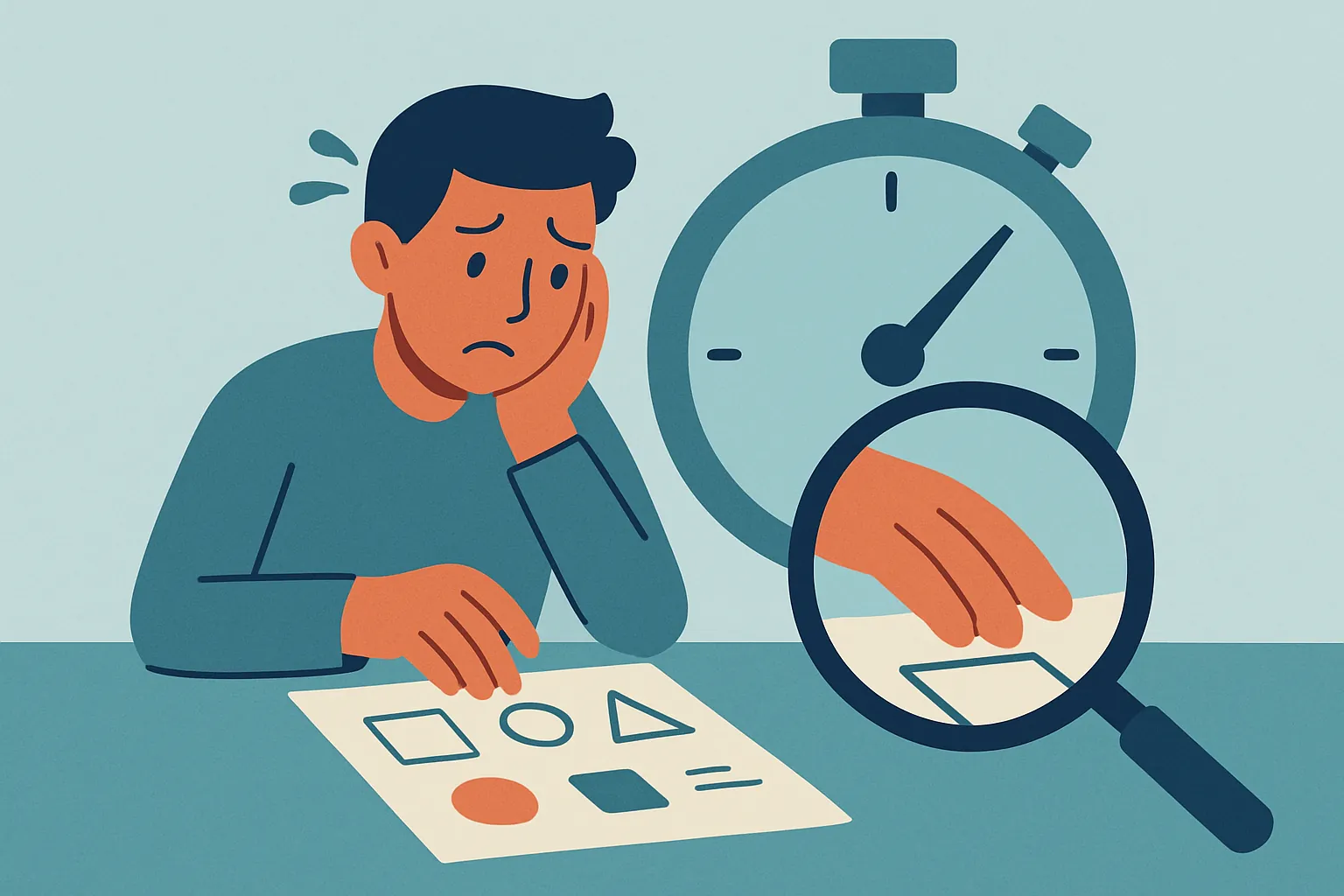
When the Processing Speed Index (PSI) on a Wechsler scale drops well below a client's other index scores, reading it as a purely neurological efficiency problem can lead to misdiagnosis. Slowed performance on Symbol Search and Coding may instead reflect worry and rumination consuming working memory, while perfectionistic clients prioritize accuracy over speed—producing a slow-but-near-flawless pattern. Interpreting a low PSI therefore means analyzing error count and test-taking behavior together; a large gap between the General Ability Index (GAI) and PSI often signals high latent ability constrained by anxiety rather than a deficit in capacity.
Is It Really Just Speed? Reading the Hidden Signal of Performance Anxiety on the Wechsler 🧠
You've almost certainly sat with this result: a client whose Processing Speed Index (PSI) lands conspicuously below every other index. The reflex is to reach for a tidy explanation—"Bright client, just slow on the motor side?" or "Maybe there's an attention problem." Many of us file it under temperament or neurological efficiency and move on.
But the number is the end of a story, not the whole of it. What the score doesn't show you is the trembling underneath it—the client who is managing fear in real time while the stopwatch runs.
Two subtests in particular put this on display: Symbol Search and Coding. Both impose a time constraint, and under that pressure, how a client works becomes far more revealing than how much they complete. A depressed processing speed here is frequently less about cognitive lag and more about a brake pedal—one pressed by perfectionism and fear of failure. In short: performance anxiety. This piece looks at how these two subtests function as a mirror for a client's anxiety, and how to convert that observation into clinical traction.
1. Walking the Speed–Accuracy Tightrope: How Anxiety Slows Processing
Cognitive interference: worry eats working memory
An anxious client doesn't spend the task fully on the task. A parallel channel is running—"What if I get it wrong?" "What if I run out of time?"—and that worry and rumination draw down the same cognitive resources the task needs. Because this load competes for working memory capacity, it physically slows the rate at which information is processed and acted on. Symbol Search and Coding both demand fast visual scanning and a quick motor response; anxiety installs a hesitation right in the middle of that loop.
The speed–accuracy trade-off, observed live
Clients high in performance anxiety—especially those with obsessive or perfectionistic features—assign far more value to not being wrong than to being fast. You can instruct them to "work as quickly as you can," and they will still review, and re-check, almost involuntarily. The tells are concrete: re-examining a symbol they've already drawn in Coding, or checking an answer in Symbol Search and then pausing a beat longer before committing.
Guarding against the interpretive error
Miss this context and the risk is real: a low PSI gets attributed to psychomotor retardation in depression, or to the inattention of ADHD. So when you see a depressed PSI, read the error count alongside the behavior. If the work is slow but errors hover near zero, you may be looking not at a capacity deficit but at over-control driven by anxiety.
2. Symbol Search vs. Coding: Where Does the Anxiety Show Up Strongest?
Both subtests measure processing speed, but they load cognition and motor output differently—so anxiety surfaces differently too. Comparing them helps you distinguish whether the anxiety arises from simple visual decision-making or from more complex motor execution and learning.
| Dimension | Symbol Search | Coding |
|---|---|---|
| Core demand | Visual scanning and discrimination | Visuomotor coordination, associative learning |
| Motor load | Low (simple check mark) | High (drawing symbols) |
| How anxiety presents | - Gaze shuttles repeatedly between target and search groups - Excessive hesitation before marking "no" | - Excessive pressure on the pencil (heavy, dark strokes) - Erasing and redrawing symbols that don't "look right" - Re-checking the key every time rather than memorizing it (low confidence) |
| Clinical implication | Anxiety around making a decision | Fear of imperfection and of making a mistake |
Table 1. Comparative analysis of anxiety presentation in Symbol Search and Coding.
3. From Score to Intervention: A Practical Workflow
Sharpen your behavioral observation
What matters more than the score is how the client got there. Did they reach for the eraser, sigh, grip the pencil hard enough to whiten their knuckles? These nonverbal cues shouldn't be buried in the "behavioral observations" box of the report—bring them into the feedback session. Something like: "I noticed you were especially careful to double-check your work during Coding. Do you tend to feel that same pressure about making mistakes in daily life?" is a genuinely strong rapport-building move.
Use the GAI–PSI gap as leverage
When higher-order abilities—verbal comprehension (VCI), perceptual reasoning (PRI)—are strong but processing speed alone sags (GAI > PSI), you can read it as latent capacity that anxiety is holding back. Reframing this for the client is therapeutically powerful: "This isn't a sign that you're not smart. It's that the part of you that wants to do well is so strong it's overloading the system."
Bridge to everyday life
The performance anxiety you saw in the testing room tends to repeat in the world outside it. Concrete connecting questions work well:
- "Have you ever run out of time on a test because you kept changing your answers?"
- "Do you find it hard to hit send on an email until you've reread it for typos?"
Linking the test result to the client's chief complaint lets you set the therapeutic goal precisely—not "get faster," but "tolerate anxiety and soften perfectionism."
4. The Insight That Records Even the Hesitation
Symbol Search and Coding are, in the end, more than IQ measurement. They are a window onto how a client meets the demands of the world—and the emotional posture they bring to it. Our job is to refuse to be captured by the number and instead read the process that produced it: the tremor, the hesitation, the anxious need to check just one more time. That interpretive act is precisely the clinical insight no tool can replace.
That said, timing the test, scoring it, and capturing every micro-reaction simultaneously is genuinely demanding. The most valuable material often comes in the inquiry phase afterward—"I was so nervous," "I was scared I'd get it wrong"—and those lines evaporate quickly if no one writes them down.
This is where a security-first AI partner for counselors—handling transcription and documentation—can be a smart adjunct. With recording and note-taking off your plate during feedback or intake, you can give your full attention to the client's nonverbal anxiety cues. Having the client's mistake-related statements accurately captured in text means that, later, during case conceptualization, you can recover signals of performance anxiety you might otherwise have lost—and build a more precise treatment plan around them.
Action item: In your next administration or feedback session, attend to test-taking behavior over the score. And consider whether a smart documentation tool might free you to catch the anxiety signals you'd otherwise miss.
Frequently asked questions
Does a low Processing Speed Index (PSI) always indicate a cognitive deficit?
No. A depressed PSI can reflect performance anxiety rather than reduced capacity. When worry and rumination consume working memory, response speed slows—yet error rates often stay near zero, which points to anxious over-control rather than a true processing deficit.
How do I distinguish anxiety-driven slowing from depression or ADHD on processing speed subtests?
Analyze error count and test-taking behavior alongside the score. Slow work with very few errors, plus checking, erasing, and hesitation, suggests perfectionistic over-control. Psychomotor retardation in depression and inattention in ADHD typically show different behavioral and error patterns, so the qualitative observation is essential.
What does a large gap between the General Ability Index (GAI) and PSI suggest?
A pattern of strong verbal comprehension and perceptual reasoning with a markedly lower PSI (GAI > PSI) often indicates high latent ability that anxiety is constraining. It can be reframed clinically as a system overloaded by the wish to perform well, not as limited intelligence.
How can I use these test observations therapeutically?
Share the nonverbal cues you observed in the feedback session, link them to the client's chief complaint, and reframe the low score as anxiety holding back real ability. This lets you set the treatment goal as tolerating anxiety and softening perfectionism rather than simply increasing speed.
This article was written and reviewed using Modalia AI's clinical guidelines, with professional human review before publication.
Related articles
 Case Conceptualization
Breaking the "Yes, But" Game: A Transactional Analysis Guide for Therapists
Every suggestion you offer gets met with "Yes, but..." Here's the TA structure behind that stall—and four clinical moves to break it.
7 min read Case Conceptualization
Yalom's The Gift of Therapy: Passages Every New Counselor Should Copy by Hand
Irvin Yalom's prescription for therapists who fear silence: meet your client as a "fellow traveler" and let the here-and-now become the heart of the work.
6 min read Case Conceptualization
Working With Silence in Therapy: What Client Silence Means and How to Hold It
Silence in session isn't empty space. Learn to read its clinical meaning, tell productive from defensive silence, and use it as a therapeutic tool.
6 min read