Art Therapy Techniques for Clients Who Struggle to Speak: A Clinician's Guide to Projective Drawing Tests
How projective drawing tests and art therapy techniques open up clients who can't find the words—plus practical PDI questioning and recording strategies.
Key takeaway
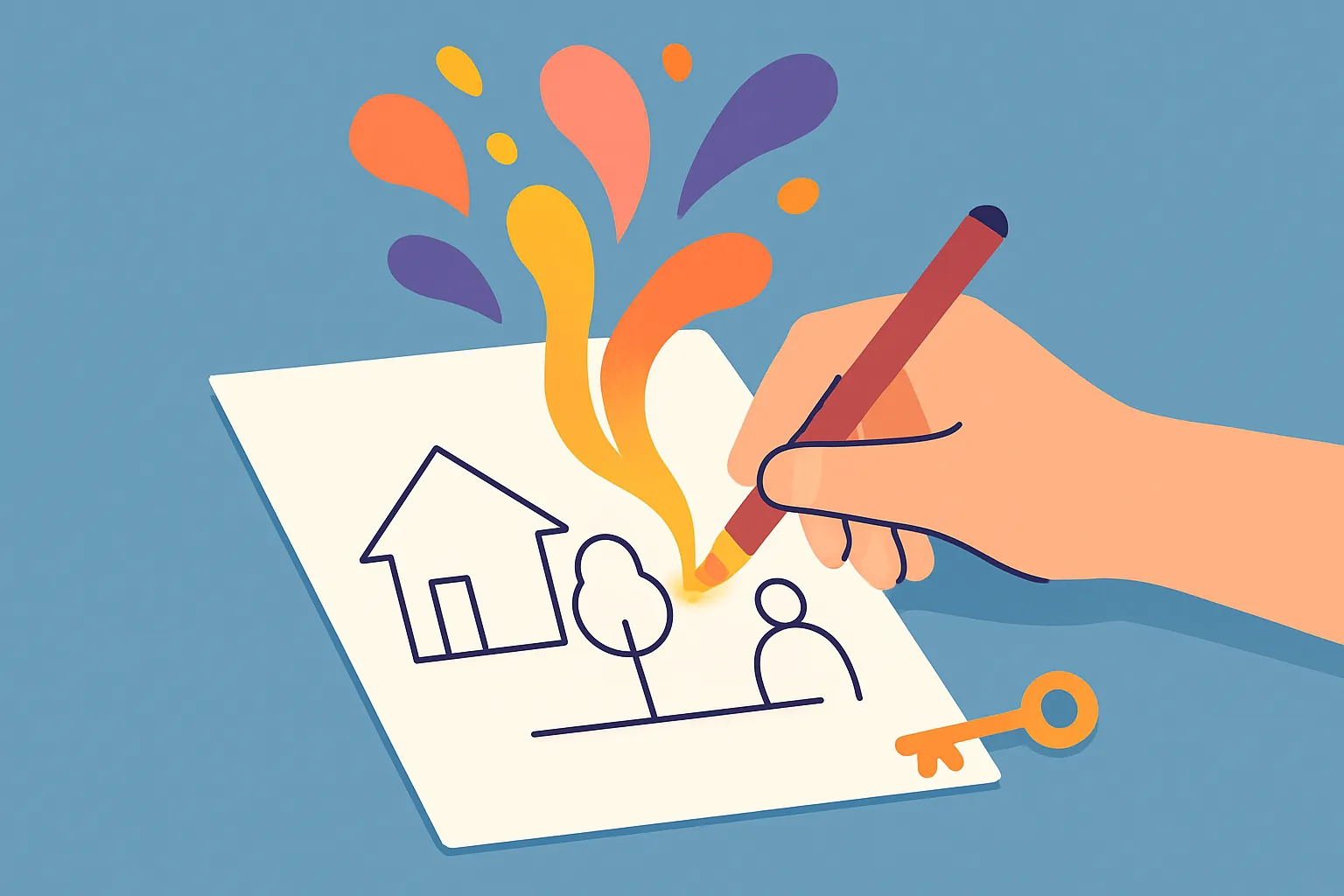
When clients present with strong verbal defenses or difficulty naming emotions, art therapy techniques and projective drawing tests offer a clinical pathway to make unconscious material visible. Instruments like HTP, KFD, and PITR are chosen selectively based on client characteristics and treatment goals, and observing the drawing process—sequence, pressure, frequency of erasing—often yields richer data than the finished image. In the post-drawing inquiry (PDI), the clinician uses open questions to support the client's own insight rather than imposing interpretation, and pairing this with AI session-recording tools lets the counselor preserve verbatim dialogue while integrating nonverbal cues.
When Words Become a Wall: Reaching Clients Who Can't Speak Their Pain
Every clinician knows the feeling. A client settles into the chair and falls silent, or cycles through "I don't know" and "I just feel stuck" without ever landing on anything more. Language is our most powerful tool, but it is also where defenses operate at full strength. For clients carrying trauma, or for those with limited capacity to identify their own feelings (alexithymia), talk-based therapy can run straight into a wall.
This is where art therapy techniques and projective drawing tests become some of the most useful instruments in clinical practice. A drawing bypasses the censorship of the conscious mind and renders the inner world visible—a kind of X-ray of the psyche. This guide walks through how to apply drawing tests effectively with clients who give us little to work with verbally, and how to manage the rich data those sessions produce.
Why a Drawing? The Clinical Value of Nonverbal Communication
Bypassing defenses, surfacing the unconscious
Drawing on the work of Freud and Jung, the unconscious is arguably structured more in images than in words. When clients describe their suffering in language, the account passes through filters of social desirability and logical self-monitoring. A drawing sidesteps those cognitive defenses. Once you lower the pressure to "draw well," clients project repressed affect in raw form—through line weight, pressure, how often they reach for the eraser, how they use the space on the page. This can create an opening at exactly the point in early treatment when rapport is hardest to establish.
Engaging right-hemisphere emotional processing
Talk therapy primarily engages the left hemisphere—logic, language, analysis. Art-making activates the right hemisphere, the seat of emotion, intuition, and imagery. Because emotional distress is so closely tied to right-hemisphere processing, the act of drawing itself can be cathartic and regulating. It helps the clinician move more quickly toward the core affect hiding beneath cognitive distortions.
A safe buffer for transference and countertransference
When direct, face-to-face eye contact feels like too much, the drawing functions as a third object—a transitional space between client and clinician. Because the client speaks through the image rather than directly to the counselor, the psychological pressure eases. The clinician, in turn, can hold a more neutral, observing stance with the drawing as the shared focus.
Comparing the Drawing Tests You'll Actually Use
Among the many projective drawing tasks available, the skill lies in matching the instrument to the client and the treatment goal. The table below compares three of the most commonly used tests in clinical settings.
| HTP (House–Tree–Person) | KFD (Kinetic Family Drawing) | PITR (Person in the Rain) | |
|---|---|---|---|
| Primary goal | Broad exploration of personality structure, ego strength, and the home environment | Family dynamics—hierarchy and interaction among family members | Assessing stress (the rain) against coping resources (umbrella, etc.) and resilience |
| Best suited for | Intake, when you need an overall read of the client's psychological state | Family conflict; child/adolescent clients; couples work | Clients reporting acute stress or in need of crisis intervention |
| What to analyze | Size, placement, and detailing of the image (doors, windows, roots) | Distance between figures, presence or absence of activity, barriers (walls, TV) | Balance between the volume of rain (stress intensity) and protective equipment (coping capacity) |
Table 1. Comparison of common projective drawing tests in clinical practice.
Three Practical Strategies to Maximize Clinical Value
Before the drawing: frame it as expression, not evaluation
Many clients resist with "I can't draw." Your instructions matter enormously here. It's essential to reassure them: "This isn't a test of artistic ability. Stick figures are perfectly fine—just express whatever comes to mind, as comfortably as you can." Offering a choice of paper and media (pencil, eraser, crayons) gives the client a sense of control, which lowers anxiety.
During the drawing: watch the process, not just the product (process analysis)
The finished drawing alone won't give you the full picture. While the client works, observe closely:
- Sequence: What did they draw first, and what came last?
- Hesitation: Do they sigh or pause at particular features?
- Revision: Where do they erase and rework repeatedly? (May suggest obsessive anxiety.)
- Pressure: Are the lines faint and weak (depression, low energy), or pressed so hard the paper nearly tears (aggression, tension)?
After the drawing: the art of the Post-Drawing Inquiry (PDI)
The heart of a drawing test is the conversation it makes possible—the PDI. Avoid handing down interpretations like "this represents your anxiety." Instead, ask questions that let the client arrive at their own insight:
- "About how old is this tree?"
- "What is this person thinking right now?"
- "What's the weather like in this picture? How might it change going forward?"
These questions become stepping stones, letting the client safely explore unconscious material and put their own feelings into words.
The Power of the Record: Capturing Drawing Sessions with AI
During a drawing test, the clinician faces a dual demand: observe and record at once. Tracking the order in which a client draws and the subtle shifts in their expression—while also documenting the flood of dialogue during the PDI—is taxing even for seasoned practitioners. And the offhand remarks a client makes during the PDI are often the most clinically significant; they're exactly what slips away when you're busy taking notes.
This is where modern AI session-recording and analysis tools can dramatically raise the quality of the work. Freed from the burden of transcription, the clinician can give full attention to the client's eyes and the emerging image.
Complete preservation of the PDI dialogue
An AI transcription tool can accurately convert the client's descriptions—down to the hesitations and silences before a particular question—into text. This becomes an undistorted, vivid record for later supervision or case study.
Integrating nonverbal cues with verbal content
The clinician can then match the drawing (image) against the AI-organized session content (text). It becomes far easier to record integrative observations such as: "When the client spoke about 'family,' their voice trembled and they repeatedly erased the legs of the family figures in the drawing." This not only shortens documentation time but sharpens the accuracy of case understanding.
Modalia AI is built as a security-first partner for exactly this kind of work—transcription, case conceptualization, and documentation—so the record stays private while you stay present.
A Warmer Window In
For clients who can't find the words, a drawing can be the gentlest form of comfort and the clearest channel for connection. With the art therapy techniques and PDI strategies above—and a smart, unobtrusive way to capture what happens—you can begin to surface the gem-like stories hidden inside a client's silence. When a clinician's attentive eye meets the right tools, the work of healing grows deeper and safer.
Frequently asked questions
When should a counselor use projective drawing tests instead of talk therapy?
Drawing tests are especially useful when clients have strong verbal defenses, difficulty identifying emotions (alexithymia), trauma histories, or when early rapport is hard to build. The drawing bypasses cognitive censorship and gives both clinician and client a shared, lower-pressure focus.
Which drawing test should I choose—HTP, KFD, or PITR?
Match the instrument to the goal. Use HTP for a broad read of personality and ego strength at intake, KFD to explore family dynamics (especially with children, adolescents, and couples), and PITR to assess stress and coping resources in clients facing acute distress or crisis.
What is the PDI (Post-Drawing Inquiry) and how should I conduct it?
The PDI is the structured conversation that follows the drawing. Rather than imposing interpretations, the clinician asks open questions (e.g., "How old is this tree?" or "What is this person thinking?") so the client can explore unconscious material safely and put feelings into words.
Why is observing the drawing process as important as the finished image?
The sequence of what's drawn first or last, hesitations, repeated erasing, and line pressure all carry clinical meaning—signaling anxiety, depression, aggression, or tension that the completed picture alone may not reveal. Process analysis adds a layer of data the static image can't provide.
This article was written and reviewed using Modalia AI's clinical guidelines, with professional human review before publication.
Related articles
 Case Conceptualization
Breaking the "Yes, But" Game: A Transactional Analysis Guide for Therapists
Every suggestion you offer gets met with "Yes, but..." Here's the TA structure behind that stall—and four clinical moves to break it.
7 min read Case Conceptualization
Yalom's The Gift of Therapy: Passages Every New Counselor Should Copy by Hand
Irvin Yalom's prescription for therapists who fear silence: meet your client as a "fellow traveler" and let the here-and-now become the heart of the work.
6 min read Case Conceptualization
Working With Silence in Therapy: What Client Silence Means and How to Hold It
Silence in session isn't empty space. Learn to read its clinical meaning, tell productive from defensive silence, and use it as a therapeutic tool.
6 min read