Geriatric Depression vs. Pseudodementia: Using Neuropsychological Testing and the WAIS-IV to Tell Them Apart
How clinicians distinguish geriatric depression from true dementia using WAIS-IV profile analysis, performance attitude, and qualitative observation.
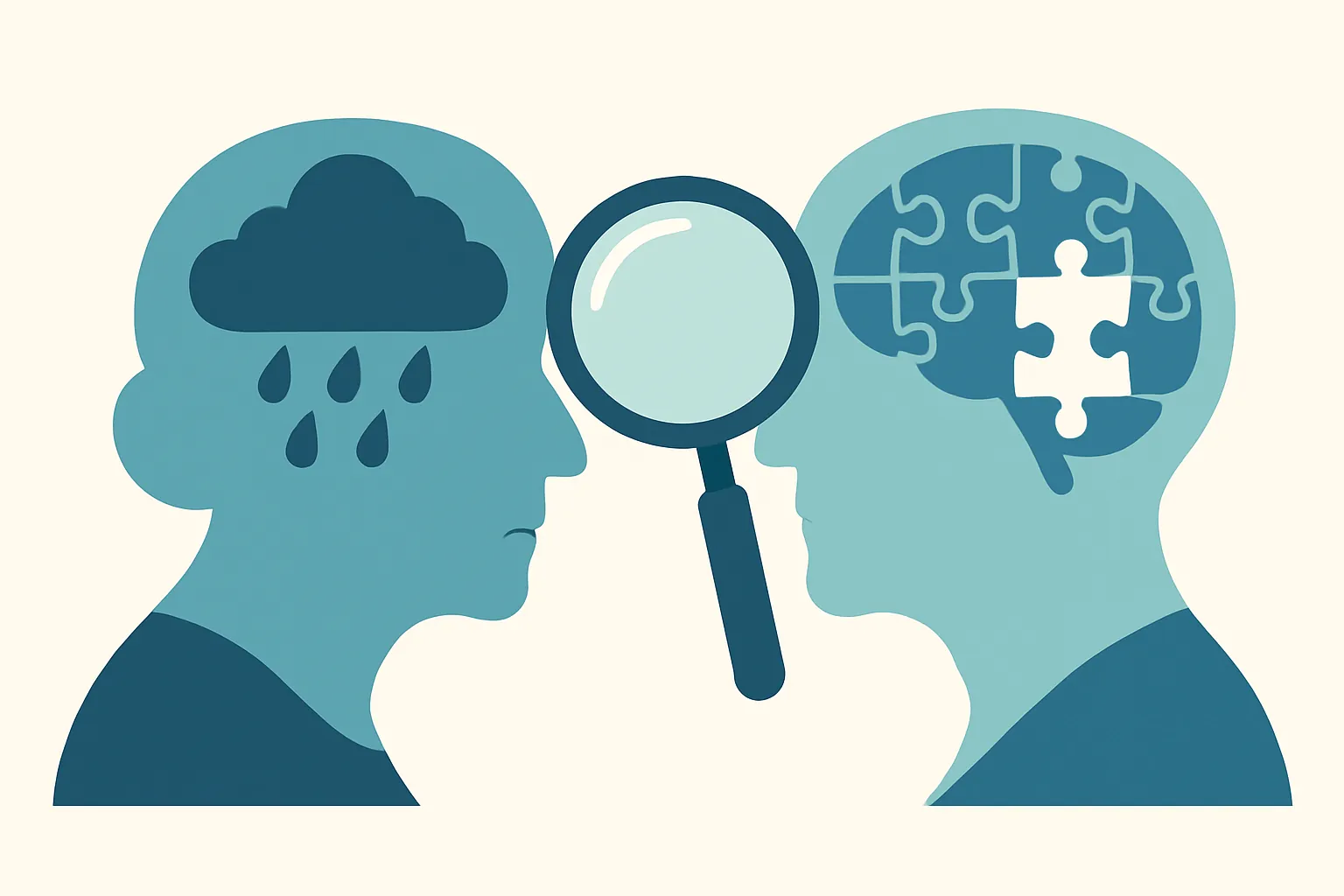
Key takeaway
When geriatric depression deepens, it can mimic dementia—a presentation called pseudodementia—making misdiagnosis a real risk. The clearest differentiators are insight and test-taking attitude: depressed older adults tend to exaggerate and complain about cognitive decline, while those with dementia minimize or deny it. On the WAIS-IV, depression typically produces lowered Processing Speed and Working Memory with relatively preserved Verbal Comprehension; reading that scatter qualitatively—alongside daily functioning—is what separates a 'mind slowed by depression' from organic decline.
"He keeps forgetting things—is it dementia?" The fine line between geriatric depression and pseudodementia
An older client and their adult child sit down across from you, faces drawn. "He's burned a pot on the stove three times this month." "She barely speaks anymore, and her memory isn't what it used to be." The family member is frightened and already convinced it's dementia; the client sits with shoulders slumped, eyes on the floor. Any clinician who works with older adults has met this presentation many times. Is this the opening chapter of Alzheimer's disease—or a cognitive paralysis carved out by deep depression?
Cognitive decline driven by geriatric depression—often called pseudodementia—can look almost identical to true dementia, and that resemblance is exactly what makes it so easy to get wrong. Mistake depression for dementia and prescribe a cognitive enhancer alone, and the client loses the critical window for treating a mood disorder that is genuinely treatable. Mistake early dementia for "just depression," and you forfeit the chance to slow its progression.
What the situation demands of us is a sharp eye for differential diagnosis—one that looks past the presenting complaint. This article walks through how neuropsychological testing, and the WAIS-IV (Wechsler Adult Intelligence Scale, Fourth Edition) in particular, can help untangle the knot, and what concrete strategies you can carry straight into the consulting room.
What actually separates pseudodementia from true dementia?
Clinically, pseudodementia describes a major depressive episode that surfaces in an older adult as a marked drop in cognitive function. Rather than organic brain damage, it is emotional distress that pulls down attention and processing speed so sharply that it reads as a memory problem. To distinguish the two, you have to compare how the symptoms emerge and how the client behaves under testing.
The single biggest discriminator lives in insight and performance attitude. Depressed clients tend to complain loudly about their memory loss and suffer over it; clients with dementia tend to minimize, deflect, or deny it. The table below lays out the contrast.
| Feature | Geriatric depression (pseudodementia) | Alzheimer's-type dementia |
|---|---|---|
| Onset | Relatively abrupt, with a datable starting point | Slow and insidious; onset hard to pinpoint |
| Chief complaint | Actively—often exaggerates—cognitive decline | Downplays or denies memory problems |
| Test-taking attitude | Gives up easily ("I don't know") | Strains to answer even when wrong (confabulation) |
| Memory impairment | Recent and remote memory impaired to a similar degree | Recent memory severely impaired; remote memory preserved |
| Mood | Depression precedes or accompanies the decline | Mood change (apathy, amotivation) follows cognitive decline |
There is a useful paradox here: when a client insists, "I've become an idiot, I can't remember anything," that very complaint points more toward depression than dementia. The capacity to notice and grieve the loss is itself a clinical clue.
Reading the WAIS-IV profile: cognitive efficiency vs. motivation
When an interview alone can't settle the question, the WAIS-IV becomes a powerful differential tool. Many counselors think of an intelligence test as a machine for producing a single IQ number, but in geriatric assessment the diagnostic gold is in the scatter between subtests and the discrepancies between index scores—not the Full Scale IQ itself.
The WAIS-IV profile of a depressed older adult tends to look distinct from that of someone with organic brain injury:
- Lowered Processing Speed (PSI): Psychomotor retardation—a core feature of depression—drags down timed tasks like Coding and Symbol Search well below the other indices.
- Lowered Working Memory (WMI): Impaired concentration weakens Digit Span and Arithmetic. The information was never lost from storage; it failed to register at the attentional input stage in the first place.
- Preserved Verbal Comprehension (VCI): By contrast, Verbal Comprehension—an index of crystallized intelligence—tends to hold up. That preservation signals a functional, mood-driven slowdown rather than organic damage.
Early Alzheimer's-type dementia, on the other hand, tends to impair new learning itself, pulling cognition down more globally, and often shows a distinct drop in visuospatial construction (e.g., Block Design). The clinician's real skill, then, is not reading the overall IQ but analyzing the gap between what is preserved and what is impaired.
What to do with this in practice
Test data alone can't decide everything. We have to look past the instrument and see the client inside the therapeutic relationship. Here are concrete moves for assessing an older client accurately and intervening well.
1. Lead with qualitative analysis, not the score.
Watch the process, not just the number. Does the client abandon a task mid-stream—"This is pointless, I can't do it anyway"? Or do they push past the time limit, determined to get it right? The former leans toward depression, the latter toward dementia. Carefully recorded behavioral observations often carry more diagnostic weight than the scaled scores themselves.
2. Cross-check against activities of daily living (ADLs).
Interview the family about real-world functioning. If test scores are low but the client still rides public transit alone and manages their own money without trouble, the likeliest explanation isn't true cognitive impairment—it's performance anxiety in the testing situation or motivational drop driven by depression.
3. Treat feedback as an intervention in its own right.
When you explain the results, the words "This is not dementia" can deliver enormous relief and therapeutic hope. A gentle metaphor—"Your brain cells are healthy; it's that a cold in the heart has slowed down the speed of your thinking"—can improve medication adherence and strengthen motivation for therapy. Done well, the feedback session is one of the most powerful interventions you offer.
In the end, an accurate diagnosis is the first step toward returning the client's lost confidence. We are not merely evaluators; we are partners helping a person regain control of their life.
Conclusion: precise records, smart tools, and the best outcome for the client
Distinguishing geriatric depression from pseudodementia can feel like finding a path through fog. The truth hides in subtle verbal nuance, fleeting changes of expression, and the texture of how someone performs under testing. In that work, the clinician's clinical insight is an irreplaceable resource.
But analyzing complex test data, capturing a client's ambiguous statements without losing a word, and simultaneously tracking nonverbal cues is genuinely demanding—especially with older clients, whose answers may wander and whose voices can be soft enough to miss.
This is where a security-first AI transcription and analysis partner for counselors can help. Modern tools not only render the session to text in real time; they can also surface quantifiable signals—how often a client said "I don't know," how long the silences (response latency) ran between answers—that are easy to lose in the moment.
An action plan you can start using now:
- 📅 Structure the intake. Pair a depression screen (such as the Geriatric Depression Scale, GDS) with a brief cognitive screen (such as the MMSE or MoCA) as a routine to capture baseline data.
- 📝 Strengthen behavioral observation. Build the habit of writing up performance attitude (gives up vs. perseveres) in its own dedicated section, separate from the scores on the report sheet.
- 🤖 Evaluate AI support. Hand the repetitive transcription work to an AI partner, and reinvest the time you recover into analyzing nonverbal behavior and building the treatment plan.
Accurate records and analysis are the surest way to prevent misdiagnosis and hand an older client back a world in sharp focus. Let technology carry the routine load so your clinical expertise can shine where it matters most.
Frequently asked questions
What is pseudodementia, and how is it different from dementia?
Pseudodementia is cognitive decline caused by a major depressive episode—most often in older adults—rather than by organic brain damage. Depression slows attention and processing speed enough to mimic memory loss, but the impairment is functional and reversible with proper mood treatment, unlike the progressive organic decline of Alzheimer's-type dementia.
What is the single most useful clinical clue for telling them apart?
Insight and performance attitude. Depressed clients tend to exaggerate and complain about their cognitive decline and give up easily on tasks ("I don't know"), while clients with dementia tend to minimize or deny problems and strain to answer even when they're wrong. Paradoxically, loud distress about memory loss points more toward depression.
What WAIS-IV pattern is characteristic of depression rather than dementia?
Depression typically lowers Processing Speed (Coding, Symbol Search) from psychomotor retardation and Working Memory (Digit Span, Arithmetic) from poor concentration, while Verbal Comprehension—reflecting crystallized intelligence—stays relatively preserved. That preserved-versus-impaired gap signals a functional slowdown rather than organic damage.
Why check activities of daily living (ADLs) during assessment?
Because a mismatch is diagnostic. If formal test scores are low but the client still uses public transit alone and manages their finances, the deficit is more likely performance anxiety or depression-driven amotivation than genuine cognitive impairment. Family interviews about real-world functioning anchor the test data in lived behavior.
This article was written and reviewed using Modalia AI's clinical guidelines, with professional human review before publication.
Related articles
 Case Conceptualization
Breaking the "Yes, But" Game: A Transactional Analysis Guide for Therapists
Every suggestion you offer gets met with "Yes, but..." Here's the TA structure behind that stall—and four clinical moves to break it.
7 min read Case Conceptualization
Yalom's The Gift of Therapy: Passages Every New Counselor Should Copy by Hand
Irvin Yalom's prescription for therapists who fear silence: meet your client as a "fellow traveler" and let the here-and-now become the heart of the work.
6 min read Case Conceptualization
Working With Silence in Therapy: What Client Silence Means and How to Hold It
Silence in session isn't empty space. Learn to read its clinical meaning, tell productive from defensive silence, and use it as a therapeutic tool.
6 min read