QEEG and Neurofeedback in Counseling Practice: Clinical Value and the Business Case
When clients ask "Is therapy actually working?", QEEG brain maps and neurofeedback offer objective answers—while opening new revenue streams for your practice.
Key takeaway
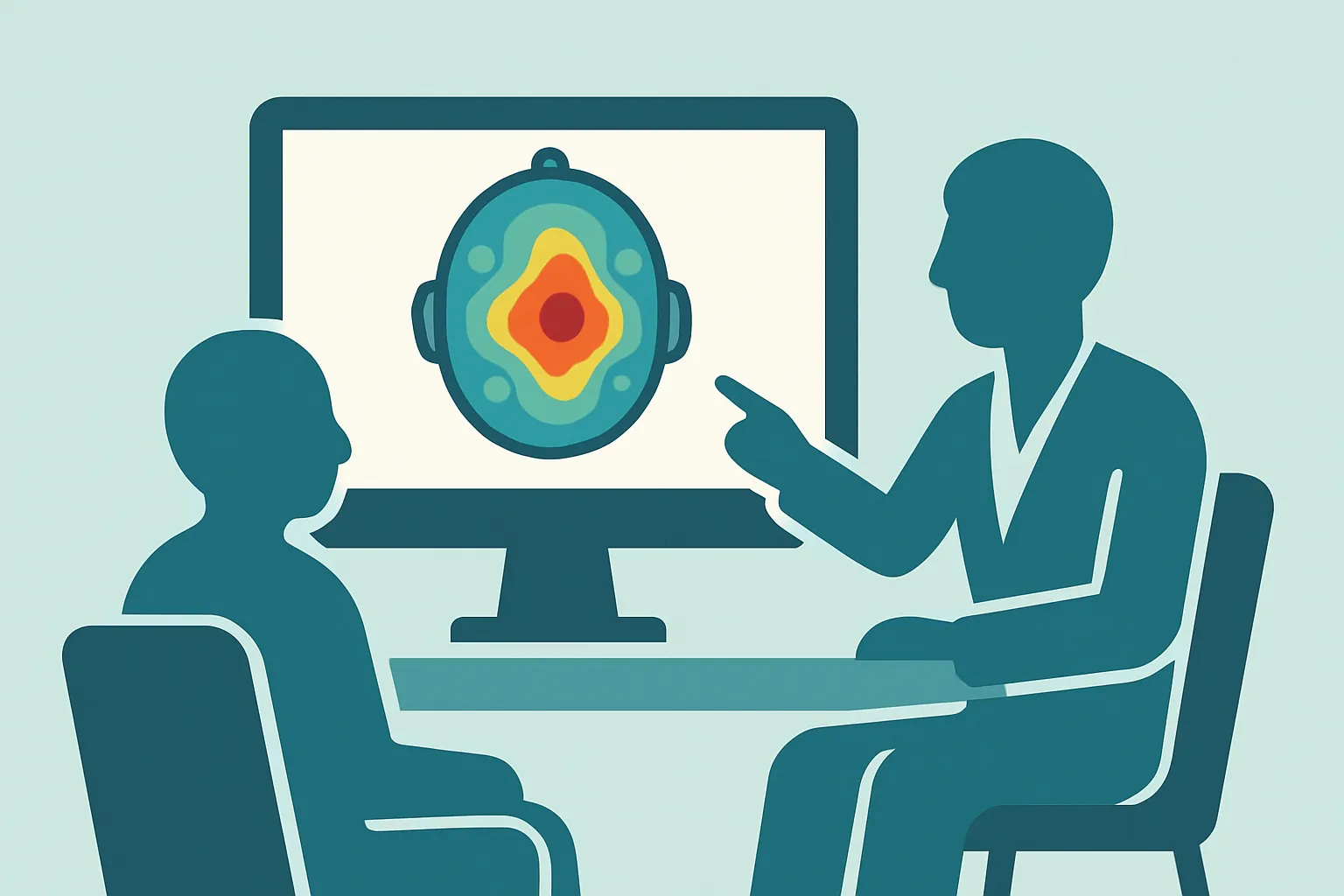
Quantitative EEG (QEEG) converts the brain's electrical activity into a visual brain map, helping clients understand their symptoms objectively and strengthening treatment motivation. Neurofeedback uses that data to train brain function noninvasively, serving as an alternative or complement to medication. Adoption carries upfront equipment and training costs, but it tends to improve client retention and supports higher-value treatment packages—provided clinicians earn proper credentials, secure supervision for interpretation, and routinize the assess–interpret–train–counsel cycle.
Answering "Is Therapy Really Working?" With Data
If you run a practice or sit across from clients week after week, you have heard some version of this question: "Am I actually getting better?" Psychotherapy works with something invisible—the mind—so we rarely get the immediate, visible change a surgeon can point to. We infer improvement from a client's self-report and behavioral shifts. But for clients who think in terms of data and evidence, subjective reassurance sometimes isn't enough. They want an objective marker.
The field has been moving past evidence-based practice as a slogan toward genuinely integrative care that incorporates biological measures. Two tools draw particular interest here: quantitative EEG (QEEG) and neurofeedback. Together they can reduce the ambiguity of talk therapy, make a practice's expertise visible, and diversify how a clinic earns revenue. The barriers are real—equipment costs and the learning curve of interpretation—but so is the upside. This article looks at how to adopt and use QEEG and neurofeedback strategically, balancing clinical value against the economics of running a practice.
1. Clinical Value: Making the Invisible Visible
The greatest strength of QEEG and neurofeedback in session is how they bypass a client's defenses and deepen insight. Many clients dismiss their symptoms as personal weakness, or deny the problem outright. Objective brain data acts as a mirror—it shows the client where things stand without assigning blame.
Setting treatment goals from objective data (brain mapping)
QEEG analyzes the brain's electrical activity and renders the distribution of delta, theta, alpha, and beta activity as a visual brain map. When a client with depression can see frontal alpha asymmetry, or a child with ADHD shows elevated frontal theta, the symptom reframes itself as a functional imbalance in the brain rather than a character flaw. That reframe lowers resistance to treatment and tends to raise motivation sharply.
Neurofeedback as an alternative or complement to medication
Neurofeedback trains brain function through operant conditioning—noninvasively. For parents wary of medication side effects, for clients who are pregnant, or for people with chronic anxiety or insomnia who feel they've hit the ceiling of what medication alone can do, it offers a meaningful option. A recurring theme in the research is that when the counselor provides emotional support and neurofeedback helps regulate physiological arousal, the effects of cognitive behavioral therapy (CBT) are amplified.
A way in for trauma and developmental work
For deep trauma that talk therapy struggles to reach, or for children with language delays and clients on the autism spectrum, neurofeedback can activate neural networks directly and build capacity for emotion regulation. Often its real value is that it creates an opening—a workable space the counselor can then step into.
2. Traditional vs. Neuroscience-Informed Counseling: The Business Case
From a management standpoint, buying equipment should be an investment, not an expense. Adding QEEG and neurofeedback isn't just another line on the menu—it repositions the practice as a science-informed clinical institution. There are upfront costs (hardware, training), but over time the payoff shows up as higher client retention and the ability to build higher-value treatment offerings.
| Traditional counseling model | Neuroscience-informed model (QEEG + NF) | |
|---|---|---|
| Assessment tools | Self-report inventories (e.g., MMPI, NEO-PI / 16PF), clinical interview | Same inventories plus QEEG and event-related potentials (ERP) |
| Client buy-in | Relies on the counselor's verbal interpretation and rapport | Visual data (the brain map) builds trust immediately |
| Revenue structure | Per-session fee (time-based) | Higher upfront assessment fee plus prepaid training packages (20–40 sessions) |
| Perceived expertise | Supportive guide and advisor | Clinical specialist, neuroscience-informed practitioner |
Table 1. Clinical and operational differences between the traditional and neuroscience-informed models.
A note on pricing: package structures vary widely by market. Whatever currency you work in, the principle holds—a prepaid block of training sessions stabilizes both the clinical course and your cash flow far better than billing one session at a time.
3. A Three-Step Guide to Adopting It Well
Buying the hardware does not, by itself, raise the quality of care or revenue. Run assessments without the skill to interpret them and you can lose a client's trust. Putting this system in place ethically and effectively takes a deliberate strategy.
Build a staged program: routinize assess–interpret–train–counsel
Rather than using QEEG in isolation, fold it into intake as part of a combined psychological-and-EEG assessment package. Framing it as "let's look at how your psychological difficulties may be affecting brain function" tends to land well with clients. Then bracket each neurofeedback session with a short 10–15 minute coaching conversation—before or after—to connect the training experience to changes in everyday life. That connective tissue is the part that matters most.
Earn the expertise: credentials and supervision
EEG data is genuinely hard to read. You need the eye to distinguish a zoned-out state from genuine relaxation, or anxiety-driven high beta from focused attention. That means completing a recognized certification and, early on, working under supervision from an EEG specialist to build your case conceptualization. Credentialing requirements differ by country—in North America, the Biofeedback Certification International Alliance (BCIA) is the common standard; check the equivalent body in your jurisdiction. Beyond clinician competence, this is also basic risk management for the practice.
Design a hybrid model
Neurofeedback is typically delivered two to three times a week. Structure one of those visits as a full psychotherapy session (50 minutes) and the other one or two as training-focused visits. The client comes in more often—which strengthens the therapeutic alliance—and the practice keeps its training room productive during otherwise idle hours, maximizing the use of space.
Conclusion: Data, Humanity, and the Role of AI
Adopting QEEG and neurofeedback can catalyze a real shift—from a practice framed as a "space for mindfulness" to one offering science-informed care. Through a biosignal as concrete as brainwave activity, clients confront their state objectively and clinicians build more precise treatment strategies. But the core truth doesn't change: a machine can read the brain, but reading the context of a mind is still the clinician's work.
This creates a new challenge. Absorbed in brainwave metrics and training protocols, a clinician can't afford to miss the verbal cues and emotional currents pouring out during the session itself. Here, again, technology can help.
An AI-assisted documentation and session-transcript tool lets you keep an accurate record of the qualitative conversation while you're occupied checking EEG values and protocols. The key themes and speech patterns an AI surfaces become far richer when combined with QEEG data, enabling a more dimensional understanding of the case. Modalia AI is built for exactly this kind of work—a security-first AI partner for counselors that handles transcription, case conceptualization support, and progress notes, so your attention stays on the client.
Action items:
- This month, review your caseload for the share of clients who resist medication or report chronic, persistent symptoms—these are often the strongest candidates for a neuroscience-informed approach.
- Request a QEEG equipment demo, or attend a workshop where you can practice interpreting real data.
- To manage EEG data and session content together, evaluate an AI transcription tool that reduces administrative load and frees up time for clinical insight.
Frequently asked questions
What is QEEG and how does it differ from a standard EEG?
Quantitative EEG (QEEG) takes raw EEG recordings and statistically analyzes the brain's electrical activity—delta, theta, alpha, and beta bands—then renders it as a visual brain map. Where a standard clinical EEG is read qualitatively for events like seizures, QEEG quantifies patterns and compares them to normative data, making functional imbalances visible to both clinician and client.
Is neurofeedback a replacement for medication?
Not a replacement so much as an option or complement. Neurofeedback trains brain function noninvasively through operant conditioning, which appeals to clients wary of medication side effects or those who feel medication alone has plateaued. Many clinicians use it alongside psychotherapy and, where appropriate, medication—decisions about prescriptions remain with the prescribing provider.
What credentials do I need to offer neurofeedback?
Requirements vary by country. In North America, the Biofeedback Certification International Alliance (BCIA) is the common standard for neurofeedback certification; other regions have their own bodies. Beyond formal certification, working under supervision from an experienced EEG clinician early on is strongly advised, since interpretation is the hardest and highest-risk part of the practice.
Is adopting QEEG and neurofeedback financially worth it for a small practice?
It carries real upfront costs for equipment and training, so treat it as an investment rather than an add-on. The return typically comes through improved client retention and prepaid training packages (often 20–40 sessions), which stabilize cash flow far better than time-based billing. A hybrid schedule that keeps the training room productive during idle hours improves the economics further.
This article was written and reviewed using Modalia AI's clinical guidelines, with professional human review before publication.
Related articles
 Clinical Skills
How to Write Better Supervision Questions: Getting What You Actually Need from Your Supervisor
Stuck on what to ask in supervision? Use these structured question strategies to turn vague check-ins into focused clinical insight.
7 min read Clinical Skills
From "The Client Seems Depressed" to a Clinical Hypothesis: How Word Choice Elevates Your Case Reports
Turn vague observations into precise clinical hypotheses. A practical guide to terminology and sentence formulas that make your case reports read like expert work.
7 min read Clinical Skills
The Wounded Healer Trap: Why "I Want to Heal Myself" Sinks Your Counseling Grad School SOP
Why admissions faculty flinch at "I want to heal my own wounds"—and how to transform personal pain into a research-grade statement of purpose that gets you in.
6 min read