Building Rapport With Involuntary Clients: Practical Strategies for Adolescents and Referred Clients
Three evidence-based strategies for breaking the silence and building trust with resistant, mandated, or adolescent clients who never chose to be in your office.
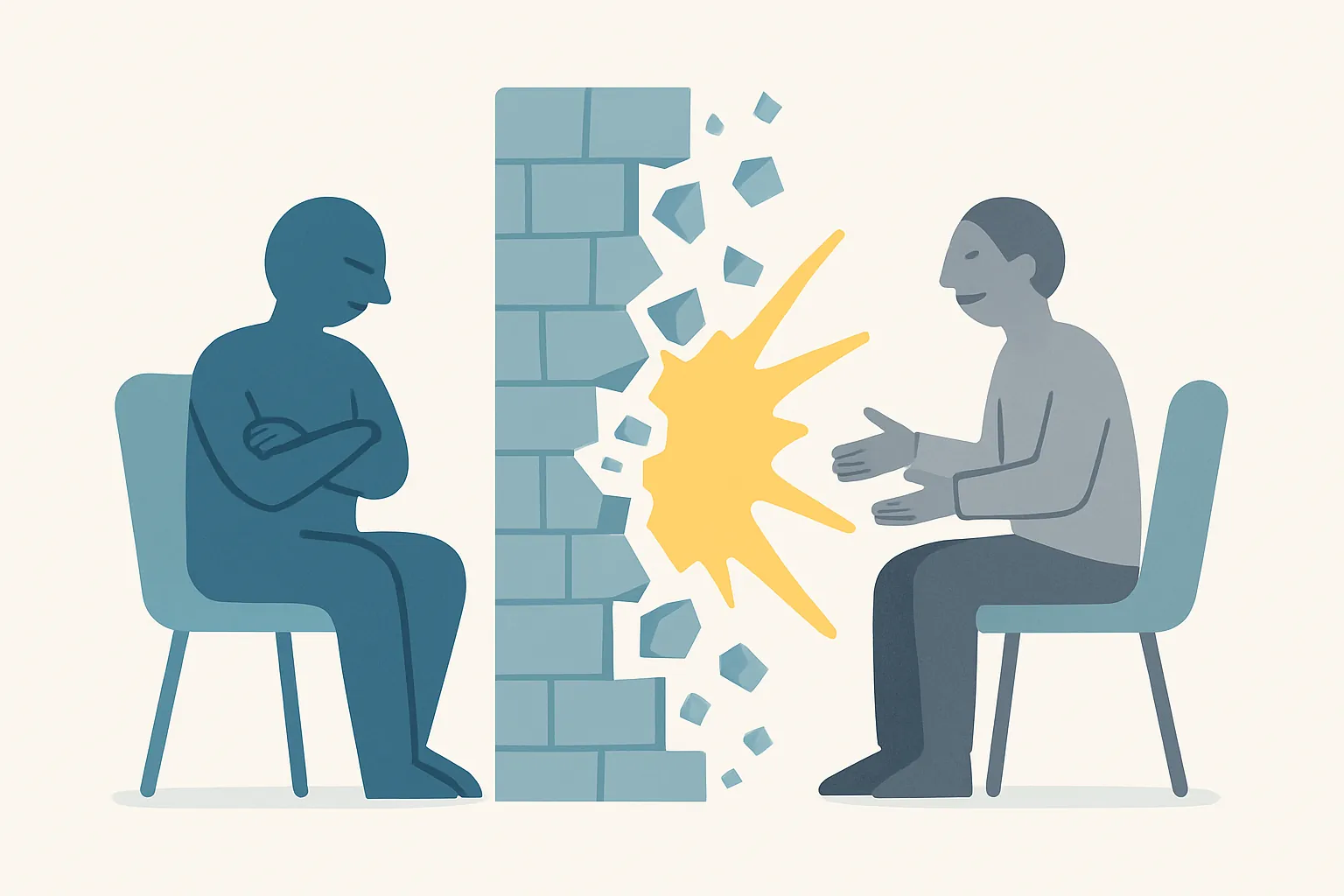
Key takeaway
An involuntary client's silence and resistance are rarely an attack on the counselor—they are a defense of personal autonomy. Reactance theory suggests that what a mandated client needs most is not problem-solving but a restored sense of safety and control. Counselors can build rapport by validating the resistance, offering structured choices, and clearly framing the limits of confidentiality. Setting aside the urge to 'fix,' tolerating silence, and giving the client room to explore are often what finally open a tightly closed door.
"I Didn't Want to Be Here": Reaching Clients Behind the Wall of Silence
The door opens and the client walks in heavily, drops into the chair, folds their arms, and stares at the floor. Every question you ask comes back as "I don't know" or "Nothing." If you've worked with adolescents—or with adults referred by a court, a school, or an employer—you've met the involuntary client. For many of them, the counseling room isn't a place of healing at all. It's an extension of the punishment.
That silence and pushback can shake even seasoned clinicians. It quietly erodes your sense of competence ("Am I doing this wrong?"), and the pressure to produce change can tempt you into intervening too hard, too soon. But from a clinical standpoint, an involuntary client's resistance is usually not an attack on you. It is a defense of their own autonomy. This article looks at the rapport-building skills that knock gently on a closed door—and at the practical habits that keep you from burning out in the process.
The Psychology of Resistance: Why They Go Quiet
Effective intervention starts with understanding the behavior. Reactance theory (Brehm, 1966) holds that when people perceive a threat to their freedom, they push back in order to restore it. For an involuntary client, counseling is the imposed situation, and resisting it can be a healthy attempt to protect their dignity and sense of self.
With adolescents, there's a developmental layer on top of that. The emotional reactivity of the amygdala tends to outrun the regulatory capacity of the still-maturing prefrontal cortex, and the central developmental task of the period is individuation—separating from adult authority. So resistance to an adult's involvement isn't just situational; it's developmentally on schedule.
The table below contrasts the psychological stance of voluntary and involuntary clients. It makes one thing clear: the two require fundamentally different opening moves.
| Voluntary client | Involuntary client (referred / adolescent) | |
|---|---|---|
| Motivation for counseling | Desire to change; relief from distress | Avoiding external pressure or punishment |
| View of the counselor | Helper, expert, ally | Authority figure, monitor, lecturer |
| Primary defense | Rationalization, repression (unconscious) | Silence, hostility, avoidance (conscious / strategic) |
| Early goal | Solve the problem, ease symptoms | Establish safety, restore a sense of control |
Table 1. Psychological stance and recommended approach: voluntary vs. involuntary clients.
As the table shows, the standard opener—"So, what's been hard for you?"—falls flat with an involuntary client. What they need first isn't a solution. It's an answer to two unspoken questions: Am I safe in this room? Is this person on my side?
Three Strategies for Building Rapport
So how do you actually move toward them? Here are three approaches you can use in the room from the first session.
1. Side With the Resistance
It sounds paradoxical, but you have to acknowledge the resistance rather than push against it. In Motivational Interviewing (Miller & Rollnick), this is the spirit of rolling with resistance. Instead of suppressing the client's irritation or boredom, name it for them:
"So you got dragged in here because someone told you to come. It's your time, you'd rather be doing almost anything else, and sitting in this chair is frankly annoying. Honestly, I'd be irritated too."
This kind of validation plants a quietly powerful idea: This person isn't like the other adults who just lecture me. It reframes you from adversary to someone it might actually be possible to talk to.
2. Offer Structured Choices to Restore Control
What an involuntary client is most starved for is a sense of control. Let them decide something inside the session, however small. But avoid wide-open questions ("What do you want to do?")—they tend to spike anxiety or simply invite another "I don't know." Bounded choices work better:
- "We've got fifty minutes. Want to use the whole time, or talk for forty and wrap up early? Or take a ten-minute break in the middle?"
- "Want to start with school, or with the stuff at home that's bugging you? Or just sit here quietly for five minutes first?"
Either way, the client experiences themselves as an active participant steering the process—not a subject being processed.
3. Make the Limits of Confidentiality Explicit
Referred clients, and adolescents especially, often assume the counselor will report everything back to a parent, a teacher, or a probation officer. Spell out the boundaries of confidentiality—and its limits—concretely and early:
"What you say in here—venting, complaints about teachers, frustration with your parents—stays in here. That's protected. The one exception is safety: if I believe you're at risk of being seriously hurt, or of hurting someone else, I'm required to act. Outside of that, I won't share anything without your okay—even if your parents ask."
Note that the specific exceptions to confidentiality—mandatory reporting of abuse, duty-to-warn, and the rules around minors' records—vary by jurisdiction. Know your own state, province, or country's statutes and your professional code, and frame this script to match them rather than promising more (or less) confidentiality than the law allows. Done well, this kind of clear structuring lowers anxiety and lays the groundwork for trust.
The Counselor's Stance: "Don't Fix—Stay"
The trap clinicians most easily fall into with involuntary clients is the righting reflex: see something wrong, want to correct it, feel the pull to steer the person toward the right path. But advice offered before a client is ready lands as nagging—just more of what they already get from every adult in their life.
Early sessions call for the courage to set the therapeutic agenda down for a while. When silence falls, tolerate it—hold it—and give the client time to get the measure of the room. Mediating objects can help: a board game, image or feeling cards, music. For an adolescent who finds direct eye contact too exposing, sitting side by side and talking toward a third object often feels far safer than talking face to face.
Protecting the Connection: A Note on Documentation
Work with involuntary clients can feel like walking on thin ice. You can't afford to miss a flicker of expression or a shift in tone, yet the moment you break eye contact to take notes, the rapport you worked so hard to build can crack.
This is one place where secure clinical-documentation support can quietly help. When you can set down the burden of note-taking and stay fully present to the client's face and eyes, they feel it: This person is actually listening to me. Tools like Modalia AI—a security-first AI partner built for counselors, with transcription, case conceptualization, and documentation support—are designed to keep your attention in the room rather than on the page, while keeping client data protected. The point isn't the technology, though. Rapport isn't a technique; it's the process of conveying that you mean it. Next session, consider setting the pen and notepad aside, and meeting the client—resistance and all—with an open, unhurried mind. That small shift can be the key that turns in a locked door.
References
- 1.
- 2.
Frequently asked questions
Why do involuntary clients stay silent in session?
Silence is usually a defense of autonomy rather than an attack on the counselor. Reactance theory suggests that when people feel their freedom is threatened, they push back to restore it. For a mandated or referred client, resistance is often a healthy attempt to protect dignity and a sense of control.
What is the single most important early goal with a mandated client?
Establishing safety and restoring the client's sense of control—not solving the presenting problem. Until a client feels the room is safe and the counselor is an ally rather than another authority figure, problem-focused questions tend to deepen the resistance.
How should I explain the limits of confidentiality to an adolescent?
Be concrete and early: state plainly what stays private and name the specific exceptions, typically risk of serious harm to self or others. Because mandatory-reporting and minors'-records laws vary by jurisdiction, tailor the script to your local statutes and professional code rather than over-promising.
What is the 'righting reflex' and why does it backfire?
It's the instinct to correct what looks wrong and steer the client toward the 'right' path. Offered before a client is ready, advice lands as nagging—more of what they already hear from every adult in their life—and reinforces the very resistance you're trying to soften.
This article was written and reviewed using Modalia AI's clinical guidelines, with professional human review before publication.
Related articles
 Case Conceptualization
Breaking the "Yes, But" Game: A Transactional Analysis Guide for Therapists
Every suggestion you offer gets met with "Yes, but..." Here's the TA structure behind that stall—and four clinical moves to break it.
7 min read Case Conceptualization
Yalom's The Gift of Therapy: Passages Every New Counselor Should Copy by Hand
Irvin Yalom's prescription for therapists who fear silence: meet your client as a "fellow traveler" and let the here-and-now become the heart of the work.
6 min read Case Conceptualization
Working With Silence in Therapy: What Client Silence Means and How to Hold It
Silence in session isn't empty space. Learn to read its clinical meaning, tell productive from defensive silence, and use it as a therapeutic tool.
6 min read