When Clients Smile Through Pain: Recognizing Reaction Formation in Session
Why do some clients laugh while describing trauma? A clinician's guide to spotting reaction formation and a 3-step intervention to meet the grief behind the smile.
Key takeaway
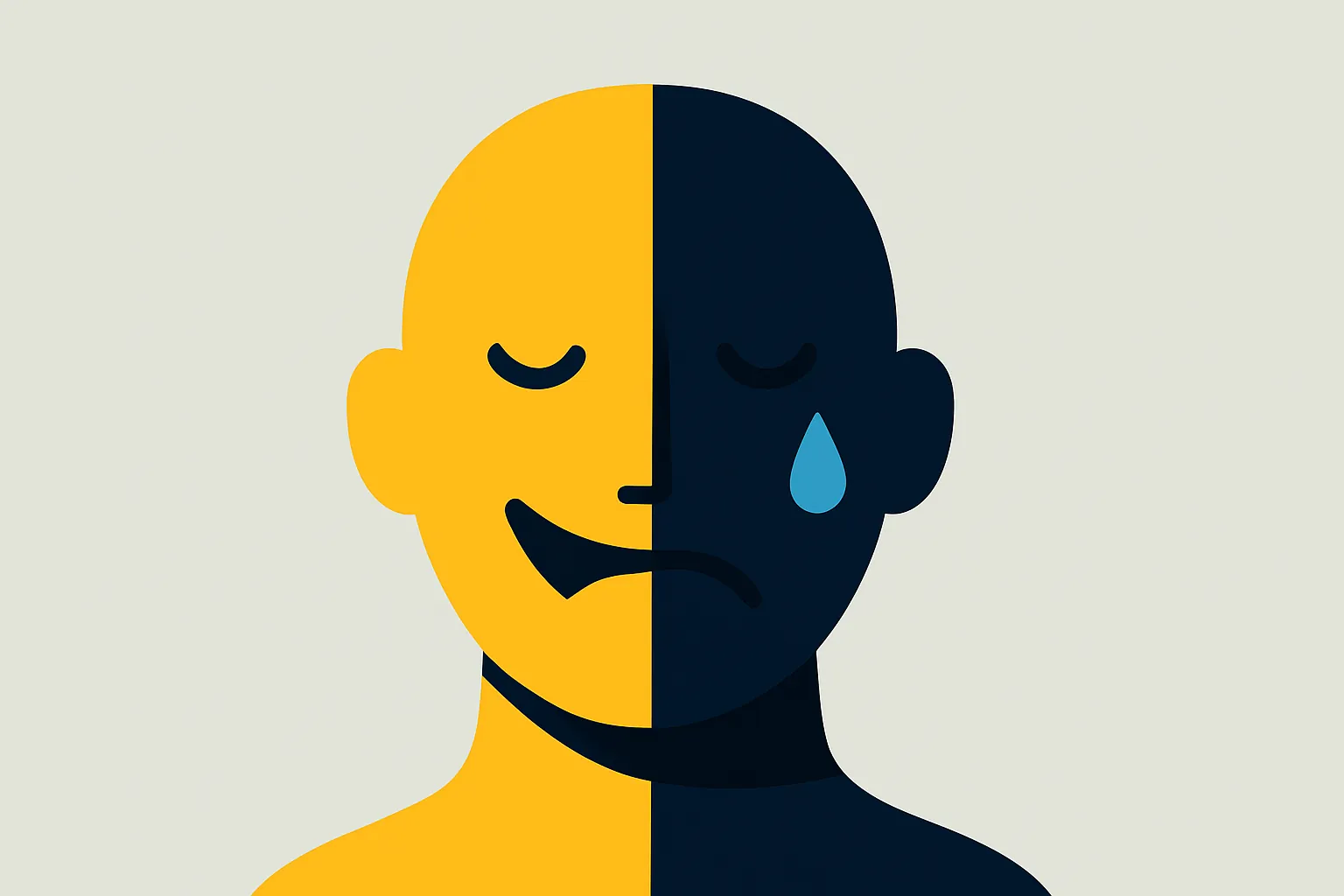
When a client laughs while recounting abuse, loss, or shame, the smile is rarely a quirk — it can signal reaction formation, a defense in which an unbearable feeling is expressed as its opposite to keep anxiety in check. This affective incongruence often reflects a need for control, fear of being rejected by the therapist, or isolation of affect. Clinicians can help clients lower the defense safely by validating the content first, gently reflecting the mismatch as a hypothesis, and then linking past to present. Documenting the nonverbal cues alongside the words — not just the content — is what turns a confusing moment into clinical insight.
"I really wanted to die yesterday… lol": Reading the Truth Behind a Client's Smile
Every clinician knows the disorienting moment. A client describes abuse, a devastating loss, or a wave of shame — and laughs out loud, or holds a face that is far too bright for the words coming out of it. Early in my career, I remember my own expression freezing as I tried to decide whether to smile along or stay solemn. Neither felt right.
This kind of affective incongruence — emotion that contradicts content — is rarely just a verbal habit. It can be the signature of one of the most clinically important defenses we encounter: reaction formation. Why would a person smile in their most painful moment? The answer is a cue we cannot afford to miss, both for reading unconscious anxiety and for deepening the working alliance.
This article unpacks the psychological mechanism behind pain disguised as laughter, offers concrete guidance for working with it in session, and — crucially — addresses how to capture those easily-missed nonverbal signals in your documentation.
1. Reaction Formation: A Desperate Shield That Hides Pain Behind Its Opposite
Reaction formation, a concept rooted in Freud's psychoanalytic theory, is a defense mechanism in which an unacceptable impulse or feeling is converted into its exact opposite in order to manage anxiety. When a client laughs while describing something terrible, the overwhelming fear or grief of facing it directly is simply too much. Unconsciously, the smile delivers a private message: I'm fine. This is no big deal.
What the "Smile" May Actually Mean
- Maintaining a sense of control. Laughter becomes a way to stay upright instead of collapsing under an overwhelming emotion — proof, to the self, that the situation is still being managed.
- Fear of the therapist's rejection. The client worries that heavy, sorrowful material will burden you or make you dislike them, so they perform the role of the "easy," upbeat client.
- Isolation of affect. The cognitive facts of an event are reported in full, but the feelings attached to them are walled off — as if narrating someone else's story.
2. Ordinary Habit or Pathological Defense? Telling the Signs Apart
Not every client who laughs in session is using reaction formation. Distinguishing simple tension-relief laughter from avoidant humor, and both from a more entrenched, defensive pattern, is essential to sound treatment planning. The comparison below can help you locate what you're seeing.
Table 1 — Clinical differentiation of reaction formation and adjacent defenses
| Dimension | Reaction Formation | Intellectualization | Social Masking |
|---|---|---|---|
| Core feature | Expressing the opposite of the suppressed feeling (e.g., anger → excessive warmth; grief → bursts of laughter) | Stripping out emotion and explaining the situation in purely rational, analytic terms | Maintaining politeness or a pleasant smile out of concern for how one is seen |
| Client's inner experience | "If I let myself feel this, I'll fall apart." (fear) | "If I analyze it, I can control it." (avoidance) | "What if the therapist thinks I'm strange?" (anxiety) |
| Nonverbal cues | Mouth smiles but eyes don't; unnaturally high pitch; rigid posture | Flat delivery, affectless expression, tidy logical narration | Watchful glances, awkward smile, frequent apologizing |
| Therapeutic approach | Don't confront the resistance head-on; build safety first, then gently name the contradiction | Invite feeling words; keep asking "what is this like for you right now" | Reassure that the room is a space free of judgment; prioritize rapport |
3. Practical Interventions: Meeting the Tears Behind the Mask
Once you recognize that a client's laughter is functioning as a defense, how should you respond? Blurting out "Why are you laughing? This is sad" only raises the wall higher. What's needed is a staged approach that lets the client disarm on their own terms.
An Effective Three-Step Process
- Step 1 — Validate the content. Before touching the laughter, attend to the painful material itself. Something like, "That sounds genuinely frightening and destabilizing to have gone through," lets you carry the weight of the event the client was trying to shrink.
- Step 2 — Mirror the incongruence. Once rapport is established, offer your observation carefully — as a hypothesis, not a verdict: "I notice you're telling me something really hard, and you're smiling as you say it. I wonder if part of you is working not to let the sadness underneath show."
- Step 3 — Connect "there-and-then" with "here-and-now." Explore how the past is being re-enacted in the room. "It sounds like crying once got you punished, so even here, with me, smiling is what feels safe." An interpretation like this opens the door to insight.
4. "The Text Doesn't Lie, but the Voice Hides the Truth" — Why Documentation Matters
Documenting sessions with these clients is genuinely demanding. Summarize only the content, and you risk a dangerous distortion in the record: "Client discussed history of abuse while presenting with a positive affect." Capturing the mismatch between text (what was said) and tone (how it was said) is the heart of clinical insight.
Tips for Accurate Documentation and Analysis
- The value of a verbatim transcript. A summarized chart — even a well-formed SOAP note — easily loses the subtle gap between a laugh and a word like "die" or "horrifying." Recording the precise moment the client laughed, and the exact words in play, is what makes the pattern visible.
- Note nonverbals alongside the words. Use parentheses next to the dialogue to log behavioral observations: (laughing bitterly), (voice trembling but corners of the mouth lifting). These belong in the record, not just in memory.
- Track your own reactions. After the session, separately note the countertransference the client's laughter stirred in you — the pull to laugh along, or, conversely, an uneasy chill. That data is clinically meaningful.
Conclusion: Understanding the Contradiction Is Where Healing Begins
A client's "sad smile" is a distress signal. See me — but don't come too close. Decoding that double message is precisely the work of an expert. The insight to see through reaction formation doesn't arrive overnight; it grows out of steady case analysis and detailed, honest documentation.
This is also where secure, AI-assisted tools are increasingly easing the clinician's load — going beyond simple dictation to help surface the gap between what a client says and how they say it, so a fleeting moment of reaction formation is less likely to slip past unnoticed. Modalia AI is built as a security-first partner for exactly this kind of work — transcription, case conceptualization, and documentation — freeing you to stay present with the client rather than scrambling to keep up with the chart.
Action items for the clinician:
- Review this week's sessions for any moment when a client's expression and content didn't match.
- In your next set of notes, deliberately include at least three nonverbal cues — laughter, silence, a sigh — alongside the dialogue.
- If charting demands are crowding out observation, consider a transcription workflow that captures nonverbal cues, so you can protect time for clinical intuition.
A clinician's careful observation and accurate record-keeping are what create the safe space where a client can finally drop the mask and cry with their own face. To everyone still leaning in to hear the truth: keep listening.
References
- 1.
Frequently asked questions
What is reaction formation in counseling?
Reaction formation is a defense mechanism, originating in psychoanalytic theory, in which an unacceptable feeling is expressed as its exact opposite to keep anxiety manageable. In session it often appears as a client laughing or smiling while describing genuinely painful material — an unconscious way of signaling "I'm fine" when they are not.
How can I tell reaction formation apart from nervous laughter or humor?
Look at the whole picture rather than the laugh alone. Reaction formation typically pairs the opposite emotion with the content (grief expressed as laughter), often with a mouth-only smile, an unnaturally high pitch, and rigid posture. Simple tension-relief laughter eases as safety grows, and intellectualization removes feeling through flat, analytic narration rather than reversing it.
How should I respond when a client smiles while describing something traumatic?
Avoid confronting the laughter directly. First validate the painful content, then — once rapport is established — gently reflect the mismatch as a hypothesis ("you're smiling while telling me something hard; I wonder if you're protecting the sadness underneath"), and finally connect how past experiences may be replaying in the room.
How do I document affective incongruence accurately?
Don't summarize content alone, which can produce a misleading note like "discussed abuse with positive affect." Record the exact words and the moment the client laughed, add nonverbal observations in parentheses (e.g., "laughing bitterly," "voice trembling"), and separately log any countertransference the moment evoked in you.
This article was written and reviewed using Modalia AI's clinical guidelines, with professional human review before publication.
Related articles
 Case Conceptualization
Breaking the "Yes, But" Game: A Transactional Analysis Guide for Therapists
Every suggestion you offer gets met with "Yes, but..." Here's the TA structure behind that stall—and four clinical moves to break it.
7 min read Case Conceptualization
Yalom's The Gift of Therapy: Passages Every New Counselor Should Copy by Hand
Irvin Yalom's prescription for therapists who fear silence: meet your client as a "fellow traveler" and let the here-and-now become the heart of the work.
6 min read Case Conceptualization
Working With Silence in Therapy: What Client Silence Means and How to Hold It
Silence in session isn't empty space. Learn to read its clinical meaning, tell productive from defensive silence, and use it as a therapeutic tool.
6 min read