What Rogers Really Meant by Congruence (And Why Endless Empathy Isn't It)
Congruence isn't nodding along to everything. Here's what Rogers actually meant by therapist genuineness — and how to use it ethically in session.
Key takeaway
In Carl Rogers' person-centered model, congruence is the alignment between what a therapist genuinely experiences inside the session and what they express outwardly. It is the most misunderstood of the core conditions — easily confused with limitless empathy or unconditional positive regard — yet research suggests a clinician's genuineness correlates with outcome more strongly than technical skill alone. Clients unconsciously detect incongruence through nonverbal cues, so practicing congruence means using I-statements to own your own reactions, working in the here-and-now, and honestly admitting uncertainty. AI documentation tools can support this by freeing clinicians from note-taking so they can stay fully present.
Are You Just Nodding Along? The Real Meaning of Rogerian Congruence in Practice
In training, and again in the first years of practice, we hear the phrase over and over: unconditional positive regard, empathy, unconditional positive regard. So we sit across from a client, nod at everything they say, and reach for the same reassurances — "That makes sense," "That sounds really hard." And yet, session after session, something can feel tight in the chest, or the work can feel like it's gliding across the surface without ever breaking through. If you've felt that, you're not doing it wrong. You're noticing something important.
The most common dilemma early-career clinicians face is the gap between the professional mask and the honest human reaction underneath it. Feeling bored by a client's looping complaints, or feeling pressure to convey acceptance toward behavior you find ethically difficult, can quietly push the relationship toward the superficial. Of Rogers' core conditions, the one most often misread — and arguably the most powerful catalyst for therapeutic change — is congruence, or genuineness. This article looks at what we lose when we try to be the "nice therapist," what congruence actually means, and how to apply it ethically and effectively in the room.
1. The "Nice Therapist" Trap: Myths About Congruence
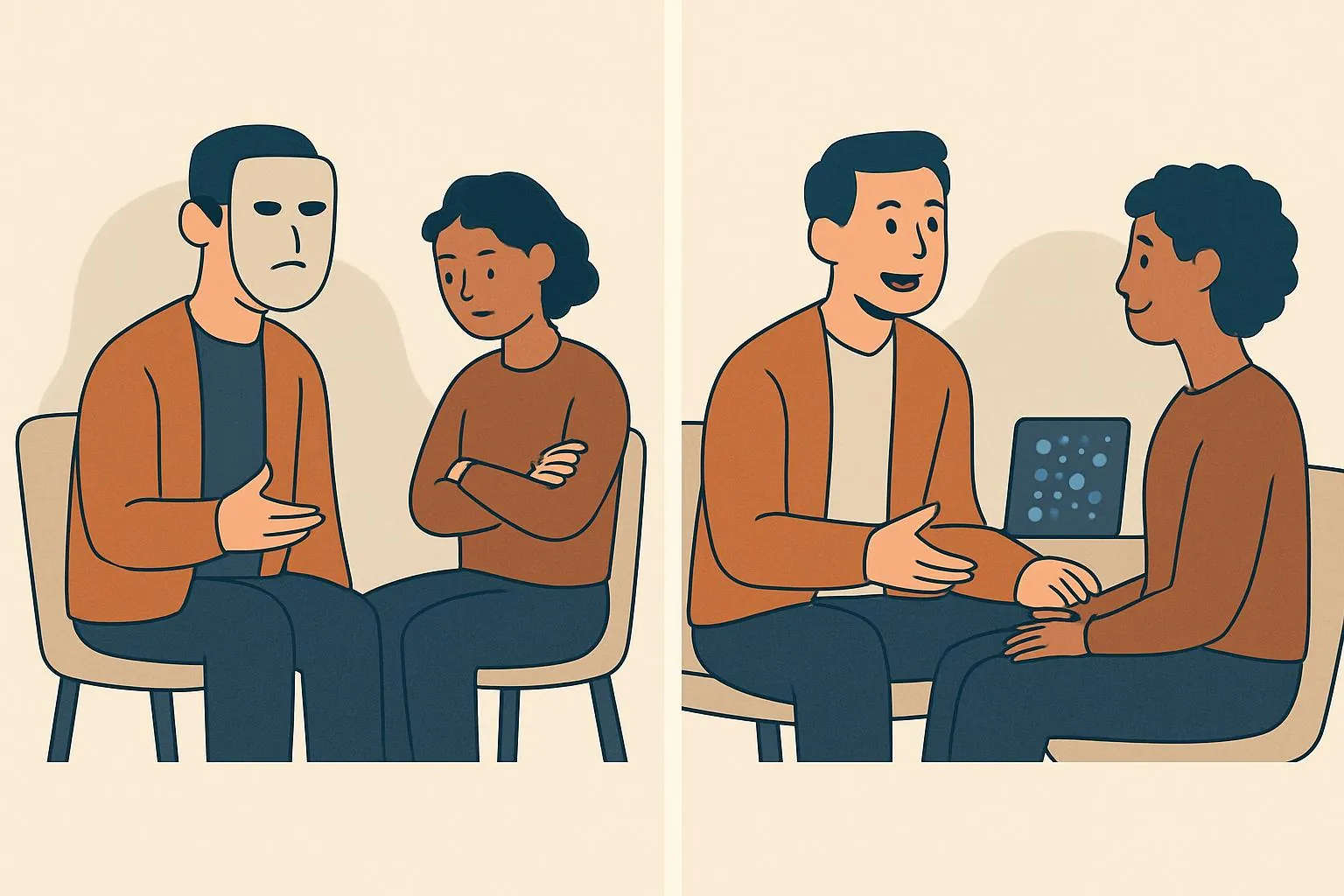
In supervision, trainees tend to misread congruence in one of two directions: as enduring everything so as never to be rude to the client, or, at the opposite extreme, as venting whatever you happen to feel. Rogers meant neither. Congruence is the state in which the therapist's inner experience within the relationship and their outward expression are in alignment.
Imagine a clinician who feels bored by a client's story but performs interest on the surface. Clients pick up on the mismatch — through micro-expressions, vocal tone, the slight lag in a response — often without consciously knowing why. What registers is a quiet sense that this person isn't really meeting me, and that perception erodes trust at the root. Research on the therapeutic relationship suggests that a clinician's genuineness correlates with outcome at least as strongly as technical proficiency.
So how does ordinary "performed empathy" differ from real congruence? The table below makes the contrast concrete.
| Dimension | Performed Empathy (Incongruence) | Therapeutic Congruence |
|---|---|---|
| Inner state | Suppressing boredom, irritation, or confusion | Aware of and accepting one's own feelings (including boredom) |
| Outward expression | Mechanical nodding, repeated "mm-hm, I see" | Disclosing feeling therapeutically, or adjusting stance, at the right moment |
| Client's experience | "They're listening, but their mind is somewhere else." | "This person is meeting me, human to human." |
| Therapeutic effect | Reinforced defenses, a thinning relationship | Trust, and a model of self-consistency for the client |
Table 1. Performed empathy vs. therapeutic congruence in clinical terms.
2. Putting Congruence Into Practice: Meeting, Not Confronting
Congruence matters, but it is emphatically not a license to discharge every feeling unfiltered. The two hinges are awareness and therapeutic intent. The skill is to know your own reaction clearly, then judge, moment by moment, whether expressing it serves the client's growth. That judgment is the clinical competence.
Three concrete strategies help bring congruence into the room.
-
Make yourself, not the client, the subject (the I-statement)
Speak to the effect a behavior has on you, rather than naming the behavior as a fault. When a client keeps circling away from the point, "Why do you keep avoiding the heart of it?" can land as an accusation. Compare: "As I listen, I notice I'm feeling a little disoriented — I wonder if we might be circling around something important right now?" That owns your own confusion honestly while inviting exploration instead of blame.
-
Use the immediacy of the here-and-now
Irvin Yalom likewise treated the here-and-now as a central engine of therapy. The work tends to deepen not when we narrate the past, but when we attend to the dynamic unfolding between therapist and client in the room. What you feel in session is often a scale model of how the client relates to others outside it — a faint pull of resistance or boredom in you may mirror the impression the client leaves on people in their life. Sharing it tentatively — "What I'm noticing right now is..." — can become unusually powerful feedback.
-
Admit uncertainty honestly
Beginning clinicians often carry a compulsion to have every answer. But pretending to understand what you don't is itself the deepest form of incongruence. When you've lost the thread, "I'm sorry — I don't think I followed that part exactly. Could you say it again?" builds more trust than an empathic response aimed in the wrong direction. It also models something valuable for the client: that you don't have to be perfect to be okay.
3. A Tool for Better Sessions: Technology in Service of Presence
Practicing congruence the way Rogers described demands sustained attention and energy across an entire session. To monitor your own inner state and track a client's subtlest shifts at the same time, you need enough cognitive bandwidth to spare. But what does the real clinic look like?
We scribble frantically so as not to lose a client's words, and we draft the next question in our heads — and in doing so we miss the meeting that's happening right now. When note-taking takes over, our eyes drift from the client's face to the page, and that inevitably frays the connection and undermines congruence. This is exactly where the thoughtful use of AI can support clinical work rather than replace it.
AI-assisted transcription and session-analysis tools are increasingly making it possible for clinicians to set down the burden of documentation and practice genuine presence.
- Reclaimed cognitive space: When conversation is transcribed and summarized automatically, you can let go of the compulsion to capture everything and give your full attention to your own reactions and the client's. That spare capacity is a precondition for congruent responding.
- A tool for self-supervision: After the session, reviewing talk-time balance, emotional keywords, and stretches of silence lets you see things objectively — "Ah, I got defensive here," or "My empathy was surface-level there." It becomes excellent material for training your own congruence.
- Rediscovering nonverbal cues: Speech habits or recurring patterns you missed while writing can surface in an analysis report, letting you offer deeper, more congruent feedback in the next session.
In the end, better tools exist not to replace the clinician but to let you meet the client as a person rather than a technician. Rogers' congruence shines brightest when the therapist is most fully human. So in your next session, consider setting down the pen — let a tool like Modalia AI carry the record, look a little longer into your client's eyes, and listen to the honest resonance stirring in you. That small act of courage may become the loudest reverberation in a client's life.
References
- 1.
- 2.
Frequently asked questions
What is congruence in person-centered therapy?
Congruence, or genuineness, is the alignment between what a therapist actually experiences inside a session and how they express themselves outwardly. Rogers named it one of the core conditions for therapeutic change. It does not mean enduring everything silently, nor venting every feeling — it means being aware of your inner reactions and expressing them when doing so serves the client.
How is congruence different from empathy?
Empathy is accurately sensing and reflecting the client's inner world. Congruence is about the therapist's own authenticity — not performing interest or warmth you don't feel. You can offer empathy incongruently (mechanical reassurance while distracted), and clients often detect the mismatch through nonverbal cues, which quietly erodes trust.
Doesn't being congruent mean saying whatever I'm feeling?
No. The two safeguards are awareness and therapeutic intent. You note your reaction clearly, then judge whether expressing it will help the client grow. Disclosure is filtered through what serves the work, not used to discharge frustration.
How can AI documentation tools support congruence?
By transcribing and summarizing sessions automatically, AI tools free clinicians from frantic note-taking so they can keep their attention on the client and on their own reactions — the bandwidth congruent responding requires. Post-session analysis (talk-time balance, emotional keywords, silences) also doubles as self-supervision material.
This article was written and reviewed using Modalia AI's clinical guidelines, with professional human review before publication.
Related articles
 Case Conceptualization
Breaking the "Yes, But" Game: A Transactional Analysis Guide for Therapists
Every suggestion you offer gets met with "Yes, but..." Here's the TA structure behind that stall—and four clinical moves to break it.
7 min read Case Conceptualization
Yalom's The Gift of Therapy: Passages Every New Counselor Should Copy by Hand
Irvin Yalom's prescription for therapists who fear silence: meet your client as a "fellow traveler" and let the here-and-now become the heart of the work.
6 min read Case Conceptualization
Working With Silence in Therapy: What Client Silence Means and How to Hold It
Silence in session isn't empty space. Learn to read its clinical meaning, tell productive from defensive silence, and use it as a therapeutic tool.
6 min read