Family Sculpting (Satir): Making Relational Distance Visible Through the Body
A clinician's guide to Virginia Satir's family sculpting—how physical placement reveals power, closeness, and communication patterns words can't.
Key takeaway
Family sculpting, developed by Virginia Satir, externalizes family dynamics by arranging members' physical positions, postures, and distances in three-dimensional space—surfacing power structures, intimacy, and communication patterns that language tends to hide. Satir held that the body does not lie, and clinical evidence suggests that clients are more motivated to change when they feel a dynamic in the body rather than only describing it. The technique unfolds in four stages: selecting a sculptor, placing the family, freezing the posture to make emotional contact, and de-roling before restructuring toward an ideal. Clinicians should attend to trauma-related triggers, build a safe holding environment, and plan ahead for how to document such a kinetic session.
When One Movement Says More Than a Hundred Words
If you've ever run a family session that hit a wall, you know the feeling. Each member arrives armored in their own defenses, and the conversation collapses into a stalemate of "the problem is them." Language is a powerful instrument of connection—but it is also the most sophisticated mask we have for hiding the truth.
A son insists, "My father controls everything I do." The father counters, "Everything I do, I do because I love you." Two parallel lines that never meet. How do we, as clinicians, actually capture the family dynamics underneath the words? This is exactly where Virginia Satir's family sculpting earns its place in the room. Instead of explaining a relationship, the family builds it—out of bodies, posture, gaze, and distance. The result is a burst of clinical insight that lands on the family and the clinician at the same time. This article walks through how to apply the technique skillfully, and the details you can't afford to miss along the way.
Beyond the Limits of Language: Why Physical Placement Works
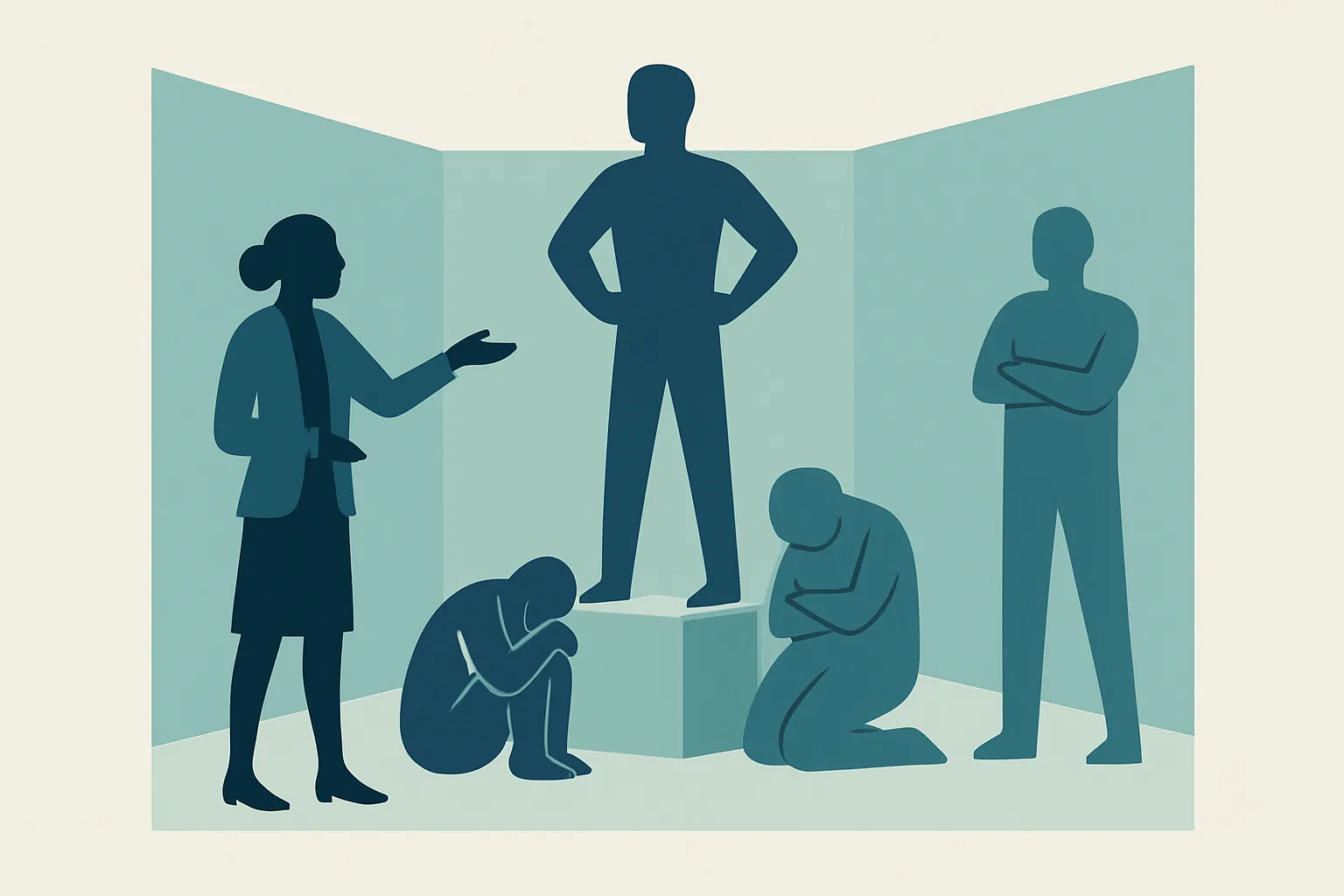
Family sculpting is not a parlor game of moving people around. It is a way of projecting a family system's power structure, intimacy, and communication patterns into three-dimensional space. The clinician helps the client translate the psychological distance they feel but can't name into literal, physical distance you can see and step between.
A substantial body of clinical work suggests that clients are more strongly motivated to change when they experience an emotion through bodily sensation than when they merely verbalize it. Satir believed the body does not lie. The accusing finger of a blaming father, the kneeling, appeasing posture of a placating mother—these expose a family's pain more nakedly than any paragraph of explanation.
The table below contrasts the clinical effect of verbal family therapy with that of sculpting.
Table 1 — Verbal Family Therapy vs. Family Sculpting
| Dimension | Verbal Family Therapy | Family Sculpting |
|---|---|---|
| Primary medium | Talk, narrative, logical explanation | Body position, posture, expression, distance |
| Defenses | Intellectualization and rationalization come easily | Immediate and intuitive; harder to defend against |
| Speed of insight | Gradual; cognitive understanding leads | Instantaneous; emotional and somatic awareness leads |
| Clinician's role | Listener, mediator, interpreter | Director, facilitator, observer |
A Four-Stage Roadmap for the Session
Running a sculpt well calls for structure. Simply telling a family to "find your spots" isn't enough. Work through these four stages.
- Stage 1 — Set the stage and choose the sculptor. Clear the center of the room to create an open "stage." Then select one family member as the sculptor. Early on, it's often wiser to choose someone with a degree of objectivity or genuine motivation to change rather than the identified patient (IP).
- Stage 2 — Sculpt and place. Without speaking, the sculptor moves family members like clay, setting each person's position and posture. The clinician supports the detail work with open questions: "Where is your father looking?", "How far is your mother standing from you?"
- Stage 3 — Freeze and feel. Once the sculpt is complete, hold the posture for about a minute. In that silence, family members vividly register their physical discomfort and emotional pain. The key prompt: "In that position, right now, what feeling is rising in you?"
- Stage 4 — De-role and restructure. After sharing the experience, always de-role so everyone returns to the present. Then invite the family to sculpt an ideal arrangement, making the therapeutic goal visible in the body.
Ethical and Practical Cautions
Because sculpting is so powerful, it carries real risks. For families with a trauma history, physical contact or a particular posture can trigger memories of past abuse. The clinician must continuously hold a safe environment—a true holding environment—and stay flexible: stop immediately if a client declines, or shift to an indirect sculpt using dolls, figurines, or empty chairs.
Countertransference is also a working tool here. When you become part of the sculpt, or notice your own bodily sensations as an observer—tightness, sadness, anger—those signals are valuable data about the family system. The skill is to refine that felt sense into a careful offering: "From where I'm standing, your father looks deeply lonely to me. Does that fit your experience?"
The Documentation Dilemma—and a Way Through
A sculpting session is kinetic. Who stood where, what crossed each face, what words broke loose in the moment—capturing all of that by hand, mid-session, is nearly impossible. The more you bend over your notes, the more nonverbal cues you miss, and every break in eye contact quietly erodes the working alliance.
As the director of the scene, you need to stay fully in the field. The instant you say, "Hold on, let me write this down," the tension and immersion of the sculpt dissolve. Tracking a family's complex choreography and the fragmented dialogue that erupts in real time—while remaining fully present—is one of the defining challenges of contemporary practice.
Sculpt the Invisible, Then Let Technology Preserve It
Satir's family sculpting works like an X-ray of a complex system: it shows the whole family at a glance. When members reveal—through physical placement—the exclusion, suppression, and longing for love they could never put into words, real healing begins. Our job as clinicians is to not let that fragile moment of movement slip away.
But conducting such a dynamic session and producing thorough notes is, realistically, a heavy load. This is where an AI-assisted transcription and session-analysis tool (the kind now common alongside everyday tools like Otter.ai or built-in meeting AI) becomes a genuinely practical option:
- Accurate speech capture. The interjections, trembling voices, and overlapping exchanges a sculpt provokes are transcribed faithfully into text.
- Integration with nonverbal cues. You set down the burden of note-taking and give 100% of your attention to changes in expression and posture. Afterward, you layer your own observations onto the transcript ("father tears up here") to build a complete clinical record.
- Material for supervision. With clients' verbal responses analyzed against the visual arrangement, you have objective data for later supervision and case studies.
In your next family session, consider setting the pen and notepad aside and asking, "Could we show our family with our bodies for a moment?" Let technology hold the record of that vivid scene—Modalia AI, a security-first AI partner for counselors, is built for exactly this—so you can stay wholly present to the hearts in the room.
References
- 1.
Frequently asked questions
What is family sculpting in therapy?
Family sculpting is an experiential technique developed by Virginia Satir in which family members arrange one another's physical positions, postures, and distances to externalize the family's power structure, intimacy, and communication patterns. It makes relational dynamics visible and felt in a way verbal description rarely achieves.
Who should be chosen as the sculptor?
Early in the work, it's often better to choose a member with some objectivity or genuine motivation to change rather than the identified patient. This person shapes the rest of the family, so their perspective sets the tone for the sculpt and the discussion that follows.
Is family sculpting safe for clients with trauma histories?
It can be, but it requires care. Physical contact or specific postures may trigger memories of past abuse, so the clinician must maintain a safe holding environment, stop the moment a client declines, and be ready to switch to an indirect sculpt using dolls, figurines, or empty chairs.
How do clinicians document such a fast-moving session?
Hand-written notes are nearly impossible to keep without losing nonverbal cues and eye contact. Many clinicians now use AI-assisted transcription to capture the dialogue automatically, then annotate the transcript afterward with their own observations of posture and expression to form a complete record.
This article was written and reviewed using Modalia AI's clinical guidelines, with professional human review before publication.
Related articles
 Case Conceptualization
Breaking the "Yes, But" Game: A Transactional Analysis Guide for Therapists
Every suggestion you offer gets met with "Yes, but..." Here's the TA structure behind that stall—and four clinical moves to break it.
7 min read Case Conceptualization
Yalom's The Gift of Therapy: Passages Every New Counselor Should Copy by Hand
Irvin Yalom's prescription for therapists who fear silence: meet your client as a "fellow traveler" and let the here-and-now become the heart of the work.
6 min read Case Conceptualization
Working With Silence in Therapy: What Client Silence Means and How to Hold It
Silence in session isn't empty space. Learn to read its clinical meaning, tell productive from defensive silence, and use it as a therapeutic tool.
6 min read