School Counseling Records: Walking the Line Between Confidentiality and Disclosure
How school counselors can document sensitive sessions without stigmatizing students—dual-record systems, neutral behavioral language, and structured consent.
Key takeaway
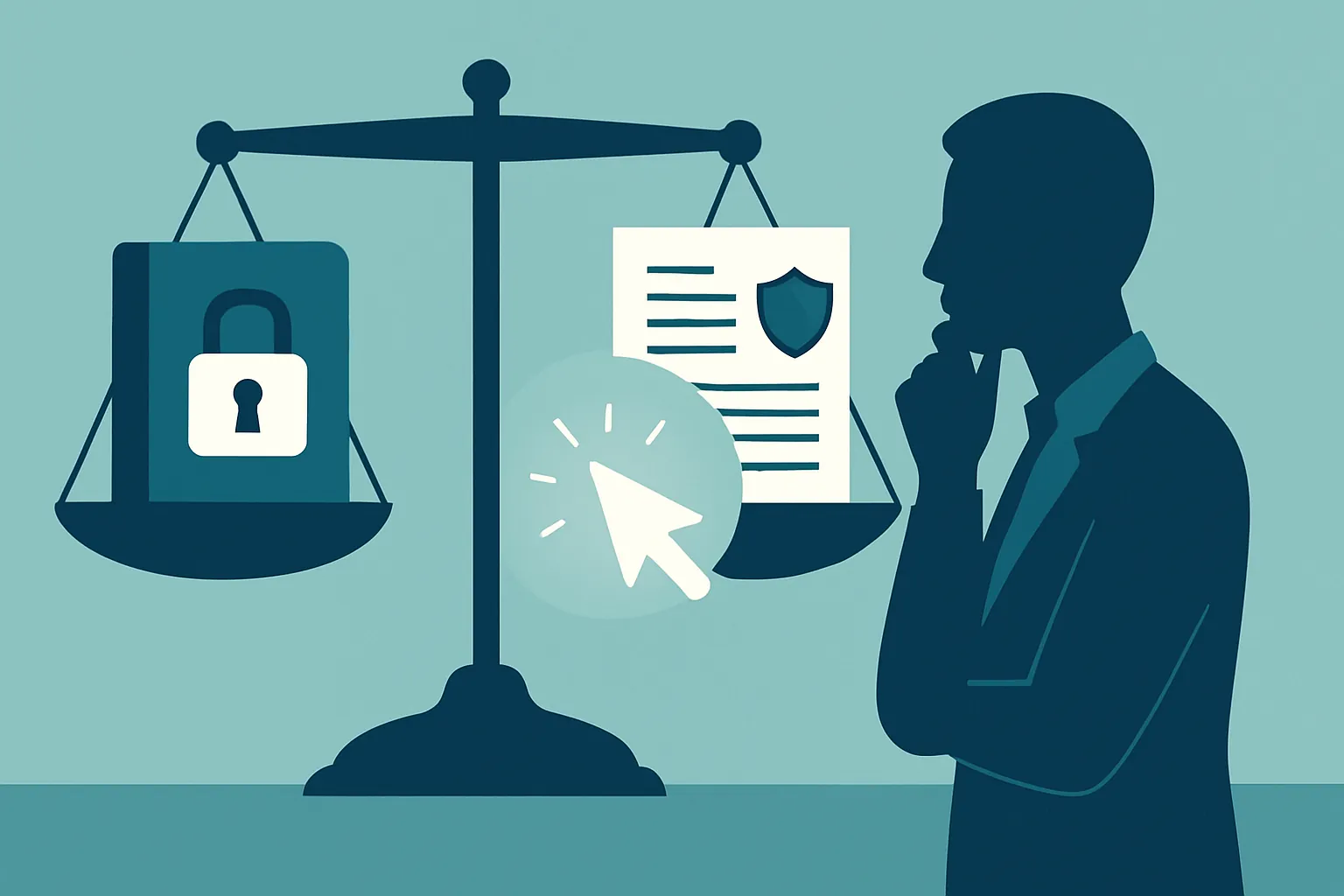
School counselors live in constant tension between the ethical duty of client confidentiality and the school's demand for safety and administrative documentation. In crisis cases—self-harm, bullying, child abuse—the question of what to record and where forces a balancing act between stigmatizing a student and exposing the counselor to liability. This article offers practical methods: a dual-documentation system that separates private process notes from official records by sensitivity, a translation strategy that converts clinical language into neutral behavioral terms, and a structured approach to informed consent about information sharing.
When the Cursor Stops Blinking: Protecting the Student Versus the School's Need to Know
The hardest moment in a school counselor's week often arrives not in the session itself, but afterward—at the keyboard. The term is ending, or a crisis has just surfaced, and you sit staring at a blinking cursor, asking yourself the same questions you've asked dozens of times: Should this go in the official school file or the internal report? Could this entry become a label that follows the child for years? But if I leave it out and a safety problem emerges later, where does that leave me?
A school is a unique ecosystem where education and care coexist. The counselor is pulled constantly between the core ethical principle of client confidentiality and the school's administrative and legal demand for student safety and educational oversight. This is not an abstract dilemma. Research on school counselor stress consistently identifies the collision between administrative documentation requirements and ethical obligations as a significant driver of burnout. If you've ever lost sleep over how much of a complex family-violence case or a student's self-harm crisis you're obligated to share with a homeroom teacher or administrator, you are not alone.
This article examines the documentation dilemma at the heart of school counseling and offers concrete strategies for writing records that protect the student while fulfilling your professional and legal responsibilities.
The Dual Nature of School Counseling Records: Where Ethics Meets Reality
Confidentiality Has Limits—and Safety Comes First
Confidentiality is foundational to counseling, but in a school setting the exceptions to confidentiality apply far more frequently and forcefully. Self-harm, suicidal behavior, child abuse, and serious peer conflict or bullying fall outside the counselor's discretion; mandated reporting is not optional. The real dilemma, then, is rarely whether to report—it's how to document and share. Recording every detail verbatim in the student information system or in a formal memo risks spreading sensitive information far beyond those who need it, exposing the student to a second layer of harm.
The Gap Between Clinical Records and Administrative Records
Clinically meaningful material—transference, specific defense mechanisms, intimate family history—is essential for therapeutic insight. But the same material, once committed to an administrative document, is ripe for misreading. A teacher or administrator without clinical training may take specialized terminology literally, or may seize on a student's problem behavior stripped of its context. This is why the counselor must perform a demanding act of translating clinical fact into educational language.
The Fear of Stigma
Once an entry lands in a cumulative student record or counseling file, it can shadow a student through the rest of their schooling. Diagnostic-sounding labels—"depression," "anxiety," "impulse-control disorder"—carry real weight: they can bias decisions about academic placement and color how future teachers approach the student. That risk is exactly what makes the pen feel so heavy.
Layering Your Records: What to Keep, What to Protect
Effective documentation begins with rigorously classifying information by sensitivity. Recording everything with equal weight is itself a risk. The table below offers a guideline for how to separate private process notes from the official record (cumulative file / student information system) based on the nature of the session content.
| Sensitivity | Example Content | Private Process Note | Official Record / Student Information System |
|---|---|---|---|
| Highest sensitivity | Suicide plan, specific evidence of abuse, sexual offense, threats to others | Date, exact statements (in quotation marks), detailed crisis-intervention steps (for legal documentation) | Action-focused wording: "Crisis counseling conducted regarding personal safety," "Referral to relevant agency and notification of guardian completed" |
| Psychological / emotional | Low mood, hostility toward parents, frustration with a teacher, irrational beliefs | Clinical hypotheses, countertransference, specific affect and dynamic analysis | Neutral / softened wording: "Supportive counseling to aid school adjustment amid emotional difficulty," "Explored stress-management strategies" |
| General | Academic and career questions, minor peer friction, daily habits | Session summary, primary presenting concern, goals for next session | Growth-focused wording: "Career exploration and academic motivation," "Practiced communication skills to strengthen peer relationships" |
Practical Solutions: Safe, Effective Documentation Strategies
Practice Translating Into Neutral Behavioral Language
Official records should center on observable behavior and constructive effort, never subjective judgments or diagnostic labels. Instead of writing "reports depression due to parents' divorce," write "provided supportive counseling during psychological adjustment to a change in family circumstances." Rather than "shows aggression due to poor impulse control," write "guided the student in regulating emotions and exploring alternative responses in conflict situations." This approach protects the student while still documenting that counseling took place.
Systematize a Dual-Documentation Workflow
It's more work, but you must keep a strict separation between the record only you see and the record you show. Your private notes need the client's raw, unfiltered language and your own clinical reasoning—this is what makes supervision useful and grows your expertise. The official record, by contrast, exists purely for administrative defensibility and educational support. Maintaining that separation is, in fact, your strongest protection if a case ever becomes a legal dispute.
Structure Informed Consent Around Information Sharing
During the early structuring phase of counseling, define the scope of information sharing explicitly with the student, the guardian, and the homeroom teacher. When briefing a teacher, set a clear professional boundary up front: "I won't be sharing everything the student tells me—only the information you genuinely need to support this child in the classroom." The guiding principle is to help, not to know.
Conclusion: Use Technology So You Can Focus on What Matters
A school counseling record is not mere paperwork. It documents a student's growth and serves as a crucial shield for the counselor in a crisis. Yet striking a perfect balance between confidentiality and disclosure remains genuinely difficult, and maintaining a dual-documentation system demands real time and energy. No counselor should be so consumed by writing records that they lose eye contact with the student in front of them.
This is where security-first AI tools for session transcription and clinical documentation are beginning to ease the burden. AI can do more than transcribe—it can surface a client's key statements, de-identify personal information, and summarize clinical insights. When AI organizes the raw conversation, the counselor is freed to focus on producing the polished official record, dramatically reducing the overhead of dual documentation. Modalia AI is built precisely for this: a security-first partner that handles transcription, case conceptualization support, and documentation so clinicians can stay present with their clients.
An Action Plan for Counselors
- Rebuild your record templates: Prepare standardized, neutral wording in advance for each crisis category (suicidality, bullying, child abuse).
- Evaluate AI tools: Use a secure service that converts and summarizes session content to cut documentation time—and reinvest the hours you reclaim in student support and self-care.
- Lean on peer supervision: For ambiguous cases, make it routine to have a colleague or supervisor review the wording of your records.
Frequently asked questions
What's the difference between a process note and an official school counseling record?
A process note is your private working document—it holds the client's raw language, your clinical hypotheses, and countertransference, and it's what you bring to supervision. The official record exists for administrative and legal purposes and should contain only neutral, behavior-focused, action-oriented wording. Keeping the two strictly separate protects both the student and the counselor.
How do I document a crisis like self-harm without stigmatizing the student?
In the official record, focus on the intervention rather than the clinical detail—for example, "Crisis counseling conducted regarding personal safety; relevant agency referral and guardian notification completed." Keep the specific statements, dates, and detailed steps in your private process note, where they serve as documentation of your duty of care if a legal question ever arises.
How much should I tell a homeroom teacher about a counseling case?
Share only what the teacher needs to support the student in the classroom—the principle is 'to help, not to know.' Establish this boundary explicitly during the structuring phase of counseling so the student, guardian, and teacher all understand that you are selecting need-to-know information rather than disclosing everything.
Can AI tools help reduce the burden of dual documentation?
Yes. Security-first AI tools can transcribe sessions, de-identify personal information, and summarize key statements and clinical insights. When AI organizes the raw conversation, you can concentrate on writing the polished official record, which significantly cuts the time spent maintaining separate sets of notes.
This article was written and reviewed using Modalia AI's clinical guidelines, with professional human review before publication.
Related articles
 Clinical Skills
How to Write Better Supervision Questions: Getting What You Actually Need from Your Supervisor
Stuck on what to ask in supervision? Use these structured question strategies to turn vague check-ins into focused clinical insight.
7 min read Clinical Skills
From "The Client Seems Depressed" to a Clinical Hypothesis: How Word Choice Elevates Your Case Reports
Turn vague observations into precise clinical hypotheses. A practical guide to terminology and sentence formulas that make your case reports read like expert work.
7 min read Clinical Skills
The Wounded Healer Trap: Why "I Want to Heal Myself" Sinks Your Counseling Grad School SOP
Why admissions faculty flinch at "I want to heal my own wounds"—and how to transform personal pain into a research-grade statement of purpose that gets you in.
6 min read