SOAP Notes for Counseling Trainees: Bad Documentation vs. Records That Earn Credit
Your case notes can protect you or expose you. Compare weak vs. defensible records and learn a SOAP/DAP workflow that proves clinical competence.
Key takeaway
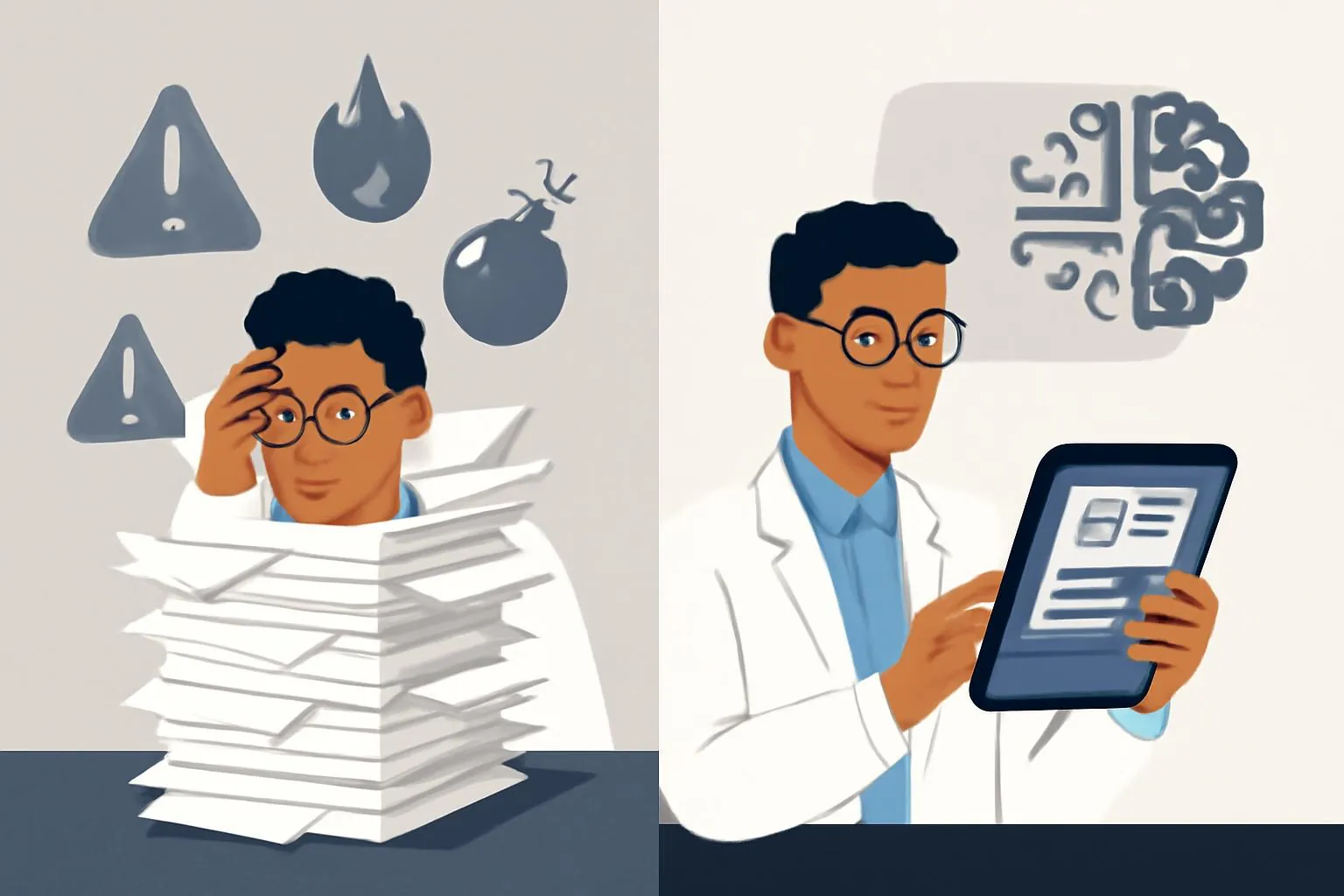
For counseling trainees, case notes and training logs are not paperwork—they are the objective evidence that protects clients and demonstrates clinical competence. Weak records blur observation with interpretation, omit specific interventions, and skip risk assessment, which creates problems at credentialing review or in any legal dispute. Defensible records use a structured format like SOAP or DAP, lead with behavioral observation, and make the clinical rationale explicit. The fastest way to raise quality is to internalize a theory-aligned template, separate the verbatim transcript from the case note, and let AI handle rote transcription so you can focus on extracting clinical meaning.
Is Your Documentation a Liability or Proof of Your Expertise?
Ask a room of counseling trainees what stresses them most, and the answer is rarely the hardest case conceptualization. It's the case note and training log waiting after every session. The moment the office door closes, you stop being a clinician and become an administrator and a writer. Memory fades under a full caseload, and the records you rush through with a quiet "that'll do" can later turn against you—at a credentialing review, in supervision, or in a legal dispute.
Documentation is not a clerical formality. It is the shield that protects your client and the only material evidence of your professional judgment. For trainees, the record is also how your supervisor understands the client and evaluates your interventions. So it's worth drawing a sharp line between the "bad record" that creates risk and the "good record" that earns full practicum/internship credit and sharpens clinical insight. This piece breaks down what determines documentation quality and shares practical habits you can adopt this week.
What Makes a Record a Liability: Subjectivity and Vagueness
The two complaints supervisors raise most often about weak notes are excessive subjectivity and blurred facts. A case note is not a diary or a short story. But when a clinician is deeply attuned to a client, it's easy to fold objective fact and personal interpretation into a single sentence without noticing.
- "The client seemed depressed" vs. "The client lowered their head and began to cry" The first is a clinician's judgment; the second is a behavioral observation. "Seemed depressed" cannot be verified by a third party and loses evidentiary weight in any dispute. It also makes it impossible for a supervisor to tell whether the note reflects the client's actual state or the clinician's countertransference.
- Missing or vague interventions "I was empathic" and "I listened well" are exactly the phrases to avoid in a training log. Without naming the specific technique used (reflection, clarification, confrontation) and how the client responded, the session reads as an ordinary conversation rather than clinical work.
- No ethical or risk sensitivity A record that omits a concrete risk assessment for warning signs—suicidality, abuse, harm to others—can become damning evidence that the clinician neglected an ethical duty.
Side-by-Side: Records That Earn Credit vs. Records That Don't
A good record is not simply a long one. It is structured, objective, and explicit about its clinical implications. Major bodies such as the APA, BACP, and BPS endorse structured formats like SOAP (Subjective, Objective, Assessment, Plan) or DAP (Data, Assessment, Plan). The structure makes your reasoning visible and dramatically improves the efficiency of supervision.
Compare the examples below and notice which version builds professional credibility.
| Element | 🚫 Liability Record | ✅ Credit-Worthy Record |
|---|---|---|
| Client presentation | "In a bad mood today and irritable. Showed a resistant attitude." (judgment-led, vague) | "On entering, shut the door hard, leaned the chair back, and crossed their arms. Said loudly, 'Why do I even have to keep coming?'" (behavior-led, specific) |
| Clinician intervention | "Comforted the client and listened to them." (everyday language, no named technique) | "Reflected the frustration underneath the client's anger and reaffirmed the structure of the session to protect the stability of the working alliance." (precise terminology, stated intent) |
| Risk and ethics | "Said they wanted to die but will probably be fine." (unfounded optimism, unsafe) | "Client reported suicidal ideation; assessed for plan and means. No specific plan, but classified as high-risk and confirmed emergency contacts and a safety plan." (thorough risk assessment and action) |
| Plan | "Will talk again next week." (no direction) | "Assigned a thought record as homework to explore a cognitive distortion (overgeneralization)." (concrete treatment goal) |
Three Strategies for Better Notes Without Burning Out
We all want flawless documentation, but time and energy are finite. Writing high-quality training logs while protecting yourself from burnout takes a smarter approach. Try these three.
1) Internalize a standardized template
Stop starting from a blank page every time. Build on a SOAP note foundation (subjective report, objective observation, assessment, plan), then prepare a keyword checklist tailored to your theoretical orientation (CBT, psychodynamic, person-centered). A CBT clinician, for example, can cut documentation time in half with a template that already prompts for automatic thoughts, core beliefs, and homework completion.
2) Keep the transcript and the case note strictly separate
The most common early-career mistake is the compulsion to record every word exactly as spoken. That's a session transcript (verbatim), not a case note. The official record should summarize the core themes and the clinical arc. If you exhaust yourself transcribing every exchange, you'll have nothing left for the work that actually matters—case conceptualization.
3) Use AI to draft and capture the data
Listening back to a recording and retyping it by hand is enormous labor. New tools can collapse that rote work dramatically. Let a tool handle the conversion of speech to text, and reserve your expertise for what only a clinician can do: extracting the clinical meaning from the transcript.
Expert Insight Begins with Accurate Records
A well-written case note does more than discharge an administrative duty—it honors the client's life and becomes one of the most powerful tools for your own growth. "If it isn't documented, it didn't happen": the record is the only proof that your intervention was professional. Move away from vague, impressionistic notes and build a habit of objective, behavior-based, structured documentation. When you become a supervisor yourself, or present a difficult case, that habit will be the asset that protects you.
If you're spending too much energy reconstructing each session from memory, adopting an AI-based documentation and transcription partner is a sensible move. Modalia AI is a security-first partner for counselors that captures the nuance and text of a session into an accurate draft, freeing you to focus on the client's core concerns and dynamics rather than the fallibility of memory.
The goal is simple: spend less time as a record-keeper and more as a clinician—closer to the essence of the work. 💡
FAQ
References
- 1.
- 2.
- 3.
Frequently asked questions
What's the difference between SOAP and DAP notes?
SOAP separates the client's Subjective report from your Objective observations before Assessment and Plan, while DAP merges them into a single Data section followed by Assessment and Plan. SOAP is useful when distinguishing reported experience from observed behavior matters; DAP is leaner for fast-paced settings. Both make your clinical reasoning visible to a supervisor.
How do I document observations without injecting interpretation?
Write what a camera would capture before you write what it means. Instead of 'the client was anxious,' record 'the client's leg bounced continuously and they spoke in short, clipped sentences,' then place your interpretation in the Assessment section. Separating behavioral data from inference keeps the record verifiable and helps you and your supervisor distinguish the client's state from your own countertransference.
What must a case note include when a client reports suicidal ideation?
Document the ideation in the client's own words, your assessment of plan and means, any protective factors, your risk classification, and the specific actions taken—safety planning, emergency contacts, consultation, and follow-up. A note that records the disclosure but omits the assessment and response is the single most common documentation failure cited in credentialing review and legal disputes.
Can AI tools be used for clinical documentation safely?
Yes, when the tool is security-first and you keep the clinician in the loop. Let AI handle the rote conversion of session audio to text and a first draft, but you remain responsible for extracting clinical meaning, verifying accuracy, and finalizing the record. The benefit is reclaiming the hours otherwise lost to transcription so you can focus on case conceptualization.
This article was written and reviewed using Modalia AI's clinical guidelines, with professional human review before publication.
Related articles
 Clinical Skills
How to Write Better Supervision Questions: Getting What You Actually Need from Your Supervisor
Stuck on what to ask in supervision? Use these structured question strategies to turn vague check-ins into focused clinical insight.
7 min read Clinical Skills
From "The Client Seems Depressed" to a Clinical Hypothesis: How Word Choice Elevates Your Case Reports
Turn vague observations into precise clinical hypotheses. A practical guide to terminology and sentence formulas that make your case reports read like expert work.
7 min read Clinical Skills
The Wounded Healer Trap: Why "I Want to Heal Myself" Sinks Your Counseling Grad School SOP
Why admissions faculty flinch at "I want to heal my own wounds"—and how to transform personal pain into a research-grade statement of purpose that gets you in.
6 min read