Somatic Symptom Disorder in Therapy: Translating the Body's Language Into Emotional Words
How to work with clients whose pain has no medical explanation—clinical strategies for validating distress and translating bodily symptoms into emotional language.
Key takeaway
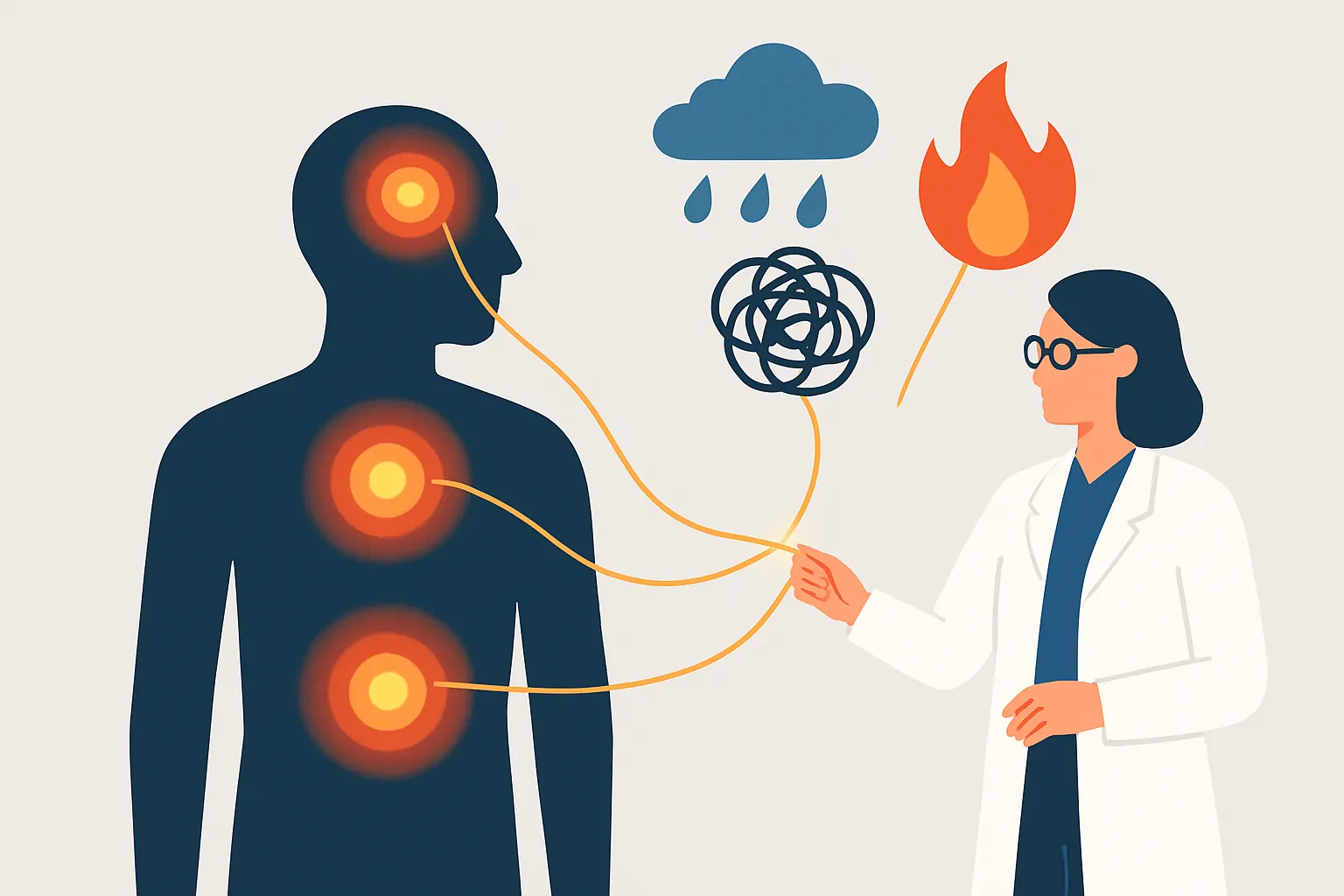
Clients with Somatic Symptom Disorder experience genuine physical suffering even when medical testing finds nothing wrong, driven in part by alexithymia and somatosensory amplification. Under DSM-5, the diagnostic core is disproportionate thoughts and anxiety about symptoms—distinguishing it from illness anxiety disorder and conversion disorder. Effective treatment begins by fully validating the client's pain, then explores the link between physical sensations and emotional context, and uses tools like progressive muscle relaxation and mindfulness to help clients re-experience bodily sensations as neutral rather than threatening.
"My doctors say nothing is wrong, but I'm in so much pain." Reading the suffering behind Somatic Symptom Disorder
Most clinicians know the moment well. A client arrives carrying a thick folder of medical records—internal medicine, neurology, orthopedics—having been told again and again that their symptoms are "just stress" or "nothing to worry about." Their expression holds a mix of frustration and quiet desperation. And as counselors, we step into a peculiar bind: the pain the client describes is unmistakably real, yet medicine cannot explain its cause.
Working with Somatic Symptom Disorder (SSD) challenges even experienced therapists. Name a psychological cause too quickly and you may hit a wall of resistance—"So you're saying I'm faking it?"—that fractures rapport in an instant. Stay only with the physical complaints, and the session can devolve into a recitation of symptoms rather than therapy. Since the shift to DSM-5, the diagnostic emphasis moved away from "medically unexplained" symptoms toward disproportionate thoughts, feelings, and anxiety about symptoms. That reframing asks something specific of us: to become interpreters who translate the body's language into psychological language. This post examines the mechanisms behind SSD and offers concrete intervention strategies you can bring into the room.
1. When the body speaks instead: alexithymia and somatosensory amplification
The first key to understanding SSD is alexithymia—difficulty identifying and putting emotions into words. Many clients with SSD struggle to name and express what they feel. When emotions like sadness, anger, or shame cannot be verbalized, the brain tends to discharge them as physical sensation instead. Rather than saying "I'm so sad my heart aches," the client feels literal chest pain and heads to the emergency room.
Layered onto this is somatosensory amplification: the client attends excessively to minor bodily sensations—heartbeat, digestion, muscle tension—and interprets them as threatening signals. This is distinct from hypochondriasis. Where health anxiety centers on the fear of having a disease, SSD is a state of being overwhelmed by the suffering itself, right now. Our starting point as clinicians must be to recognize that the client's pain is not imagined—it is genuine pain produced by a pain-processing pathway that has become hypersensitive.
2. A confusing diagnosis, a clearer intervention: differentiating SSD from look-alikes
In practice, SSD is easily confused with illness anxiety disorder and conversion disorder. Because the therapeutic focus differs for each, drawing clear distinctions matters a great deal when setting treatment goals. The table below summarizes the core differences.
| Dimension | Somatic Symptom Disorder | Illness Anxiety Disorder |
|---|---|---|
| Core focus | The physical symptoms actually experienced (pain, fatigue, etc.) | The fear of having a specific disease |
| Presence of symptoms | Distinct physical symptoms are present | Symptoms absent or very mild |
| The client's complaint | "My stomach hurts so badly I can't stand it." (symptom-focused) | "What if this turns out to be stomach cancer?" (disease-focused) |
| Treatment goal | Improve coping with symptoms and restore functioning | Modify irrational disease beliefs and anxiety |
Table 1. Comparing the clinical features of Somatic Symptom Disorder and Illness Anxiety Disorder.
For clients with SSD, in other words, a reassurance strategy of "there's nothing wrong with you" is far less effective than a focus on "how can you build a life even while these symptoms are present?"
3. Three practical intervention strategies for clinicians
So what, concretely, do we do in the room? Here are three steps for moving past the tug-of-war and into a collaborative therapeutic alliance.
-
Validation and separating the "symptom"
The first task is to fully accept the client's suffering. Never say, "Your test results are normal, so it must be psychological." Instead: "The tests don't capture it, but I know the pain you feel is real, and that it's exhausting." From there, help the client step out of the identity of "me = a sick person" by objectifying the symptom. Language that treats the symptom as a separate entity helps: "How much did the pain trouble you today?"
-
Connecting body and emotion
When a client reports a physical symptom, explore the emotional context behind it. If they say, "My head was splitting," ask: "What happened just before the pain started? Who were you with?" This helps the client discover their own patterns—for example, a tense conversation with a demanding colleague (stress) → headache (somatization). CBT techniques are effective here for mapping and visualizing the links between bodily sensation, negative automatic thoughts, and emotion.
-
Relaxation training and re-experiencing sensation
Clients with SSD often carry significant physical tension. Progressive muscle relaxation (PMR) and mindfulness help them practice receiving bodily sensations as neutral stimuli rather than threats. The work involves breaking the habit of interpreting every sensation as "pain" and expanding the vocabulary—"warmth," "heaviness," "tightness"—for what the body is actually doing.
4. Capturing complex, repetitive complaints without losing the thread
Another challenge in SSD work is the sheer volume of repetitive symptom reporting. A client may spend the full session cataloguing complaints—"yesterday my stomach hurt, today my shoulder aches, my leg is tingling." The clinician must find the meaningful psychological clues buried in that stream, yet frantically writing it all down makes it easy to miss the nonverbal cues and moments of transference that matter most.
In these sessions, it's clinically far more valuable to stay fully present with the interaction than to capture every symptom by hand. This is one reason many clinicians now lean on AI session-note tools to handle the mechanical record. Such tools can accurately convert the frequency and patterns of a client's recurring physical complaints into text. Reviewing the resulting notes after the session, a counselor might objectively confirm a pattern in the data—for instance, "every time the client mentioned chest tightness, a story about their workplace followed."
To translate the body's language into psychological language, the clinician's energy has to go toward insight and analysis, not documentation labor. When technology raises the accuracy of the record and frees the counselor to read the client's eyes, expression, and the suppressed emotion beneath them, therapeutic outcomes change.
Conclusion: becoming a translator of suffering
The body of a client with SSD is like a cry they could never quite put into words. Rather than growing weary of their recurring complaints, our role as clinicians is to read the message hidden inside them: "Please understand me. This is so hard." Validating the pain, surfacing the links between body and emotion, and helping clients reclaim agency rather than be overwhelmed by sensation—none of it is easy, but it is deeply worthwhile work.
To catch the full complexity of these complaints while keeping your clinical intuition sharp, consider making active use of modern tools like AI-assisted session transcripts. Spotting recurring patterns and drawing data-grounded insight is a fast track to higher-quality care. Are you ready to listen to the story your next client's body is telling?
References
- 1.
Frequently asked questions
How is Somatic Symptom Disorder different from illness anxiety disorder?
SSD centers on distress and preoccupation with physical symptoms the client genuinely experiences (pain, fatigue), with the goal of improving coping and functioning. Illness anxiety disorder centers on the fear of having or developing a serious disease, often with few or no actual symptoms, and treatment targets the irrational disease beliefs themselves.
Is the pain in Somatic Symptom Disorder real?
Yes. The pain is not imagined or fabricated. It reflects a pain-processing pathway that has become hypersensitive, often amplified by difficulty naming emotions (alexithymia). Validating that the suffering is real is the essential first step before any psychological exploration.
Why shouldn't I reassure a client that their tests are normal?
Telling a client with SSD that nothing is medically wrong often reads as "you're faking it," triggering resistance and damaging the alliance. A more effective stance acknowledges that the pain is real even when tests don't capture it, and shifts the focus toward building a functional life alongside the symptoms.
What evidence-based techniques help with somatization?
CBT is used to map the links between bodily sensations, negative automatic thoughts, and emotions. Progressive muscle relaxation and mindfulness help clients re-experience physical sensations as neutral rather than threatening, expanding their vocabulary for the body beyond "pain."
This article was written and reviewed using Modalia AI's clinical guidelines, with professional human review before publication.
Related articles
 Case Conceptualization
Breaking the "Yes, But" Game: A Transactional Analysis Guide for Therapists
Every suggestion you offer gets met with "Yes, but..." Here's the TA structure behind that stall—and four clinical moves to break it.
7 min read Case Conceptualization
Yalom's The Gift of Therapy: Passages Every New Counselor Should Copy by Hand
Irvin Yalom's prescription for therapists who fear silence: meet your client as a "fellow traveler" and let the here-and-now become the heart of the work.
6 min read Case Conceptualization
Working With Silence in Therapy: What Client Silence Means and How to Hold It
Silence in session isn't empty space. Learn to read its clinical meaning, tell productive from defensive silence, and use it as a therapeutic tool.
6 min read