Soundproofing a Solo Counseling Office on a Budget: DIY Acoustic Privacy and Sound Masking That Actually Work
Protecting client confidentiality doesn't require a five-figure renovation. Here's how to build clinic-grade speech privacy with DIY acoustic fixes and sound masking.
Key takeaway
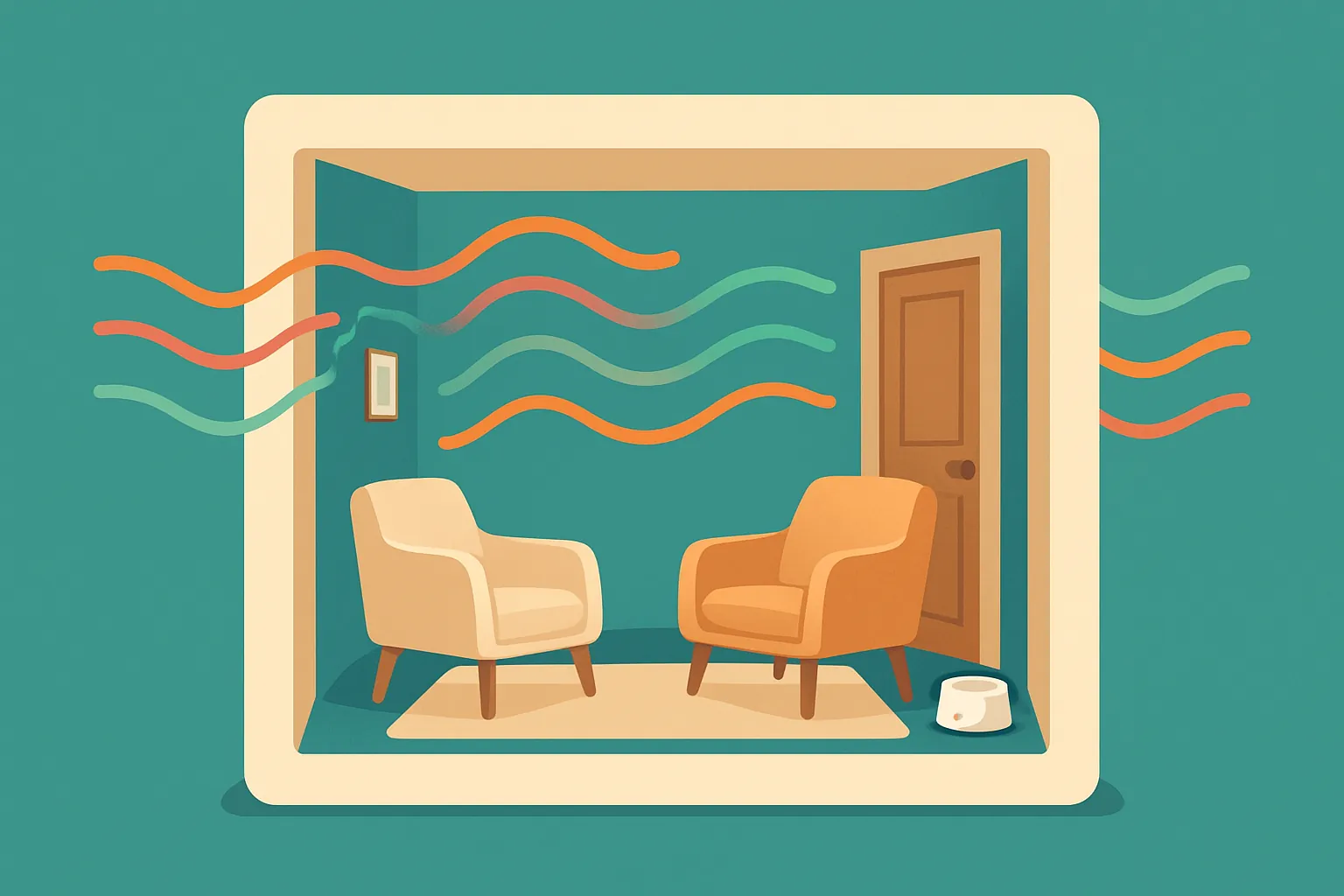
Soundproofing a counseling room is the physical embodiment of the ethical promise of confidentiality, and it measurably affects client self-disclosure and the working alliance. The goal is not to eliminate all sound but to achieve speech privacy—a level where conversation can be heard but not understood. You get there affordably by combining sound insulation (sealing gaps, adding mass) with sound absorption (soft, porous materials), then deploying a sound-masking device in the hallway or waiting area so any leaking speech dissolves into a neutral background.
Can Your Clients Be Overheard? Affordable Acoustic Privacy for the Solo Practice
When you open a solo or private counseling practice, there's a long list of things to get right: warm lighting, a comfortable chair, an accessible location. But the one element that quietly underwrites everything else is acoustic privacy—the physical condition that lets you keep the promise of confidentiality you make to every client.
If a client's tears, or the substance of what they're disclosing, can be heard in the waiting room or hallway, the room has already failed as a secure base. No amount of décor compensates for that.
The obstacle, of course, is budget. A professional soundproofing contractor can easily run $2,000 to $10,000 or more, depending on your space—a serious line item for anyone just opening their doors or trying to keep overhead lean. But abandoning soundproofing isn't an option either. It isn't decoration. It's a clinical instrument: the thing that lets a client take off their psychological armor and speak freely.
The good news is that you can get most of the way there with DIY fixes and a few inexpensive tools. This guide covers why acoustic privacy matters clinically, then walks through cost-effective treatments and a sound-masking strategy you can implement this week.
1. Why Acoustic Privacy Is a Clinical Concern, Not Just a Construction One
Soundproofing a consulting room is more than a physical task. It's a literal enactment of what Wilfred Bion called containing. If the therapist is the psychological vessel that holds and metabolizes a client's affect, the room is its physical shell. When that shell leaks, clients sense it—often pre-consciously—and a quiet anxiety takes hold: what I say here might travel. That anxiety reinforces defenses and blocks the descent into deeper insight.
The research on therapeutic environments points in the same direction: the privacy of the physical setting correlates meaningfully with client self-disclosure and with the strength of the therapeutic alliance. You don't need acoustic perfection. You need a space where the client can feel protected—and that feeling is a precondition for effective work.
This reframes the goal. We're not chasing a soundless vacuum. We're aiming for speech privacy: a state in which sound may carry, but its content cannot be made out.
2. Seal the Gaps First: Insulation vs. Absorption
Effective DIY treatment depends on understanding two different acoustic mechanisms and using each where it belongs. Many clinicians assume that gluing foam (the egg-crate kind) to the wall will keep sound from escaping. That's only half right.
- Sound insulation (blocking): stops sound from passing through a barrier. It requires heavy, dense materials—mass-loaded vinyl, rubber sheeting, solid-core doors.
- Sound absorption (damping): reduces sound bouncing around inside the room. It requires soft, porous materials—fabric panels, thick curtains, rugs.
In a solo practice, the best value comes from blending the two. The table below maps materials to where they earn their keep.
| Stage | Key materials | Where & how (DIY tips) | Cost & difficulty |
|---|---|---|---|
| 1. Seal the gaps (best value) | Weatherstripping, rubber gaskets, a door sweep / door bottom | Seal the gap around all four sides of the door frame and the gap underneath. Sound travels on air—closing even a pinhole gap pays off. | Low cost / easy |
| 2. Add absorption | Fabric acoustic panels, heavy blackout curtains, a thick rug | Mount acoustic panels on interior walls (they double as décor). Hang dense curtains over windows; lay a rug to deaden floor reflections. | Moderate cost / moderate |
| 3. Upgrade the door | Mass-loaded vinyl or rubber sheet + an absorptive panel layered over it | The door is usually the weakest link. Add a dense sheet to the existing door, then a panel on top, raising the door's mass and density. | Higher cost / harder |
A staged DIY strategy for improving consulting-room acoustic privacy.
3. The Acoustic Safety Net: How to Use Sound Masking
Even after you've sealed gaps and added mass, structural realities—vibration carried through walls, faint speech leaking through shared partitions—mean you may not block everything. This is where sound masking (sometimes called white noise) earns its place. The principle is to cover sound with sound: not to make speech inaudible, but to make it unintelligible.
Placement is everything: outside the room, not inside
Many clinicians put the device inside the consulting room, where it can distract the client. The masking device belongs outside the door—in the hallway or waiting area. When a steady, neutral sound (rainfall, soft wind, gentle café ambience) fills the space outside, any speech leaking from inside gets buried in that background and reads, to anyone outside, as nothing more than a muffled murmur.
Choose the right sound and level
Favor pink noise or nature-blended audio over harsh, mechanical tones—it's far easier on the person waiting (often your next client). Set the volume just high enough to cover conversation, while keeping it comfortable for anyone in the waiting room. Around 40–50 dB is the widely used target; it's loud enough to mask speech and quiet enough not to become an irritant.
Make the protection visible
Place a small notice in the waiting area: "A sound-masking system is running to protect the privacy of your conversations." That single line signals to clients how deliberately you safeguard their confidentiality—and builds trust before the session even begins.
4. From Physical Privacy to Data Privacy: Completing the Loop
We've covered how to maximize a solo practice's acoustic privacy without a large budget. A single rubber gasket on a door, a gentle wash of sound in the hallway—small things that add up to a safe space for the client and a quiet sense of ethical confidence for the clinician. Closing the physical sound leaks is the first stitch in the fabric of trust, and one of the most powerful non-verbal messages you can send.
Once the physical environment is sound, the natural next question is the security and integrity of your clinical records. If soundproofing keeps the session from being overheard, secure documentation keeps it from being lost or recorded inaccurately. As a security-first AI partner built for counselors, Modalia AI is designed around encryption and confidentiality—helping you turn sessions into accurate transcripts, support case conceptualization, and streamline documentation without compromising client data.
For a solo practitioner carrying everything alone—sessions, notes, and administration—that matters. The time you reclaim from writing up transcripts is time you can redirect to where it counts: conceptualizing the case and planning treatment. Consider reinvesting what you save on soundproofing into the clinical efficiency of a trusted AI partner. When physical privacy and digital security reinforce each other, the consulting room becomes what it's meant to be—a genuinely safe place to heal.
✅ An Action Plan for Practitioners
- Close your consulting-room door today and record from outside to hear exactly how much carries through.
- Order rubber acoustic gaskets and weatherstripping and seal all four sides of the door (roughly $15–$30).
- Set up an inexpensive Bluetooth speaker or dedicated sound-masking device in the hallway or waiting area and start masking.
- With physical privacy handled, look at tightening the accuracy and security of your records—Modalia AI can help carry that load.
References
- 1.
Frequently asked questions
What is "speech privacy" and why is it the right goal for a therapy room?
Speech privacy is a level of acoustic separation where speech may still be faintly audible outside the room but its content cannot be understood. It's a more realistic and clinically sufficient target than total silence, because what protects confidentiality—and the client's sense of safety—is unintelligibility, not the complete absence of sound.
What's the difference between sound insulation and sound absorption?
Insulation blocks sound from passing through a barrier and relies on heavy, dense materials like mass-loaded vinyl or solid doors. Absorption reduces sound bouncing inside the room and uses soft, porous materials like fabric panels, curtains, and rugs. A budget setup combines both: seal and add mass to stop sound leaving, then absorb reflections inside.
Where should a sound-masking device be placed?
Outside the consulting room—in the hallway or waiting area—not inside, where it can distract the client. Placed outside, it fills the surrounding space with neutral sound so any speech leaking from the room is buried in the background and heard only as a muffled murmur.
How loud should sound masking be?
Around 40–50 dB is the widely used target. That's loud enough to cover conversation but quiet enough to stay comfortable for anyone in the waiting room. Pink noise or nature-blended audio is gentler on listeners than harsh mechanical tones.
This article was written and reviewed using Modalia AI's clinical guidelines, with professional human review before publication.
Related articles
 Clinical Skills
How to Write Better Supervision Questions: Getting What You Actually Need from Your Supervisor
Stuck on what to ask in supervision? Use these structured question strategies to turn vague check-ins into focused clinical insight.
7 min read Clinical Skills
From "The Client Seems Depressed" to a Clinical Hypothesis: How Word Choice Elevates Your Case Reports
Turn vague observations into precise clinical hypotheses. A practical guide to terminology and sentence formulas that make your case reports read like expert work.
7 min read Clinical Skills
The Wounded Healer Trap: Why "I Want to Heal Myself" Sinks Your Counseling Grad School SOP
Why admissions faculty flinch at "I want to heal my own wounds"—and how to transform personal pain into a research-grade statement of purpose that gets you in.
6 min read