Stretches for Therapists: Why Your Back Pain Is an Empathy Problem
Chronic tension from back-to-back sessions doesn't just hurt—it narrows your capacity for empathy. Here are three 5-minute resets you can do between clients.
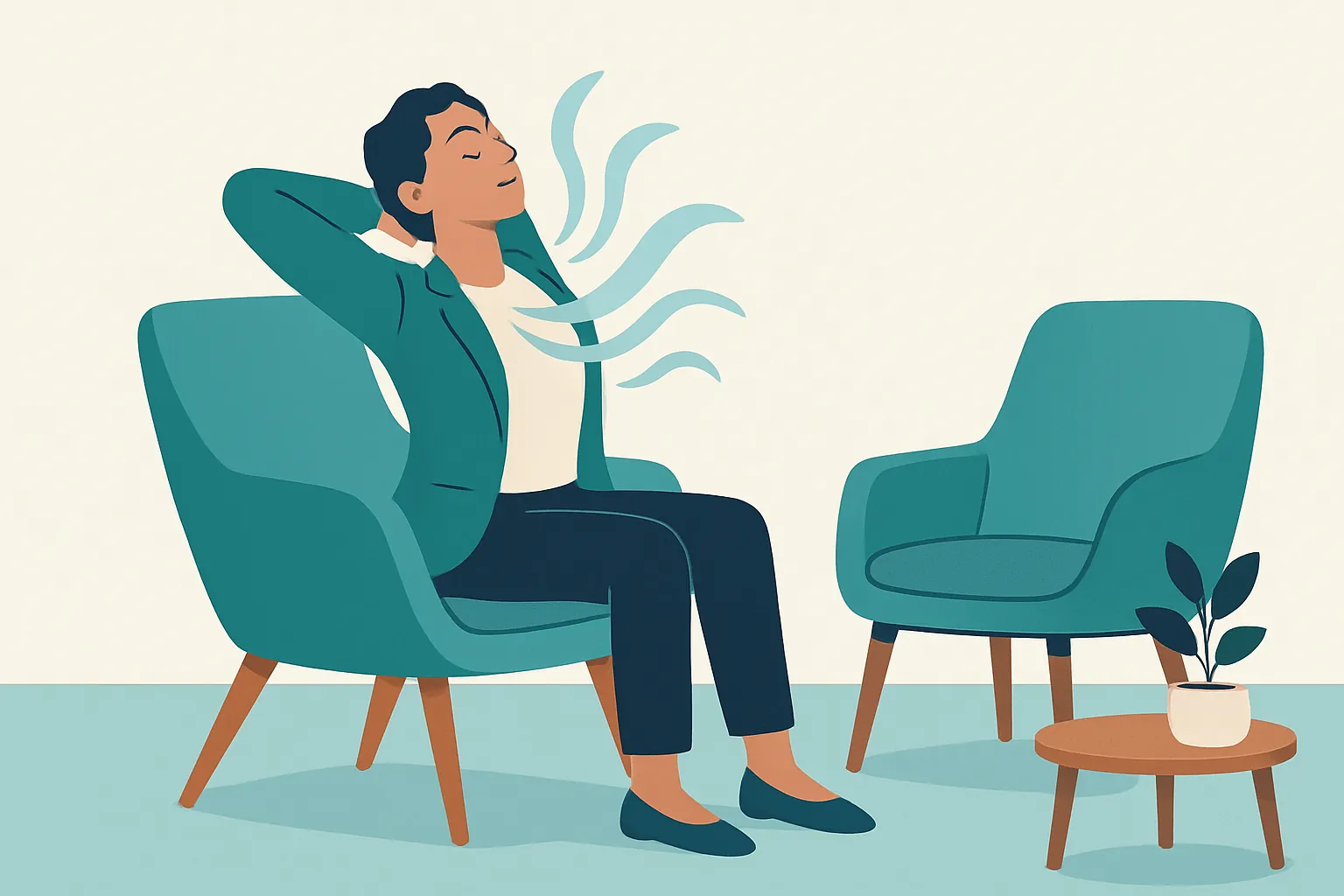
Key takeaway
Therapists who run six or more sessions a day accumulate chronic tension in the neck, shoulders, and hip flexors—and that physical strain is not just a personal wellness issue. Through the lens of polyvagal theory, chronic neck and shoulder tension suppresses the parasympathetic activity that powers the social engagement system, shrinking your capacity to hold a client's distress, while prolonged sitting shortens the psoas, shallows the breath, and dulls cognitive clarity. This article offers three under-5-minute recovery routines you can do between sessions—a sternocleidomastoid release, a thoracic rotation, and a seated psoas stretch—plus practical systems for micro-breaks, ergonomics, and reclaiming time from documentation.
Is Your Empathy Stuck Behind Your Back Pain?
We train ourselves to catch everything: the micro-shift in a client's expression, the tremor in a voice, the weight of a silence. Yet we are often deaf to the signals our own bodies are sending. After a full day in the chair—holding affect, leaning in, staying attuned—the shoulders have quietly locked up and the lower back has started to ache.
A therapist's physical health is not a private wellness footnote. Physical discomfort erodes sustained attention and accelerates compassion fatigue. From a somatic-psychology perspective, a clinician who is physically braced and contracted struggles to offer a client a felt sense of a secure base. This piece looks at how prolonged sitting degrades clinical performance, then offers concrete, in-office strategies you can use the same day.
How Physical Bracing Blocks Clinical Insight: Somatization and Countertransference
We tend to think of therapy as a verbal, mental activity. In practice it is also a sustained physical one. The discomfort you carry isn't merely a musculoskeletal complaint—it can become a source of somatic countertransference, shaping the relationship in the room before a word is spoken.
The Body–Empathy Link
Neurobiological research increasingly shows that our physiological state is bound up with our capacity for affect regulation. Polyvagal theory (Porges) suggests that chronic neck and shoulder tension suppresses parasympathetic activity and interferes with the social engagement system—the very network that lets us signal safety and stay receptive. When the body reads itself as under strain, the nervous system treats it as a threat cue, and we drift, often unconsciously, toward a more defensive posture. That shrinks the container we can offer a client's pain and, over time, weakens the working alliance.
Sitting and "Clinical Numbing"
A full day in a seated position shortens the psoas major and restricts the movement of the rib cage, which shallows the breath. Shallow breathing means less oxygen and reduced cognitive clarity. The difficulty concentrating while writing a progress note or building a case conceptualization—or that wave of drowsiness mid-session—may not be simple fatigue. It can be the physiological downstream of a body that has been held in one shape for too long.
Posture and Emotional Stance Are Connected
The posture we hold doesn't only send a nonverbal message to the client; it shapes our own internal state. Poor positioning produces physical pain and hastens psychological burnout. Here is how three common seated patterns play out, physically and clinically.
The Slump. The back rounds, the chin juts forward, and the pelvis tilts back. Physically this drives forward-head strain, lumbar disc compression, and sluggish digestion. Clinically it reads as low energy and passive listening—and it invites flat mood and drowsiness.
The Rigid. The shoulders ride up toward the ears, the spine is held bolt-upright, and the hands clench. Physically it produces upper-trapezius pain, tension headaches, and jaw (TMJ) strain. Clinically it telegraphs a defended, sometimes cold or authoritative stance, and it undermines empathic attunement.
Active Sitting. Weight rests on the sit bones, the spine keeps its natural S-curve, and the feet are grounded. Physically this engages the core, frees diaphragmatic breathing, and improves circulation. Clinically it supports an open stance, steady alertness, and the grounded presence that lets you hold a client's affect safely.
As the contrast makes clear, active sitting isn't just healthier—it shapes the quality of the work. But holding any single posture flawlessly for fifty minutes isn't realistic. That's why short, strategic resets between sessions matter so much.
Three Under-5-Minute Recovery Routines for Between Sessions
The most common objection is "I don't have time to exercise." The good news is that you don't need a gym—you need brief, targeted movement that releases the fascia that stiffens over a clinical day. Each of the following can be done in professional clothing, in a small office.
1. Sternocleidomastoid and Scalene Release (Open the Channel for Empathy)
Nodding along and leaning forward to attend to a client shortens the muscles at the front of the neck, which can feed headaches and a wired, on-edge feeling.
- Sit upright and hold the underside of the chair with your right hand (this anchors the shoulder).
- With your left hand, gently cradle the upper-right side of your head and ease it toward the left.
- From there, lift your chin slightly toward the ceiling until you feel the diagonal muscles at the front of the neck lengthen.
- Repeat on the other side, breathing deeply three times per side.
2. Thoracic Rotation and Chest Opener (Expand Your Capacity)
Listening to heavy material, we unconsciously curl the chest inward. Opening the closed rib cage is a reliable way to discharge built-up tension.
- Sit and interlace your fingers behind your head.
- Inhale, open the elbows wide, and lift the chest toward the ceiling.
- Exhale and rotate your upper body to the right while keeping the pelvis still.
- Return to center and rotate to the other side. Let each segment of the spine unwind.
3. Seated Psoas Stretch (Restore Vitality)
The muscle that suffers most from prolonged sitting is the psoas, which links the spine to the hip. When it shortens, it drives both low-back pain and chronic fatigue.
- Perch on the front edge of the chair, keeping only your right hip on the seat, and extend your left leg long behind you.
- Lower the left knee toward the floor until you feel the front of the hip open.
- Keep the torso tall; if you can, reach the left arm overhead to lengthen through the side body.
- Hold for about 10 seconds, then switch sides.
Building a Sustainable Practice
Clinician self-care is significant enough to appear in our ethics codes—it's a professional obligation, not an indulgence. When the body breaks down, so does the vessel that holds the work. Yet between administrative load and documentation, even finding time to stretch can feel impossible. A few practical strategies:
- Build in micro-breaks. Of the ten minutes between sessions, protect at least three to stand up and move. Treat it as a deliberate physical reset before you receive the next client.
- Improve your ergonomics. Bring the monitor to eye level, use lumbar support, and—if you have access to a sit-stand desk—document standing up for part of the day.
- Reclaim time from documentation. For many of us, the biggest reason there's no time to stretch is the hours spent reconstructing and typing up sessions. Reducing that load frees up the very minutes self-care requires.
This is one place where tooling can genuinely help. Secure, purpose-built documentation support—including AI assistance for transcription and progress notes—can shrink the after-session paperwork burden so you have room to attend more fully to nonverbal cues and to recover between clients. The point isn't the technology itself; it's the ten minutes it can give back. Tools like Modalia AI are designed for exactly this—handling the documentation in a security-first way so the clinician can step away, roll the shoulders, and take a real breath. (If you adopt any such tool, choose one built around client confidentiality and your jurisdiction's privacy requirements.)
Your health is, in a real sense, your client's healing. After today's last session—or in the short gap between two—consider standing up and lengthening through the body for a moment. Supple thinking and deep empathy tend to flow from a supple body.
References
- 1.
- 2.
- 3.
Frequently asked questions
How can physical tension affect my work as a therapist?
Chronic neck, shoulder, and hip tension does more than hurt. It can erode sustained attention, accelerate compassion fatigue, and show up as somatic countertransference. Through the lens of polyvagal theory, physical bracing suppresses the parasympathetic activity behind the social engagement system, which narrows your capacity to stay open and hold a client's distress.
What stretches can I realistically do between sessions?
Three under-5-minute resets work well in professional clothing in a small office: a sternocleidomastoid and scalene release for the front of the neck, a seated thoracic rotation and chest opener, and a seated psoas stretch for the hip flexors. Each takes a minute or two and targets the areas most affected by prolonged sitting.
How many minutes between sessions should I protect for movement?
If you have a ten-minute gap, aim to protect at least three minutes to stand up and move. Treat it as a deliberate physical reset before the next client rather than spillover time for notes or email.
How does reducing documentation time help my physical health?
For many clinicians, the main reason there's no time to stretch is the hours spent reconstructing and typing up sessions. Secure documentation support—including AI assistance for transcription and progress notes—can shrink that load and give back the very minutes that micro-breaks and recovery require.
This article was written and reviewed using Modalia AI's clinical guidelines, with professional human review before publication.
Related articles
 Case Conceptualization
Breaking the "Yes, But" Game: A Transactional Analysis Guide for Therapists
Every suggestion you offer gets met with "Yes, but..." Here's the TA structure behind that stall—and four clinical moves to break it.
7 min read Case Conceptualization
Yalom's The Gift of Therapy: Passages Every New Counselor Should Copy by Hand
Irvin Yalom's prescription for therapists who fear silence: meet your client as a "fellow traveler" and let the here-and-now become the heart of the work.
6 min read Case Conceptualization
Working With Silence in Therapy: What Client Silence Means and How to Hold It
Silence in session isn't empty space. Learn to read its clinical meaning, tell productive from defensive silence, and use it as a therapeutic tool.
6 min read