Building Clinical Muscle: A Case-Based Study Group for Structural Family Therapy
Minuchin's model reads clean on the page but feels murky in the room. Here's how an enactment-based study group builds the clinical reflexes textbooks can't.
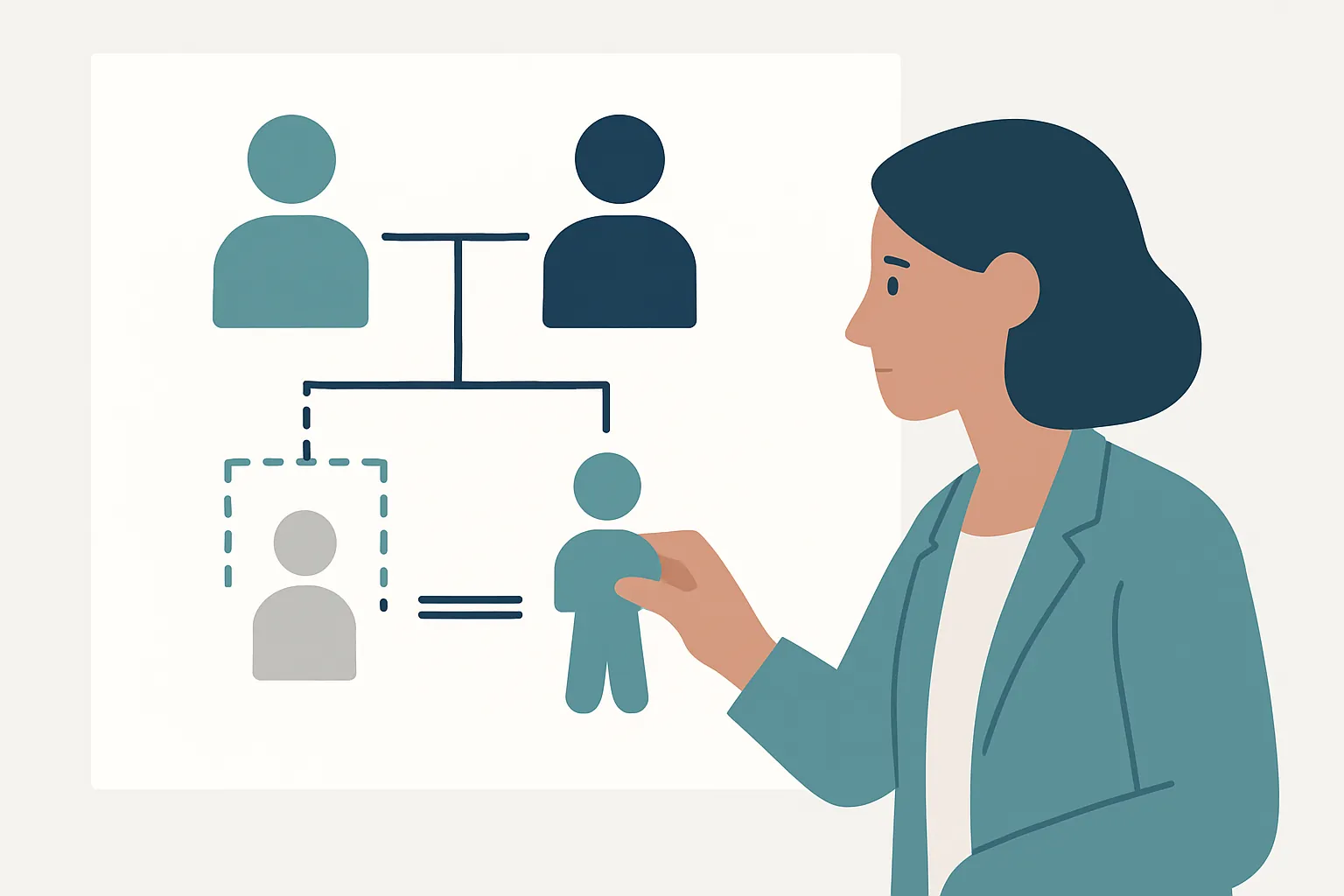
Key takeaway
Salvador Minuchin's structural family therapy is conceptually elegant but clinically demanding, because the therapist must act as an active director of the family system rather than a passive listener. A peer study group can build that skill by pairing three practices: converting written cases into family maps, running enactment-based role-plays that reproduce real family dynamics, and conducting line-by-line analysis of session transcripts. The hours that transcription normally consumes can be reduced with speaker-diarizing AI tools, freeing clinicians to focus on intervention strategy and peer discussion.
When Minuchin Makes Sense on Paper but Not in the Room
If you have ever walked out of a family session wondering whether you got pulled into the family's conflict instead of restructuring it — or whether you set boundaries with anything like the clarity the textbooks describe — you are in good company. Salvador Minuchin's structural family therapy (SFT) is one of the most visually intuitive models we have for reading family dynamics and intervening in them. Yet it is also one of the hardest to enact well.
The reason is structural, not personal. SFT asks the clinician to stop being a careful listener and start being the director of the family system — actively shifting alliances, intensifying interactions, and redrawing boundaries in real time. That is a performance skill, and performance skills do not develop by rereading the source material alone. They develop through repetition, observation, and feedback with peers.
This article lays out a practical way to run a clinician study group that teaches SFT the way it actually has to be learned: through mapping, enactment, and microanalysis of real sessions.
1. Train the Clinical Eye: Family Mapping Workshops
The core of SFT is making a family's invisible rules and hierarchy visible. The most common trap for newer clinicians is staying fixated on the presenting content — the complaint, the symptom, the story — and missing the structure that holds it in place. So the first habit your group should build is converting a written case into a family map.
A three-step mapping drill:
- Standardize the notation. Make sure every member uses the same symbols Minuchin used — clear boundaries, enmeshed (diffuse) boundaries, rigid boundaries, conflict, coalition, and so on. Shared notation is what makes comparison meaningful.
- Blind mapping. One member presents an anonymized case verbally while everyone else only listens and draws their own map. No peeking at each other's work.
- Compare and discuss. Lay the maps side by side. The productive questions are the disagreements: "Why did you read the couple as detouring rather than in open conflict?" These differences in structural interpretation are exactly where learning happens.
This exercise builds the metacognitive habit of stepping back from the family's words and watching the patterns instead. A central goal is learning to see how the identified patient (IP) uses the symptom to preserve the family's homeostasis — and how addressing the symptom without addressing the structure rarely holds.
2. Embody the Work: Enactment-Based Role-Play
If mapping trains the eye, enactment trains the body — and enactment is the signature technique of Minuchin's approach. In session, the therapist invites the family to reproduce its usual dysfunctional pattern in the room, then intervenes on the spot to alter it. You cannot learn this sitting at a desk. The study group has to become a low-stakes laboratory for it.
Table 1 — Theory-centered vs. enactment-centered study groups
| Dimension | Traditional theory-centered group | Enactment-centered group |
|---|---|---|
| Learning goal | Understand concepts (boundaries, subsystems) | Train timing and intensity of intervention |
| Core activity | Presentations, summaries, literature review | Role-play, live intervention, feedback |
| Therapist role | Receiver of knowledge | Active director and boundary-setter |
| Clinical effect | Increased cognitive insight | Faster in-session response, lower anxiety |
Tips for running effective role-plays:
- Set a concrete scenario. Build a specific triangle, e.g., "A parent disciplines the child while the grandparent cuts in to shield them." Specificity makes the structure visible.
- Let the family resist. The members playing family roles should push back, escalate, and express real emotion — giving the "therapist" appropriate pressure to work against, just as a live family would.
- Use a freeze-frame cue. Have an observer or supervisor call "Freeze" mid-scene. At that moment, analyze what the therapist actually did: which joining move did they make? How did they use intensity to push the system?
3. Get Precise: Microanalysis of Session Transcripts
SFT moves fast. In a live session, a fleeting nonverbal cue or a subtle shift in power can slip by unnoticed. That is why your group also needs slow, microscope-level work on the verbatim transcript of an actual session.
A reframing drill using transcripts:
- Capture the client's language. Find the line — for example, a parent saying, "He just ignores his father."
- Interpret it structurally. Reframe it as structure: "The parental coalition is weak, and the child is moving into the gap."
- Write an alternative response. Place your actual in-session response next to a new one that applies a structural technique (for instance, unbalancing). Seeing them side by side sharpens your repertoire.
Here is the honest problem: producing verbatim transcripts is one of the biggest time sinks in clinical work. Replaying a recording a dozen times to type out who said what drains exactly the energy you needed for the analysis itself. This is where current technology earns its place.
Conclusion: Grow with Tools and With Peers
Structural family therapy asks the clinician to hold two things at once — a warm heart and the cool head of a strategist. You build that combination far faster by mapping cases with colleagues and physically rehearsing enactments than by studying alone. That practice is where clinical confidence to shift and rebalance a family system actually comes from.
To protect the group's time, cut the low-value, repetitive labor wherever you can. Modern AI documentation and transcription tools built for clinical use can apply speaker diarization to distinguish several family members in a conversation and convert it to accurate text — turning hours of replay into minutes of review.
An action plan for your group:
- 📝 Automate transcription. Use a clinical AI tool to draft your transcripts, and redirect that reclaimed time toward family mapping and intervention planning with peers.
- 🤝 Form a four-person team. One therapist plus two to three "family" members makes an ideal role-play unit. Start small and meet regularly.
- 🔍 Re-examine stuck cases. For a case that won't move, use objective data — such as talk-time distribution or emotional keyword frequency from an AI analysis — to check whether you have unintentionally sided with one family member.
A quick safety note: any time clinical material touches a client in acute distress, route them to your local or national crisis line or emergency services, and choose tools that keep client data private and secure.
Ready to build some clinical muscle? Reach out to a few colleagues this week and propose the group.
References
- 1.
Frequently asked questions
Why is structural family therapy harder to apply than it looks?
Because the model asks the clinician to act as an active director of the family system — shifting alliances, intensifying interactions, and resetting boundaries in real time — rather than listening passively. That is a performance skill that develops through rehearsal and feedback, not through rereading theory.
What is an enactment in structural family therapy?
An enactment is when the therapist invites a family to reproduce its usual dysfunctional pattern during the session, then intervenes on the spot to alter it. It lets the clinician observe and reshape the family's structure directly instead of only hearing about it secondhand.
How can a study group practice enactment safely?
Use role-play with concrete scenarios, let members playing family roles resist and express real emotion, and add a freeze-frame cue so an observer can pause the scene and analyze the therapist's joining and intensity moves.
How does AI transcription help a counseling study group?
Clinical AI tools with speaker diarization can distinguish several family members and convert recordings to accurate text, cutting the hours normally spent replaying audio. That reclaimed time can go toward family mapping, intervention planning, and peer discussion — provided the tool keeps client data secure.
This article was written and reviewed using Modalia AI's clinical guidelines, with professional human review before publication.
Related articles
 Clinical Skills
How to Write Better Supervision Questions: Getting What You Actually Need from Your Supervisor
Stuck on what to ask in supervision? Use these structured question strategies to turn vague check-ins into focused clinical insight.
7 min read Clinical Skills
From "The Client Seems Depressed" to a Clinical Hypothesis: How Word Choice Elevates Your Case Reports
Turn vague observations into precise clinical hypotheses. A practical guide to terminology and sentence formulas that make your case reports read like expert work.
7 min read Clinical Skills
The Wounded Healer Trap: Why "I Want to Heal Myself" Sinks Your Counseling Grad School SOP
Why admissions faculty flinch at "I want to heal my own wounds"—and how to transform personal pain into a research-grade statement of purpose that gets you in.
6 min read