Structured Peer Supervision: How to Run a Trainee Study Group That Actually Builds Clinical Skill
Turn your trainee peer group from a venting session into a high-yield clinical training engine—with a staged curriculum, defined roles, and smarter transcript analysis.
Key takeaway
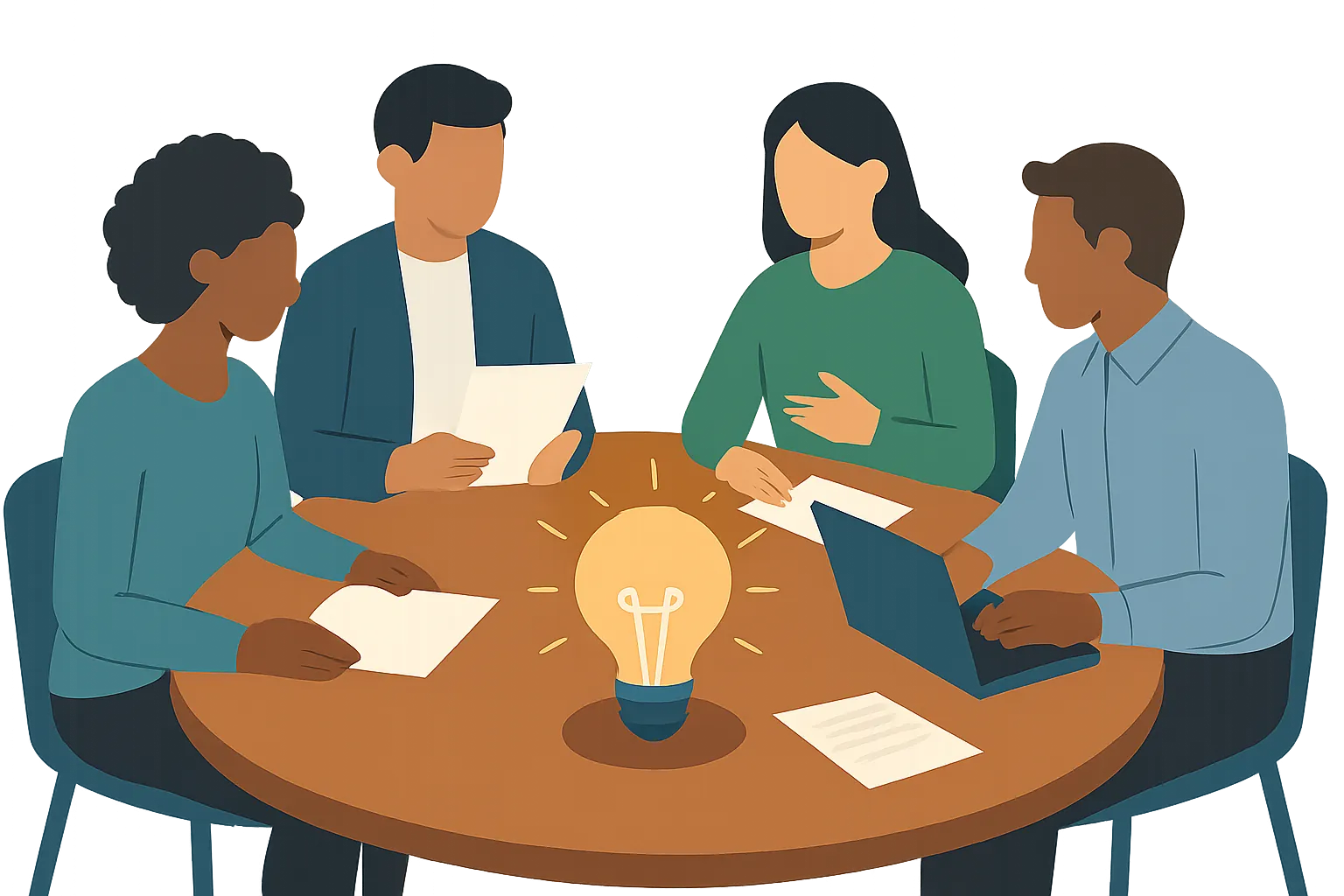
A trainee peer group can do far more than offer emotional support—done well, it becomes a venue for expanding clinical insight through collective intelligence. Research on structured peer-group supervision suggests it can rival individual supervision for building counselor self-efficacy and preventing burnout. The key is a staged curriculum (theory review, simulated case conceptualization, then transcript-based peer supervision), defined roles (facilitator, scribe, and a designated devil's advocate), and time-boxed structure. Because a full session transcript can take three to four hours to produce by hand, AI transcription tools let groups spend their energy on insight rather than typing.
Is Your Trainee Study Group Just a Place to Vent?
If you're in clinical training, you probably belong to a peer group—a circle of fellow trainees who meet to discuss cases, share resources, and lean on one another. Peer groups form for good reasons: individual supervision is expensive, and the emotional weight of clinical work is real. But too often these groups drift. Meetings become a loop of "that case was so hard this week," or they dissolve into aimless reading with no clear destination.
Peer support matters. We need it. But trainees also carry an obligation to grow into competent, accountable clinicians. A well-organized peer group is more than a comfort circle—it's a chance to expand clinical insight through collective intelligence. The literature on structured peer-group supervision (see Bernard & Goodyear's foundational work on clinical supervision, and Borders' models for peer consultation) indicates that a deliberate, structured format can meaningfully build counselor self-efficacy and buffer against burnout—sometimes approaching the benefits of formal supervision. The question is how to convert your group's limited time into genuinely high-yield clinical training. Here's a curriculum and operating model that holds up.
1. Decide What You're Building: A Staged Curriculum
The difference between a group that grows and one that stalls is a clear goal. The right focus shifts with developmental stage: early-career trainees need theoretical grounding, while those further along are hungry for case conceptualization practice. Saying "let's just present cases" tends to produce either defensiveness or surface-level advice. A staged approach works better.
Stage 1: Review Core Theory and Current Trends
Theory is the foundation—but reading a textbook cover to cover is inefficient. Instead, pick a specific modality (CBT, psychodynamic, ACT) and use case-based learning: how would this approach actually apply to a real client presentation? Summarizing one recent journal article per session—on emerging areas like trauma-informed care (TIC) or multicultural counseling ethics—is another strong format.
Stage 2: Practice Case Conceptualization in a Safe Sandbox
If opening a real client feels too exposed early on, use a character from a film or novel, or a published transcript. Pose the question: "If I were this client's counselor, how would I structure the first three sessions?" Building a treatment plan around a low-stakes case is the best simulation there is for the uncertainty you'll meet in the room.
Stage 3: Peer Supervision and Transcript Analysis
This is the core. Don't open with a vague "so, what do you think of this client?" Instead, excerpt a focused 5–10 minute segment of transcript from a point where the work hit an impasse, and analyze it closely. The crucial move: focus less on the client's pathology and more on the counselor's responses—countertransference, the appropriateness of interventions, missed openings.
2. Operating Rules That Maximize Yield
Groups go slack for two reasons: no defined roles, and vague feedback. Simply taking turns presenting drains the energy out of the room. High-yield groups assign clear roles and use a structured feedback format. Compare the two models below and check where yours falls.
Ordinary study group vs. high-yield peer group
| Dimension | Ordinary group (low yield) | High-yield peer group (growth-oriented) |
|---|---|---|
| Time use | 30 min catching up, 30 min presenting, 30 min chatting (no boundaries) | 10 min check-in, 60 min case analysis (timed), 20 min wrap-up |
| Format | One person explains; everyone else listens | Collective intelligence: assigned facilitator, scribe, and devil's advocate |
| Feedback | "I really feel for you," "that sounds hard" (support only) | "What defense is the client using here?" "What was the intent behind your response?" (testing clinical hypotheses) |
| Materials | Handwritten or unorganized notes | Standardized case report plus an accurate transcript of key moments |
| Goal | Finish the program (process-focused) | Acquire specific clinical skills and sharpen case conceptualization (outcome-focused) |
I'd strongly encourage assigning a devil's advocate. When everyone is nodding along, this person is tasked with raising the critical question or naming the blind spot the group is skating past. It's one of the most effective guards against groupthink and one of the fastest ways to widen everyone's clinical field of view.
3. Reclaim Hours from the Transcript and Spend Them on Insight
The session transcript is the hardest and most valuable artifact a peer group handles. Capturing the exchange word-for-word is essential for a counselor's self-reflection. But transcribing 50 minutes of a session by hand can swallow three to four hours of administrative effort—and by the time you've finished typing, you're too drained to do the real work of analyzing content and exploring alternatives.
Get Out of the Transcription Trade
This is where smart tools earn their place. General-purpose AI transcription services—Otter.ai, Fireflies, Notta—and clinical-grade tools built for counselors can cut raw transcription time dramatically. What a peer group should be doing is not dictation, but argument: Why did the client fall silent at that moment? Did my intervention land on the client's core affect, or glance off it? Hand the mechanical work to software and pour your energy into the uniquely human domain—insight.
A security-first option built for clinicians is Modalia AI, which handles session transcription, case conceptualization support, and documentation so the group's shared workflow stays inside one tool rather than spread across consumer apps.
Trade Objective, Data-Backed Feedback
The better clinical note tools don't just convert speech to text. They surface objective signals—talk-time share (counselor vs. client), frequency of silences, recurring keywords. Reviewing that data together lets you give concrete, evidence-based feedback: "You spoke about twice as much as the client this session—what was the anxiety underneath that?" That kind of specific observation drives behavior change far more powerfully than a vague suggestion.
Conclusion: Go Fast Alone, Go Far Together
Clinical work is solitary. Sitting with a client's pain in a closed room, you can lose your bearings. That's exactly why a healthy, professional peer group is so valuable. Apply the curriculum and operating model above, and your group becomes more than a place to be consoled—it becomes a base camp that pulls everyone's clinical development forward.
And let modern tools carry the heavy administrative load. If your group adopts an AI-supported transcript workflow as a shared standard, the hours you used to spend on documentation get reinvested where they belong—in case analysis and treatment strategy. So make the proposal at your next meeting: "What if, starting next week, we don't just meet—we run the kind of study group that actually makes us better?"
References
- 1.
- 2.
Frequently asked questions
Is peer supervision as effective as individual supervision?
Structured peer-group supervision won't fully replace individual supervision, but research on peer consultation models (e.g., Bernard & Goodyear; Borders) suggests a well-run, structured group can meaningfully build counselor self-efficacy and reduce burnout. The key word is structured—unstructured venting groups don't produce the same benefit.
What roles should we assign in a peer supervision group?
At minimum, rotate three: a facilitator who keeps time and focus, a scribe who captures key points and action items, and a devil's advocate tasked with raising critical questions and naming blind spots. The devil's advocate role is the single best guard against groupthink.
How should we choose what part of a session to analyze?
Don't review a whole session. Excerpt a focused 5–10 minute segment from a point of impasse, and center the discussion on the counselor's responses—countertransference, timing, and intervention choices—rather than only on the client's pathology.
How can AI transcription tools help a peer group?
Hand-transcribing 50 minutes of session audio can take three to four hours. Tools like Otter.ai, Fireflies, Notta, or clinician-focused platforms such as Modalia AI cut that dramatically and can surface objective data—talk-time share, silence frequency, recurring keywords—that fuels concrete, evidence-based feedback.
This article was written and reviewed using Modalia AI's clinical guidelines, with professional human review before publication.
Related articles
 Clinical Skills
How to Write Better Supervision Questions: Getting What You Actually Need from Your Supervisor
Stuck on what to ask in supervision? Use these structured question strategies to turn vague check-ins into focused clinical insight.
7 min read Clinical Skills
From "The Client Seems Depressed" to a Clinical Hypothesis: How Word Choice Elevates Your Case Reports
Turn vague observations into precise clinical hypotheses. A practical guide to terminology and sentence formulas that make your case reports read like expert work.
7 min read Clinical Skills
The Wounded Healer Trap: Why "I Want to Heal Myself" Sinks Your Counseling Grad School SOP
Why admissions faculty flinch at "I want to heal my own wounds"—and how to transform personal pain into a research-grade statement of purpose that gets you in.
6 min read