When Supervision Stings: How to Receive Feedback Without Taking It Personally
When a supervisor's note feels like a personal attack, try these three clinical strategies to protect your confidence and turn feedback into fuel for growth.

Key takeaway
Critical supervision feedback can feel like a personal attack because counselors use the Self as their primary instrument, blurring the line between professional and personal identity. Much of the shrinking or fear you feel in supervision may be a parallel process—your client's dynamics re-enacted in the room. Growth-oriented clinicians separate feedback about the skill from feedback about the person, choose clinical curiosity over defensiveness, and rely on objective session records to keep supervision focused on facts rather than memory.
Have You Ever Cried After Supervision?
The moment you close the door behind a tough supervision session and feel your legs go weak or your chest tighten—that experience isn't unique to early-career clinicians. Seasoned therapists know it too. "Was that really the best intervention here?" "You completely missed the client's dynamics." A supervisor's sharp observation can land like a wholesale rejection of your competence—what self psychology calls a narcissistic injury.
And yet we know supervision exists for a reason: it protects both the counselor's growth and the client's safety. So why is it so hard to metabolize feedback as a clinical asset instead of an emotional blow? This isn't a character flaw. It reflects the unique tension at the heart of our work—the tension between the vulnerability of using ourselves as the instrument and the professional responsibility to keep improving. This article looks at the psychological mechanics of that tension and the concrete strategies that turn the discomfort of supervision into momentum.
Why Feedback Sounds Like Criticism—and What to Do About It
The core reason a supervisor's comment registers as a personal attack is the blurred boundary between your professional identity and your personal self. We aren't technicians operating a tool external to us; we use the Self as the instrument. So a critique of our clinical work is easily mistaken for a critique of who we are. Untangling this takes work on three fronts.
1. Recognize the Parallel Process: Is This My Feeling, or the Client's?
The shrinking, anger, or helplessness you feel in supervision may not originate with you. Often it's a parallel process: the affect a client projected onto you in session gets re-enacted as you sit with your supervisor (Searles, 1955).
For example, the dread of "getting in trouble" with your supervisor may be the very fear your client carries toward a parent or authority figure—an emotion you are carrying on their behalf through projective identification (Ogden, 1979). Once you adopt this lens, "I got criticized because I'm bad at this" becomes a clinical insight: "I'm experiencing my client's fear in a vivid, embodied way."
2. Decouple Who You Are From How You Performed
Healthy differentiation matters here. Your supervisor's feedback is not "you are a bad counselor." It's "this particular intervention, in this particular session, needs revision." Locate the feedback precisely—aim it at the skill, not the self. This is essentially applying a CBT stance to yourself: dispute the irrational belief ("I must never make a mistake") and redirect your attention to a specific, workable behavior change.
3. Choose Curiosity Over Defense
When we hear feedback, the brain reflexively shifts into fight-or-flight and our defenses come online. Instead of making excuses (fight) or going silent (flight), activate clinical curiosity. Try: "I can see how it looked that way. Given that, what alternative question could I have asked at that moment?" A question like this converts a vertical, evaluative relationship into a horizontal alliance of inquiry.
The Growing Clinician vs. the Stalled Clinician
How you receive feedback today shapes where your clinical skill sits in five or ten years. Use the table below to check your current stance and chart a healthier professional posture.
| Dimension | Defensive / Stalled Stance 🛑 | Growth-Oriented Stance 🌱 |
|---|---|---|
| How feedback is read | As a personal slight or dismissal ("Do they not like me?") | As data to help the client ("That's a new angle") |
| Primary response | Excuses, rationalizing, silence, avoidance | Questions, specifics, exploring alternatives, taking notes |
| After supervision | Consumed by shame; motivation drops (burnout risk) | Motivated to try something new; revises clinical hypotheses |
| Record-keeping | Edits or distorts the transcript to hide mistakes | Surfaces the verbatim record and asks for accurate analysis |
Table 1. A growth model of how counselors receive supervision feedback.
Objective Data Lowers the Emotional Labor
Another reason supervision turns into an emotional tug-of-war is the subjectivity of memory. The counselor reports from recall, the supervisor judges from that report, and misunderstandings multiply. "Did I really say that?" "That's not the tone I meant." The best way to cut down on these draining exchanges is to bring an objective record into the room.
This is where the AI-assisted session documentation and transcription tools now entering clinical practice earn their place. An accurate, machine-generated transcript becomes a neutral third data point between counselor and supervisor. Instead of spending energy defending your performance, you and your supervisor can analyze what the text actually shows. Modalia AI is built for exactly this kind of work—a security-first AI partner for counselors that handles transcription, case conceptualization, and documentation so the conversation stays focused on the clinical material, not on whose memory is correct. (General-purpose tools like Otter or Upheal serve a similar transcription role; the key is having a shared, objective record.)
Learning not to take feedback personally is ultimately the discipline of decentering the "I" and putting the facts and the client at the center. If a pointed comment stung today, that sting is evidence of how badly you want to be a good clinician. Pair that drive with modern tools and a mature clinical posture, and you have everything you need to take the next step up.
References
- 1.
- 2.
- 3.
- 4.
Frequently asked questions
Why does supervision feedback feel so personal?
Counselors use the Self as their primary clinical instrument, so the boundary between professional performance and personal identity is naturally blurred. A critique of a specific intervention can be misread as a critique of who you are. Naming this confusion is the first step to receiving feedback as information rather than injury.
What is parallel process in clinical supervision?
Parallel process describes how the dynamics between a client and counselor get unconsciously re-enacted between the counselor and supervisor. Feelings of fear, helplessness, or defensiveness in supervision may actually mirror the client's relational patterns—offering useful clinical data rather than evidence of failure.
How can I stop becoming defensive when receiving feedback?
Replace the reflexive fight-or-flight response with clinical curiosity. Instead of explaining or going silent, ask a genuine question such as, 'Given that, what alternative could I have tried at that moment?' This shifts a vertical, evaluative exchange into a collaborative alliance of inquiry.
How do session transcripts make supervision easier?
Much of the friction in supervision comes from the subjectivity of memory. An accurate transcript serves as a neutral third data point, so counselor and supervisor can analyze what was actually said instead of debating recollections—reducing emotional labor and keeping the focus on the client.
This article was written and reviewed using Modalia AI's clinical guidelines, with professional human review before publication.
Related articles
 Case Conceptualization
Breaking the "Yes, But" Game: A Transactional Analysis Guide for Therapists
Every suggestion you offer gets met with "Yes, but..." Here's the TA structure behind that stall—and four clinical moves to break it.
7 min read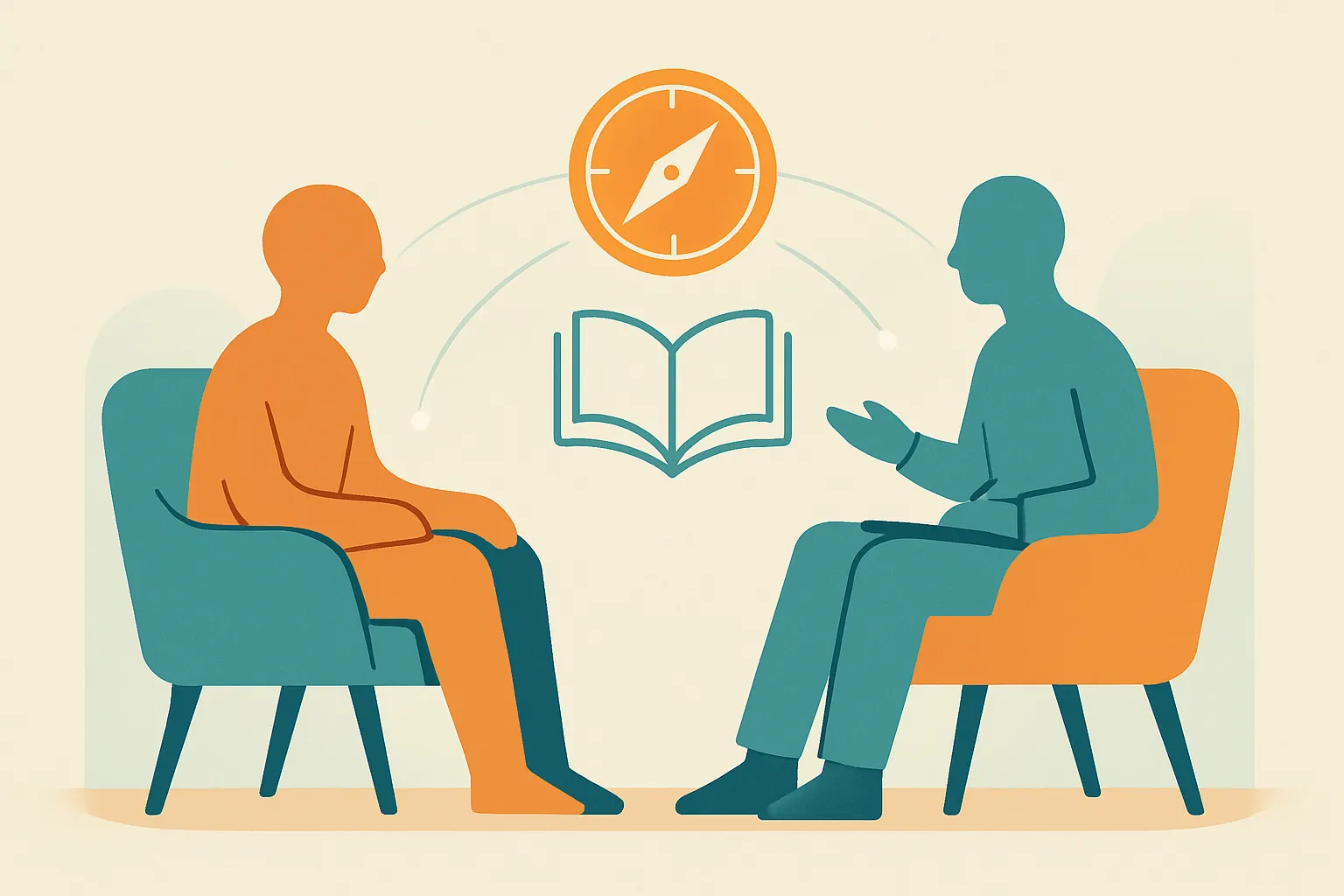 Case Conceptualization
Yalom's The Gift of Therapy: Passages Every New Counselor Should Copy by Hand
Irvin Yalom's prescription for therapists who fear silence: meet your client as a "fellow traveler" and let the here-and-now become the heart of the work.
6 min read Case Conceptualization
Working With Silence in Therapy: What Client Silence Means and How to Hold It
Silence in session isn't empty space. Learn to read its clinical meaning, tell productive from defensive silence, and use it as a therapeutic tool.
6 min read