When Clients Bring Tarot Into Therapy: The Psychology Behind It and How to Use It Clinically
Why clients turn to tarot, what the impulse reveals, and how to repurpose it as a projective doorway into psychological reality in session.
Key takeaway
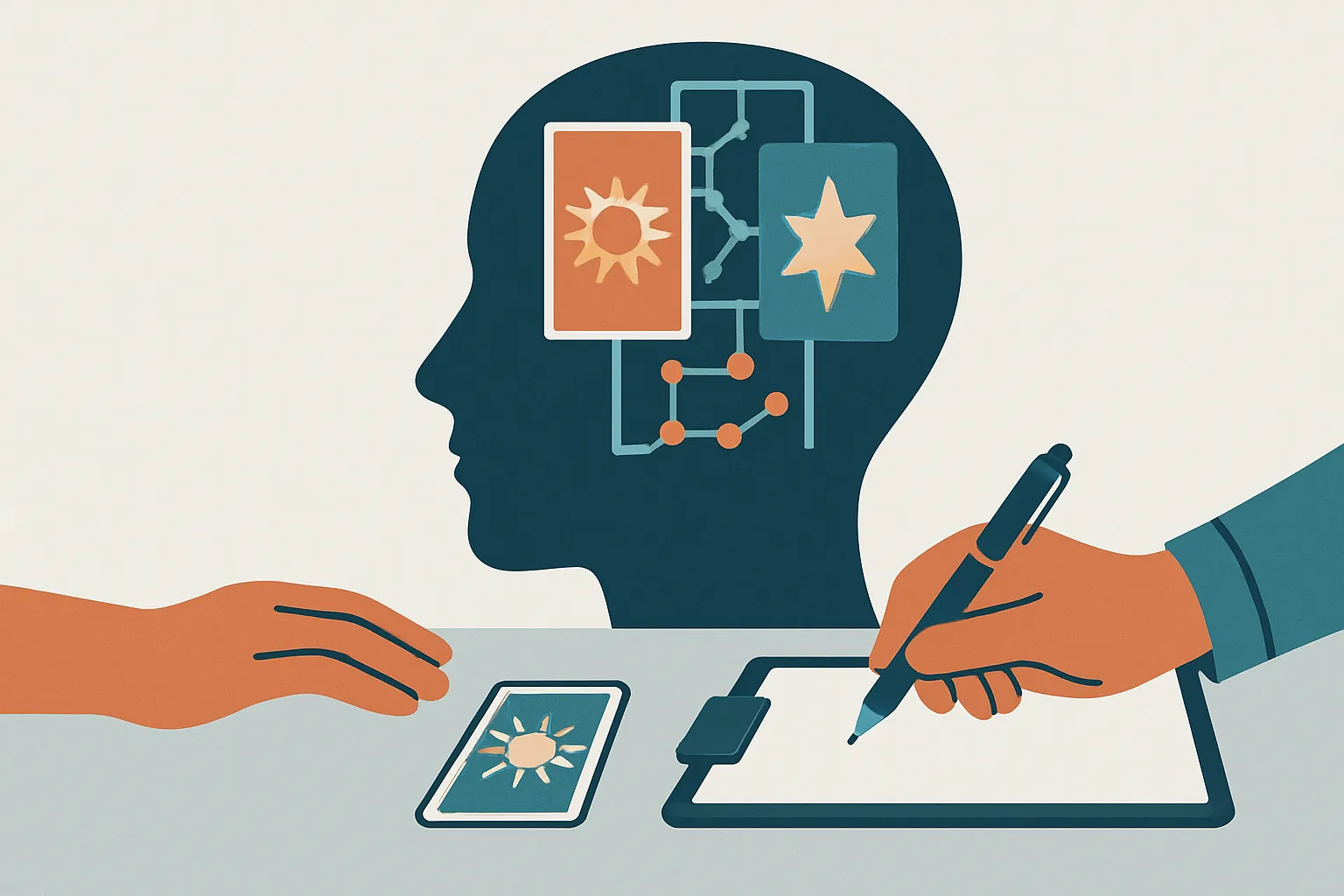
When clients put more faith in a tarot reading than in therapy, the pull usually comes from two needs: to resolve uncertainty instantly and to shift the burden of a decision onto an external force like fate or the cards. The Barnum effect lets vague statements feel personally true, producing a sense of being understood faster than the slower work of therapy allows, while tarot's imagery can function—through a Jungian lens—as a projective screen for archetypal material. Rather than dismissing the interest, clinicians can treat it as a kind of projective test: a way to explore the client's psychological reality, reverse-engineer their underlying wishes, and open metaphorical dialogue through symbols.
"My tarot reading told me to break up with him": what a client's faith in the cards is really asking for
Somewhere in the early work of building rapport and setting goals, many clinicians hit a disorienting moment: the client trusts a tarot reading—or an astrology chart—more than they trust the room they're sitting in, and they bring that reading back as the basis for a major decision. "You never just give me the answer," one client said, "but the tarot reader told me exactly what was going on, and that felt good." It's easy to underestimate how much that lands as a quiet indictment of our expertise.
The reflexive move is to file it under unscientific dependence on superstition and move on. But doing so may cost us one of the most revealing pieces of data the client has handed over. In an era of high uncertainty, divination-style consultations have become a kind of psychological first aid for many people—especially among younger generations—and the question worth asking is not whether the cards are "real," but why this client needs them right now. This piece looks at the structural difference between a tarot reading and psychotherapy, and at how the cards can become a doorway into the client's unconscious rather than a rival for their trust.
Why a client reaches for the cards instead of the consulting room
The core appeal of a reading is immediacy and external attribution. Therapy is the slow cultivation of the client's own insight; tarot appears to hand over a finished answer on the spot. Three mechanisms tend to be at work.
Externalizing the locus of control
A client who feels psychologically depleted often experiences their life as something they can no longer steer. A reading lets them relocate the responsibility for a decision onto "fate" or "the cards"—an external object that carries the weight for them. In the short term this functions as a defense mechanism that lowers anxiety.
The Barnum effect and the illusion of being understood
Readings trade in statements that are vague and near-universal, yet the client receives them as uniquely, specifically about them. They mistake this for the reader's exceptional insight—and may feel understood faster and more intensely than they have in the consulting room. That felt sense of recognition is precisely what keeps them coming back.
Intuitive, image-based communication
For clients who struggle to put feelings into words, the visual imagery of the cards is a powerful prompt for unconscious material. From a Jungian standpoint, tarot operates as a projective screen onto which archetypes of the collective unconscious are cast—a way of speaking that bypasses verbal defenses.
Tarot reading vs. psychotherapy: drawing the boundary clearly
Both a reading and a therapy session "deal with the client's problem," but their methods and aims diverge sharply. Holding that distinction clearly is what lets us articulate the specific value of therapy to a skeptical client—without disparaging what drew them to the cards.
| Dimension | Tarot reading (divination-centered) | Psychotherapy (clinically centered) |
|---|---|---|
| Core goal | Predict the future; deliver an outcome | Foster self-understanding and a process of change |
| Stance | Directive, deterministic (gives the answer) | Non-directive, collaborative (helps find the answer) |
| Agent of change | The cards, fate, cosmic energy | The client's own ego |
| Working tools | Mystical symbols, intuition | Theory, clinical data, the therapeutic relationship |
Table 1. A structural comparison of a tarot reading and clinical psychotherapy.
Three ways to use tarot as a clinical tool
If a client is drawn to tarot, there's no need to push it away. Treated as a kind of projective test—much the way clinicians use associative image cards or art-therapy techniques—it can become a surprisingly effective medium for the work. Three concrete strategies:
1. Focus on the interpretation, not the outcome
When a client says, anxiously, "I drew the Death card," the clinical response isn't reassurance about the future—it's an invitation inward: "What did that image stir up in you? How does it connect to where you are right now?" This converts a fortune-telling prediction into an exploration of the client's psychological reality.
2. Use it to trace the client's underlying needs
Asking what a reading said is, in effect, a way of reverse-engineering what the client most wanted to hear. "If that reading felt true, is it possible some part of you was hoping for exactly that outcome?" From there you can explore the unconscious wishes—and fears—the reading was quietly organized around.
3. Open a metaphorical dialogue through symbols
When a client can't yet name a feeling directly, let the card's imagery serve as metaphor: "Does the stuckness you're describing look anything like the figure in this image?" Working through the symbol lowers defenses and offers a safer route into the client's inner world than a head-on question would.
What's really being asked for—and not missing it
Inside the person walking into a reading, two things usually coexist: an urge to quiet anxiety, and an aching wish for someone to listen to their story. The clinical task is to treat tarot not as a competitor but as a cultural code—one more route into the client's deeper psychology. More skilled than criticizing a client for clinging to a reading is empathizing with why they're clinging, and converting that energy into momentum for their own growth.
This kind of work also demands a fine ear for the symbolic language and subtle nuance the client uses. Phrasings like "the cards all collapsed" or "she looked like the Empress to me" aren't just description—they're meaningful data about the client's self-image. Catching that level of clinical detail depends on accurate, attentive session records.
An action plan for clinicians
- Stay open. The next time a client brings up a reading, don't shut it down—listen to it through a projective lens.
- Capture the symbolic material. The flood of imagery and shifting affect a client produces in these sessions is easy to lose; whatever your method—structured notes, recordings, or a documentation tool—make sure the nonverbal context and key symbols survive into your post-session work, where they sharpen the quality of your case conceptualization.
- Check your countertransference. If you feel irritation toward a client who believes in tarot, bring it to supervision and ask whether it's coming from a felt threat to your own professional authority.
Frequently asked questions
Is it appropriate to let a client talk about tarot in a clinical session?
Yes—when you treat it as projective material rather than a competing belief system. A client's reaction to a card, the meaning they assign it, and the outcome they hoped for are all data about their psychological reality. Listening through that lens turns the interest into a useful doorway rather than a derailment.
Why do clients sometimes trust a tarot reading more than their therapist?
Readings offer immediacy and external attribution: an instant answer and a way to hand decision-making over to fate or the cards. The Barnum effect—accepting vague, universal statements as personally true—can also create a sense of being understood faster than the slower, collaborative work of therapy allows.
What's the core difference between a tarot reading and psychotherapy?
A reading is directive and outcome-focused, locating the agent of change in the cards or fate. Therapy is collaborative and process-focused, locating change in the client's own ego and grounding the work in theory, clinical data, and the therapeutic relationship.
What if I feel irritated by a client's belief in tarot?
Treat the irritation as countertransference worth examining. It often reflects a felt threat to your professional authority rather than anything about the client. Supervision is the right place to unpack it so it doesn't quietly shape your stance in the room.
This article was written and reviewed using Modalia AI's clinical guidelines, with professional human review before publication.
Related articles
 Case Conceptualization
Breaking the "Yes, But" Game: A Transactional Analysis Guide for Therapists
Every suggestion you offer gets met with "Yes, but..." Here's the TA structure behind that stall—and four clinical moves to break it.
7 min read Case Conceptualization
Yalom's The Gift of Therapy: Passages Every New Counselor Should Copy by Hand
Irvin Yalom's prescription for therapists who fear silence: meet your client as a "fellow traveler" and let the here-and-now become the heart of the work.
6 min read Case Conceptualization
Working With Silence in Therapy: What Client Silence Means and How to Hold It
Silence in session isn't empty space. Learn to read its clinical meaning, tell productive from defensive silence, and use it as a therapeutic tool.
6 min read