Gaming Disorder in Teens: Why Banning Screens Breaks the Therapeutic Alliance
Banning games rarely works with adolescent clients. Use motivational interviewing and self-determination theory to read the need beneath the screen.
Key takeaway
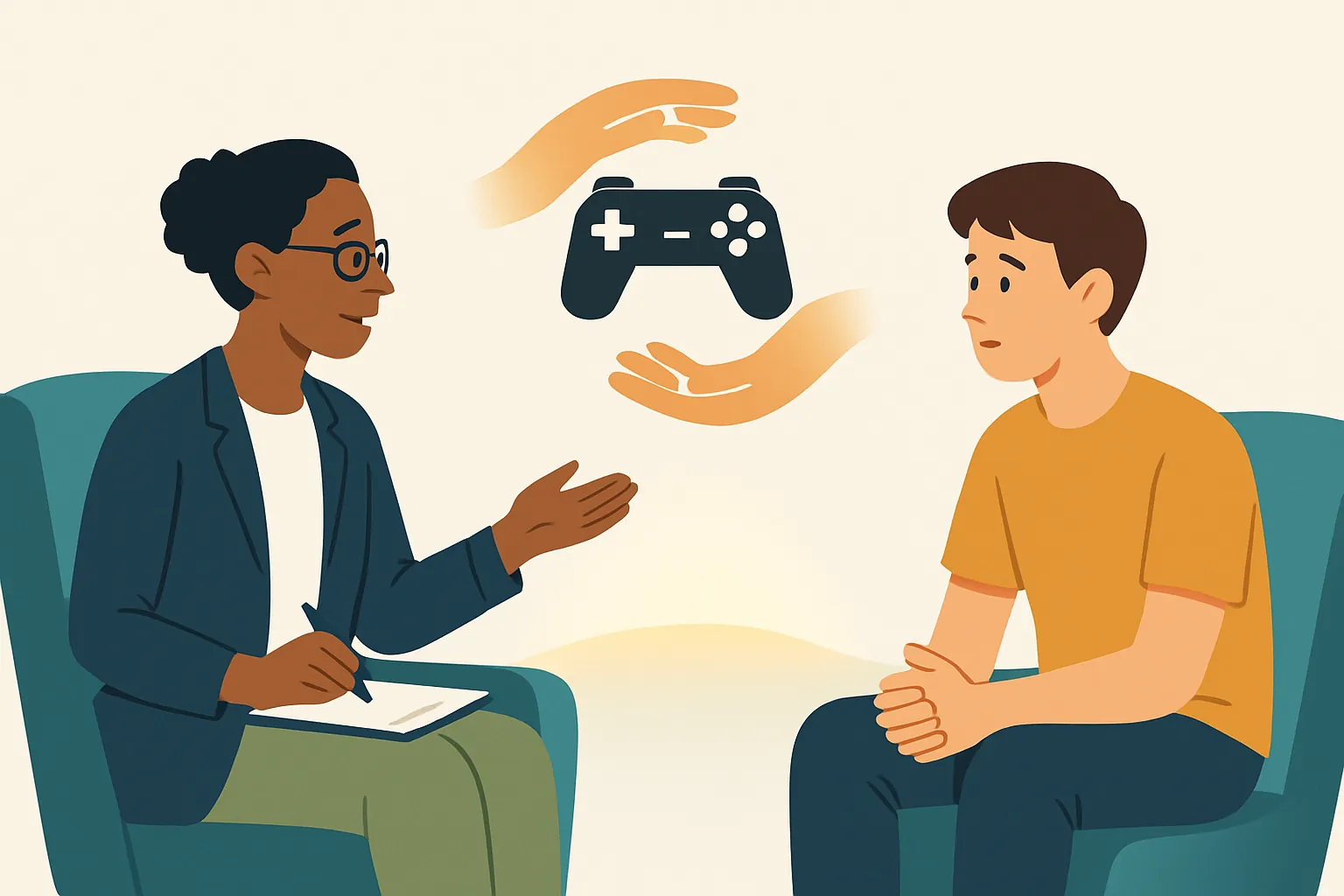
When an adolescent is referred for gaming disorder or smartphone overuse, proposing an outright ban is the fastest way to collapse rapport. The adolescent prefrontal cortex is still maturing, and abruptly cutting off a reliable dopamine pathway provokes psychological reactance and entrenched resistance. Self-determination theory reframes the screen as a substitute world that satisfies autonomy, competence, and relatedness the client cannot find offline—so banning it without an alternative strips away their only coping mechanism. The more effective stance shifts the clinical question from 'how do I get this teen to quit?' to 'why did this teen have to escape into the game in the first place?'—using motivational interviewing to surface ambivalence, target healthy regulation instead of abstinence, and let the client name the reasons for change.
"Are You Going to Say the Same Thing My Mom Says?"
You probably recognize the face. An adolescent referred for smartphone overuse or gaming disorder walks into the room, drops into the chair, arms crossed, jaw set. The nonverbal message is unmistakable: If you're here to take my phone, we have nothing to talk about.
This is the bind so many clinicians face with adolescent screen and gaming concerns. The parent wants fast behavioral correction—"just make him stop playing." But the moment you propose an outright ban to the teen sitting in front of you, the working alliance collapses. Neurodevelopmentally, the adolescent prefrontal cortex is still under construction, and forcibly cutting off a dependable dopamine pathway tends to trigger acute withdrawal-like distress and a surge of psychological reactance.
So we have to change the question. Not "How do I get this kid to quit gaming?" but "Why did this kid have to escape into the game in the first place?" This article walks through the clinical stance and concrete strategies that lower an adolescent's defenses and open the door to real change.
Why "Just Ban It" Sabotages the Work
The paradox of psychological reactance
Jack Brehm's theory of psychological reactance holds that when people sense a freedom is being threatened, they push back—often by doing the threatened behavior even harder—to reassert control. When a counselor opens with a controlling move ("let's cut your gaming time down"), the adolescent doesn't experience it as treatment. They experience it as a freedom grab. The result shows up as resistance, and it's one of the leading drivers of premature termination in this population.
What the game is actually feeding: a self-determination lens
Ryan and Deci's self-determination theory (SDT) identifies three basic psychological needs: autonomy, competence, and relatedness. For an adolescent whose offline life is dominated by academic pressure, conflict at home, and strained peer relationships, those needs are chronically frustrated—and the game is the most accessible place to get all three met at once.
Inside the game, the player is the protagonist with real agency (autonomy), levels up for immediate, visible mastery (competence), and coordinates with a guild or squad to feel they belong (relatedness). Seen this way, banning the game with nothing to replace it is functionally identical to confiscating the client's only working coping strategy.
Strategies for Working With Resistance and Building Motivation
Effective work with screen and gaming overuse depends on a motivational interviewing (MI) stance rather than directive instruction. The counselor's job is to roll with resistance—to move with the client's defensiveness rather than against it.
Table 1. Directive counseling vs. motivational interviewing
| Dimension | Directive counseling (not recommended) | Motivational interviewing (recommended) |
|---|---|---|
| Goal | Immediate cessation and time limits | Explore ambivalence; evoke intrinsic motivation |
| Counselor stance | Expert advice, warnings, persuasion | Curiosity, acceptance, partnership, affirmation |
| Client response | Defending, excusing, avoiding ("Fine, I'll cut back.") | Self-disclosure, change talk ("Honestly, I am kind of tired.") |
| Core questions | "Why didn't you keep your promise?" / "Do you know how bad this is for your brain?" | "What does the game give you that you enjoy?" / "If even one percent of you wanted to cut back, what would that one percent be about?" |
Strategy 1: Honor the function of the game—and get specific
Ask about the game itself, with genuine interest: "What are you playing?" "What's your role on the team?" An adolescent opens up only once they sense the counselor is trying to understand them rather than indict them. Through that curiosity, you map the psychological payoff the game provides—stress relief, escape, social connection—which becomes the clinical material you actually work with.
Strategy 2: Surface the ambivalence
The wish to keep playing and the wish to stop coexist inside the same client. Your job is to catch the change talk when it slips out. When a teen says, "Yeah, it's fun, but staying up all night and then sitting through school feeling foggy kind of sucks," don't let it pass—reflect it back:
"So the game gives you something real, and at the same time you're not loving how wrecked you feel the next day."
Strategy 3: Reframe the goal from abstinence to healthy regulation (harm reduction)
The target isn't zero. It's restoring day-to-day functioning—a kind of "digital diet." Rather than imposing a flat time cap, help the client set concrete, achievable, self-determined goals: protecting sleep, putting the phone down during meals. The fact that they choose the goal is what makes it stick.
Documentation and Analysis: The Details Drive Outcomes
With adolescents—especially around addictive behaviors—catching subtle shifts in language is everything. The clinical skill lies in spotting the fleeting cue of change buried inside a stream of resistance. Yet stopping to write notes mid-session can read, to a guarded teen, as "you're grading what I say," and that alone can dent the alliance.
Smart note-keeping for clinical insight
Reviewing a session transcript afterward, clinicians often surface a core defense mechanism or a recurring cognitive distortion they missed in the room.
- Pattern analysis: Notice when and in what context projection appears ("I'd stop if my mom would just get off my back")—and what reliably precedes it.
- Tracking change talk: Across sessions, watch whether sustain talk decreases and change talk increases—ideally with a record you can actually compare over time.
A security-first AI partner like Modalia AI can take the documentation load off your hands here—transcribing sessions and surfacing these patterns so you stay fully present with the client rather than buried in your notepad—while keeping sensitive clinical data protected.
Conclusion: Change Begins When You Let Go of Control
The goal of treatment isn't to drive game time to zero. It's to help the client feel alive in the real world—alive enough that the game stops being the only place they can breathe. An unconditional ban buys you nothing but a severed relationship. Understand the need, respect the autonomy, and become the companion who helps the adolescent arrive at the need for regulation on their own terms.
That means looking the client in the eye and giving them your full attention. Put down the pen, meet their gaze, and let the connection do its work—because that's where healing starts.
References
- 1.
- 2.
- 3.
- 4.
Frequently asked questions
Why doesn't banning games work with adolescent clients?
An outright ban triggers psychological reactance—when a teen senses a freedom is threatened, they push back harder to reclaim control. Because the adolescent prefrontal cortex is still maturing, abruptly cutting off a reliable dopamine pathway also provokes withdrawal-like distress, fueling resistance and premature termination rather than change.
What psychological need does gaming meet for teenagers?
Self-determination theory points to three basic needs: autonomy, competence, and relatedness. Inside a game, a teen has agency as the protagonist, gains immediate mastery through leveling up, and belongs to a guild or squad. When school, family, and peers frustrate these needs offline, the game becomes the most accessible place to satisfy all three.
How does motivational interviewing help with gaming overuse?
MI replaces directive instruction with curiosity, acceptance, and partnership. Instead of warning or persuading, the counselor honors the game's function, surfaces the client's ambivalence, reflects change talk, and lets the client name their own reasons to cut back—building intrinsic motivation that outlasts any imposed limit.
Should the treatment goal be complete abstinence from gaming?
Usually not. A harm-reduction goal—restoring sleep, focus, and daily functioning through a 'digital diet'—is more realistic and more durable than zero screen time. Letting the client choose concrete, achievable targets makes the change self-determined, which is what makes it hold.
This article was written and reviewed using Modalia AI's clinical guidelines, with professional human review before publication.
Related articles
 Case Conceptualization
Breaking the "Yes, But" Game: A Transactional Analysis Guide for Therapists
Every suggestion you offer gets met with "Yes, but..." Here's the TA structure behind that stall—and four clinical moves to break it.
7 min read Case Conceptualization
Yalom's The Gift of Therapy: Passages Every New Counselor Should Copy by Hand
Irvin Yalom's prescription for therapists who fear silence: meet your client as a "fellow traveler" and let the here-and-now become the heart of the work.
6 min read Case Conceptualization
Working With Silence in Therapy: What Client Silence Means and How to Hold It
Silence in session isn't empty space. Learn to read its clinical meaning, tell productive from defensive silence, and use it as a therapeutic tool.
6 min read